

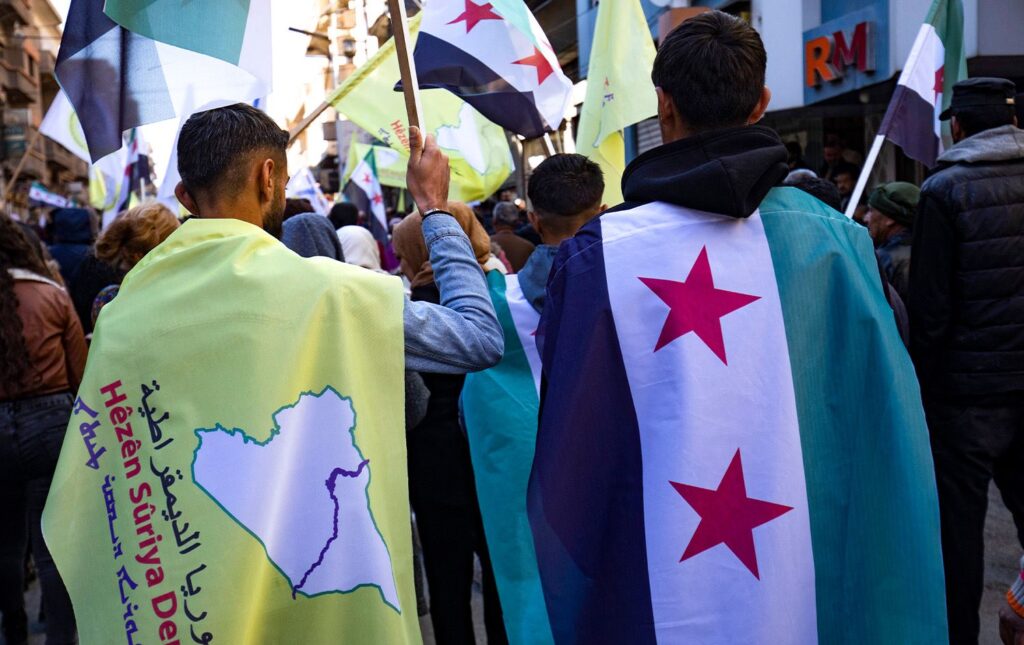

The past several weeks have been eventful in Syria. In a dramatic turn of events, Kurdish self-rule in the country appears to be nearing its end. This raises pressing questions about the nature of the Kurds and their political aspirations. First, it’s important to identify who currently rules Syria. The ruling elites in Damascus since December, 2024, consist of men who fought against nearly all other factions within the country. Their ideological roots lie in the worldview of Jabhat al-Nusra. Al-Nusra explicitly stated its intention to establish Islamic emirates in Syria, marking a significant shift within the broader global jihadist agenda. Whereas al-Qaeda’s declared objective focused on attacking and weakening the West rather than territorial governance, groups such as ISIS pursued the creation of an “Islamic State” as a foundation of global expansion. And so, in contrast, al-Qaeda traditionally emphasized the destruction of the West over state-building projects.
The current ruling group is deeply shaped by distrust and accumulated negative experiences with other actors. This has the consequences of its members only trusting and recognizing one another. This governance is likely to be based primarily on loyalty rather than on inclusive or institutional principles. This loyalty is rooted in the conflicts fought by the former terrorist organization and in its shared experiences in Idlib. By mobilizing these memories and emotions, the group seeks to assert dominance over all other forces in the country. To achieve this objective, their primary action has historically consisted of violence and warfare. As its access to military capabilities expands, this approach is likely to include aerial bombardment and other forms of coercion which will depend on the arsenal at its disposal. While this strategy may result in military victory, it is likely to produce a more deeply fragmented society which will not only consist of alienating minorities, but also distancing a much broader spectrum of Syrian society.
The current ruling group is operating within a particular sociopolitical habitus. This habitus is a deep-seated dichotomies structuring ways of thinking of the social world. They are the product of half a century of Assad’s rule and civil war, entrenched with feelings of revenge and radical non-civil ways of relating to others.
The Imagined Sunni State
The political goal of the current rulers of Syria is the establishment of a Sunni state. This is by definition the establishment of a theocratic and sectarian state, unable to grant equal rights to different identities within its territory. Above this, the Sunniness as the identity of the state can be understood as a direct reaction to the half a century of non-Sunni rule. Based on this background, Sunni elites and the community at large have reactionary tendencies and a lack of political confidence, features that make them allude to violence and fear any minor recognition and concession. However, the concept of Sunni Arab in Syria is not an established unit. Sunnis were not uniformly excluded from the Assad regime. Take for instance the Baggara tribe in Aleppo. The notorious Liwa al-Baqir, or Baqr Brigade, despite being Sunni, had long historical loyalty to the Assad family.
“If Hezbollah was long considered the crown jewel of Iran’s Axis of Resistance in the Middle East, then the Baqir Brigade held that distinction in Syria.”
Al Baggara is acting like a tribe, rather than a sect. The tribal ethos is survival and alliance with the winner. That is what the Baggara tribe did, from hosting Qasim Sulaimani to the HTS group. These tribes allied and opposed everyone in the country, as President Masoud Barzani put it. The domination of the tribe has led the Sharaa administration to open a special office to deal with them, headed by Jihad Issa al-Sheikh. In this regard, the administration relies on the old tricks, namely “material concessions to secure clan cooperation.” According to Wassim Nasr, this “may provide short-term stability but risks creating new inequalities and resentments.” This has especially become unstable as the tribal groups are no longer just local actors, but they have experienced external connections and resources.
Accordingly, Sunni unity in Syria appears less as an empirical reality than a wishful imagined community. Perhaps for this reason, Sunni political narratives reach back a millennium to establish their mythical foundation, basing it on figures like Abd al-Rahman al-Dakhil7, who established an independent Umayyad emirate in al-Andalus (the Muslim-held parts of Iberia) in 756 CE. This historical reference is problematic, not least because Umayyad authority is nonexistent in the current Syria, dismantled by the Abbasids. Nevertheless, the attempt to make Syria based on this sectarian imagination carry grave repercussions for all segments of society. The non-Sunni communities are pushed toward their ethnic and religious identities more than ever. As a well-informed observer put it, if the people in Suwayda who were separated were only 10% in the past, now it is 80%. For Bashara, what happened was not a mistake. This is a problem of approach, according to him. It is also an absence of a Syrian unifying approach.
Against this background, what will happen to the Kurds?
The majority of Kurds are Sunnis, but the sect is not the main cleavage. They are more identified with their ethnic identity. This is a challenge for two main streams of the current Syrian elites: the Islamists and the Arabists. The current Presidential Decree No. 13, issued by President Ahmed al-Sharaa in January 2026, might be a good step, but the long systematic exclusion requires Kurds to have a base in the country and operate as a minority group with their explicit identity. This is not granted in the current decree. The agreement’s language raises as many questions as it resolves regarding the fate of the Kurdish fighters, men and women, and the nature of the administration and local political representation. The decree does not contain any mechanism in order to deal with the integration or national partnership.
These ambiguities and current collective Sunni social moods make some experts not very hopeful about the prospects for peace between Damascus and Kurds. This is primarily because of the increasing securitization of the Kurdish issue by reducing it to a “PKK problem.” A model similar to the Turkish one. Securitization refers to the process through which an issue is considered an existential threat requiring exceptional measures. To achieve this, the current elites in Damascus are willing to make concessions to external actors in order to suppress internal opposition. This was the core of the Paris deal between Syria and Israel, under the auspices of the US and Turkey. Kurds have become the latest victim of this policy. Accordingly, Syria will be shaped based on the outsiders’ permissions and interests. In this regard, for instance, what Turkey wants “is to centralize Syria and steer it toward the dissolution of the Kurdish armed group. The current “Israel’s perspective,” which manifests in “direct dialogue—or Western-mediated dialogue—with Syria toward advancing a security arrangement.”
Returning to the great thesis of Syrian expert Patrick Seale, in his renowned book, ‘The Struggle for Syria: A Study in Post-War Arab Politics, 1945-1958,’ Syria lies at the center of multiple regional and international cross-currents. Its internal affairs are largely unintelligible when examined in isolation from the broader regional environment, first of its Arab neighbors and then of other interested external powers. It is therefore no accident that Syria’s internal political structures have historically mirrored the rivalries of surrounding states. Accordingly, the Kurdish question in Syria is profoundly shaped by external actors, both directly and indirectly, most notably Turkey, Israel, and the United States. Consequently, while numerous external powers possess the capacity to obstruct a resolution of the Kurdish issue, meaningful progress toward its resolution is likewise contingent upon pressure exerted by these same external actors.
Now Kurds in Syria lost but also gained. Until recently the Kurds, who comprise 10% of the population, were seen as “the Forgotten People,” as Kerim Yildiz’s book title in 2005 shows. They were generally marginalized and depoliticized through the policy of deprivation of citizenship, wealth, rights, and representation; the process was known as maktumin. People with no official paper had deep implications in the domains of property, education, and finance. In the last decade Syrian Kurds and Rojava turned into the space of siege and heroic battlefield, as in Kobane, fighting ISIS, and became the land of young girls like Shravan in contrast to women enslaved by Islamic terrorism. Today it has become the center of pan-Kurdish nationalism. The current Damascus elites want to deprive Kurds of resources, borders, and any form of self-rule; unless Syria becomes another North Korea, it is impossible.