


What Happened: The Architecture of Unprecedented Targeting
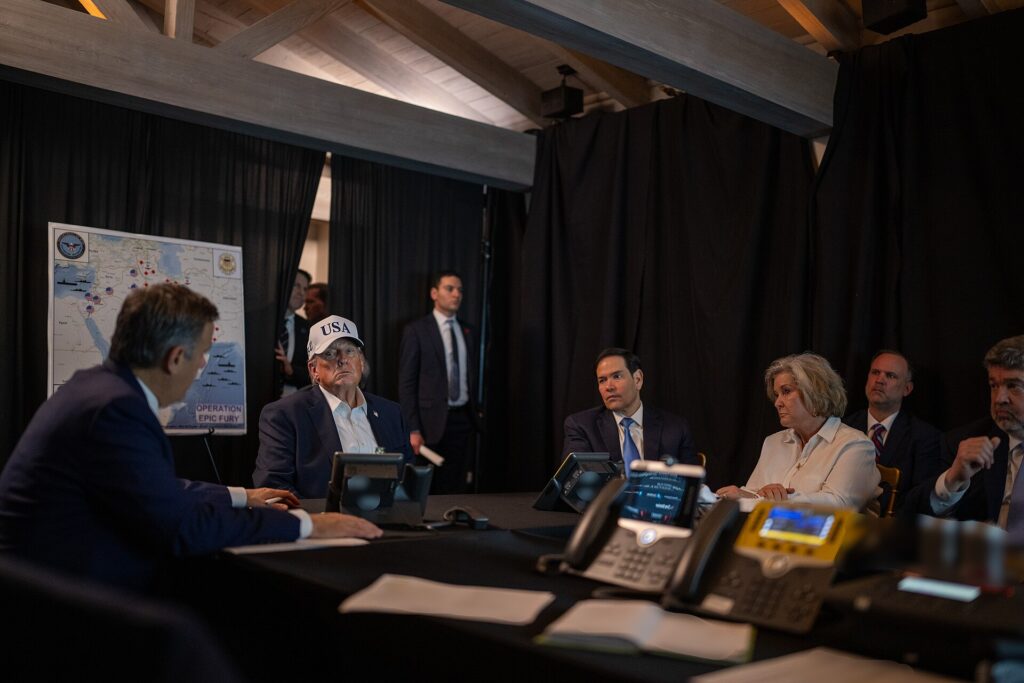
In the early hours of February 28, 2026, a coordinated American-Israeli air campaign designated Operation Epic Fury struck multiple targets across Iran simultaneously. The first wave of strikes largely carried out by American B-2 Spirit bombers and Israeli F-35I aircraft operating from forward positions in the region, was widely anticipated to follow the template established by the twelve-day conflict of June 2025: nuclear enrichment sites, ballistic missile storage facilities, air defense nodes, and Revolutionary Guard command centers. What unfolded, however, exceeded that template in ways that surprised even veteran observers of the conflict. Confirmed targets included the Ministry of Intelligence headquarters in northern Tehran, the Ministry of Defense complex on Shahid Chamran Highway, the IRGC headquarters in the Lavizan district, and critically the Palace of Justice on Shahid Beheshti Avenue, the symbolic and administrative center of Iran’s judiciary. Explosions were recorded in the Jomhouri district in central Tehran, a densely populated commercial and civic zone housing the Great Bazaar of Tehran, the Arg Mosque (one of the oldest mosques in the capital) and numerous government buildings. Simultaneously, strikes were reported against border guard installations in West Azerbaijan, Kurdistan, Sistan and Baluchestan, and Khuzestan, with particular intensity along the Iraq-Iran frontier.
Supreme Leader Ali Khamenei was killed in a strike on his Pastour residential compound, the first sitting Iranian supreme leader to die by external military force since the Islamic Republic’s founding in 1979. State television confirmed his death and announced forty days of national mourning. Alongside him, IRGC Commander Mohammad Pakpour, Chief of Staff Mohammad Bagheri, Defense Minister Aziz Nasirzadeh, and senior adviser Ali Shamkhani were all killed in near-simultaneous strikes. The decapitation of Iran’s entire military and political leadership in a single night was without precedent in the modern history of the Middle East.
The targeting of the Tehran Bazaar merits particular analytical attention. Unlike the IRGC headquarters, the bazaar is not a security installation. It is Iran’s most historically consequential commercial institution. a labyrinthine network of over thirty thousand shops and workshops extending across more than ten kilometers of covered passages in the heart of the capital. The collateral destruction in the 15 Khordad district and the strikes on the Arg Mosque, which has served the bazaari merchant community for over two centuries, immediately raised questions about deliberateness. A senior Israeli military source described the targeting rationale in terms of disrupting the economic sinews that sustain the government’s patronage networks — a formulation that reveals much about the strategic imagination driving these operations.
Israel’s Strategic Rationale: Decapitation, Disarmament, and the Decomposition of Sovereignty
To understand why Israel targeted police stations and border guard posts alongside nuclear installations, it is necessary to reconstruct the underlying theory of change animating Israeli strategic planners. The logic rests on four interlocking propositions, each addressing a different pillar of the Islamic Republic’s survival architecture.
The first proposition holds that the Islamic Republic’s durability depends not on popular legitimacy which by December 2025 had reached its historical nadir, with protests across all thirty-one provinces constituting the largest civic uprising since 1979, but on its monopoly of coercive instruments. Police stations, Basij mobilization centers, and border guard installations are the capillary system of this monopoly. A senior Israeli official articulated the goal with unusual candor: to create conditions for government collapse by eliminating anyone capable of disrupting the overthrow. In this framework, a neighborhood police station in Sanandaj or Zahedan is not a law enforcement facility. it is a node in the architecture of political control. Dismantle enough of these nodes simultaneously, the reasoning goes, and the government loses its ability to suppress organized dissent precisely when leadership decapitation has left it most vulnerable.
The second proposition is geographically more ambitious and arguably more consequential. It concerns the deliberate activation of Iran’s ethnonational periphery. The geographic distribution of border guard strikes was emphatically not random. Kurdistan, West Azerbaijan, Sistan and Baluchestan, and Khuzestan are precisely the provinces where Iran’s non-Persian minorities Kurds, Azeris, Baluch, and Arabs respectively are most concentrated, where the central state’s legitimacy deficit runs deepest, and where cross-border ties to co-ethnic populations in neighboring states remain organizationally active. The strikes on border installations in these regions must be read alongside a development that preceded them by exactly six days: on February 22, 2026, five major Iranian Kurdish political parties formally announced the creation of the Coalition of Kurdish Political Forces of Iran, with representatives stating that their armed contingents were already positioned inside Iranian territory along the Iraq-Iran frontier. The temporal precision of this sequencing, coalition announced, border guards eliminated within the week, is not coincidental. It reflects a coordinated strategy whose explicit objective is what analysts have termed Balkanization: the fragmentation of Iran’s territorial sovereignty into ethnically defined zones of contested control modeled loosely on the dissolution of Yugoslavia in the 1990s but transposed onto a civilizational state with incomparably deeper roots.
The Balkanization thesis deserves careful scrutiny, because its logic is seductive but its premises are contestable. The underlying assumption is that Iran’s non-Persian minorities are held within the state primarily by coercion, and that removing coercive capacity will release centrifugal ethnonational pressures that have been artificially suppressed. There is partial truth in this: the Baluch of Sistan and Baluchestan have endured decades of economic marginalization and state violence; the Kurds of Iran maintain cultural and political connections to the broader Kurdish national movement; the Arab population of Khuzestan has legitimate grievances about environmental devastation and the diversion of oil revenues. Yet the assumption that these grievances translate automatically into separatist mobilization once central state capacity is removed ignores both the organizational requirements of territorial secession and the complexity of minority identification with Iranian national identity. Khuzestan’s oil fields the most productive in Iran make it an object of intense external interest from Saudi Arabia and the UAE, but external interest does not translate into internal separatist will.
The third proposition concerns the economic foundations of clerical authority. The bazaari merchant class has occupied an ambiguous position in Iranian political history: financiers of the 1979 revolution, beneficiaries of the Islamic Republic’s import-substitution economy, and periodic sources of commercial pressure on the government during economic crises. Israel’s targeting logic identifies the bazaar not merely as economic infrastructure but as a patronage network. The mechanism through which the government converts oil revenues and import monopolies into merchant loyalty and political quiescence. The fourth and final proposition is psychological: by destroying the physical symbols of state coercive power while President Trump directly addressed Iranian citizens urging them to take their country back, the operations were designed to signal that the government can no longer protect those who remain loyal to it.
Table 1: Strategic Strengths and Weaknesses of Israel’s Targeting Doctrine — February 28, 2026
| Dimension | Strategic Strength | Strategic Weakness |
|---|---|---|
| Decapitation of Leadership | Simultaneous elimination of Supreme Leader Ali Khamenei, IRGC Commander Pakpour, Chief of Staff Bagheri, and Defense Minister Nasirzadeh removed the entire command structure in one night, historically unprecedented. | Decapitation without a designated successor creates a dangerous power vacuum. The IRGC retains organizational coherence and may seize power on terms less amenable to negotiation than the clerical establishment. |
| Dismantling Coercive Apparatus | Targeting police stations and Basij centers removes the capillary infrastructure of street-level repression, potentially enabling the popular uprising building since December 2025 to escalate without immediate suppression. | Security forces that lose institutional affiliation do not disappear; they fragment into dispersed armed groups capable of prolonged low-intensity violence far more difficult to manage than a coherent authoritarian state. |
| Border Guards and Ethnic Periphery | Coordinated with formation of the Kurdish Political Forces Coalition (Feb 22, 2026), removal of border guards in Kurdistan, West Azerbaijan, Sistan-Baluchestan, and Khuzestan creates territorial vacuums that organized ethnic militias can fill, fracturing central state control. | Iranian ethnonational identity is not simply Persian imposition. Azeris (30% of population) have served in senior IRGC and clerical roles. A Balkanization scenario risks producing ungoverned zones penetrated by Turkey, Iraq, and Pakistan powers with interests hostile to Israeli security. |
| Targeting the Tehran Bazaar | The bazaari merchant class constitutes a critical patronage network. Disrupting it degrades the government’s ability to convert oil revenues into commercial loyalty and signals that association with the Islamic Republic carries existential economic risk. | Historical evidence from the London Blitz to Baghdad consistently shows that attacks on civilian commercial infrastructure generate nationalist solidarity rather than government abandonment. The Arg Mosque’s destruction risks becoming an icon of foreign aggression, not liberation. |
| Nuclear Infrastructure | If Trump’s claim of complete destruction of enrichment facilities is accurate, weaponization timelines are set back by years eliminating the immediate strategic rationale for the operation. | IAEA assessment indicates only a months-long setback. Nuclear knowledge cannot be bombed. Post-regime actors may pursue weaponization with fewer constraints than the Islamic Republic exercised. |
| Psychological Messaging | Celebrations in Tehran streets and Trump’s direct address suggest meaningful resonance of the liberation narrative among a population suffering severe economic deterioration since December 2025 protests. | The killing of 108 schoolgirls in Minab fundamentally undermines the liberation narrative. No information operation can neutralize mass civilian casualties among Iran’s most sympathetic demographic. |
| Regional Isolation of Iran | Abraham Accords architecture remains intact. Gulf states share a structural interest in neutralizing Iranian regional hegemony creating tacit alignment with Israeli operational objectives. | Iranian strikes on US bases in Qatar, Kuwait, UAE, and Bahrain, states that actively lobbied against the attack have damaged the very relationships that regional stability depends upon. |
Source: Author’s analysis based on field reports, CENTCOM statements, IAEA assessment, and open-source intelligence, March 2026.
Geography, Civilization, and the Limits of Military Logic
Robert Kaplan’s intellectual project, developed across three decades from Balkan Ghosts to The Revenge of Geography, rests on a foundational claim: that the physical environment includes mountains, deserts, river systems, maritime chokepoints shapes political behavior in ways that ideological frameworks consistently underestimate. His 2012 work identifies Iran as perhaps the most geopolitically consequential country in Eurasia, positioned at the intersection of the Persian Gulf energy system, the Central Asian landmass, and the South Asian subcontinent. Reading the events of February 28 through this lens generates insights that conventional strategic analysis misses.
Kaplan makes a distinction that is crucial to evaluating the Balkanization strategy: the difference between states and civilizations. Iraq, Syria, and Libya are what he calls post-colonial constructs, states whose borders were drawn by European powers with scant regard for ethnic or geographic logic. When the coercive apparatus of such states is dismantled from outside, what remains is not a coherent people capable of building new institutions but a collection of competing factions struggling over ruins. Iran is categorically different. The Persian cultural sphere, traceable through the Achaemenid, Sassanid, and Safavid empires, represents one of the world’s oldest and most internally coherent civilizational identities. The Persian language has remained substantially continuous for over a millennium. The sense of Iranian distinctiveness from the Arab world, from the Turkic world, and from the West is not a regime-manufactured ideology but a lived cultural reality that predates Islam and would outlast the Islamic Republic. This is precisely why the Balkanization scenario that Israeli planners appear to have in mind is so historically improbable: Yugoslavia dissolved because it was a twentieth-century political construction without civilizational depth; Iran has been Iran, in a meaningful cultural sense, for twenty-five centuries.
This civilizational depth has direct implications for the border guard targeting strategy. The Azeri population of northwestern Iran approximately thirty percent of the total population and the country’s largest ethnic minority has historically produced some of the Islamic Republic’s most committed institutional servants, including military officers, clerics, and intelligence officials. The notion that Azeri Iranians will seize on a moment of central state weakness to align with the Republic of Azerbaijan or Turkey misreads a complex identity that is simultaneously Azeri in language and Iranian in political and cultural orientation. Similarly, while Iranian Kurdish political parties have maintained armed presences in Iraqi Kurdistan for decades, the Kurdish population inside Iran is not a monolithic separatist constituency; it is a socially and politically diverse community whose relationship to the Iranian state is characterized by negotiation and contestation as much as by rejection.
Kaplan’s analysis of the Strait of Hormuz is particularly germane. He argues that Iran’s geographic control over the strait represents a form of leverage that no military operation can permanently neutralize short of physical occupation of the Iranian coastline itself made prohibitively costly by the Zagros ranges that have frustrated conquerors for millennia. The closure of the strait on the first day of hostilities and the sinking of tankers attempting passage demonstrates this logic with brutal clarity. Israel can destroy enrichment centrifuges and kill supreme leaders, but it cannot widen the thirty-three-kilometer throat of the world’s most critical energy chokepoint. For Beijing, which imports approximately five million barrels of Iranian oil daily, the closure is a strategic catastrophe — and Chinese pressure for a negotiated settlement will intensify with every additional day the strait remains closed, creating a geopolitical dynamic that the operation’s architects appear to have underweighted.
The final Kaplanian insight concerns the Tehran Bazaar itself. In his reading of Middle Eastern political geography, Kaplan emphasizes urban commercial networks as repositories of civic identity and institutional memory the informal connective tissue that sustains social order when formal state structures fail. The bazaar in Persian urban life is not merely an economic institution; it is an organizational form, a space of informal governance, a technology for coordinating trust across complex transactional relationships that has survived Mongol destruction, Qajar decline, and revolutionary upheaval. When the 1979 revolution succeeded in overthrowing the Pahlavi monarchy, bazaari networks provided critical organizational infrastructure. Destroying that infrastructure does not eliminate the social capital it embodies; it disperses it in unpredictable ways. The rubble of the Arg Mosque and the collapsed storefronts of the Jomhouri district may yet serve as the iconic images around which a new Iranian national solidarity one that does not serve Israeli strategic objectives coalesces.
Conclusion: The Geopolitical Limits of Surgical War
The strikes of February 28, 2026 represent the most ambitious attempt in the modern era to engineer political transformation through aerial bombardment. Israel’s targeting of police stations, border guard posts, and the commercial center of Tehran reflects a coherent theory of how coercive monopolies sustain authoritarian regimes, how ethnonational peripheries might be activated by central state collapse, and how merchant networks underpin clerical political economy. Each element of this theory has genuine analytical merit. Where the strategy risks strategic failure is precisely in its encounter with what Kaplan calls the deep structure of Iranian civilization.
Iran is not a post-colonial construct held together by coercion alone. It is a civilizational state whose political culture has survived the Mongol invasions, the Arab conquest, Safavid confessionalism, Qajar decline, and the ideological turbulence of the twentieth century. Removing the coercive apparatus of the state does not dissolve Iranian civilizational identity; under certain conditions, it intensifies it. The destruction of the Tehran Bazaar and the deaths of 108 pupils in Minab introduce precisely the kind of civilizational grievance that historically transforms domestic frustration with an authoritarian government into national resistance against a foreign enemy. The Balkanization strategy, however carefully coordinated with Kurdish political actors and however precisely timed to the elimination of border guard capacity, confronts this civilizational coherence as an obstacle it cannot overcome by force.