


Since the adoption of the 2005 Iraqi Constitution, Iraq has formally operated as a federal state. The aim was to distribute authority over natural resources, fiscal powers, and regional autonomy. The Constitution establishes joint ownership of oil and gas (Articles 111-112) and recognizes the Kurdistan Region and its authorities (Articles 117, 121, 141). It also mandates federal institutions to ensure coordination and dispute resolution. However, several key institutional provisions, including the enactment of a federal oil and gas law and the establishment of the Federal Council, remain incomplete. This institutional underdevelopment has generated persistent ambiguity regarding revenue management and fiscal authority between Baghdad and Erbil. In this context, tensions intensified in 2014. Federal budget transfers to the Kurdistan Region were suspended amid disputes over independent oil exports. Later developments, including the 2017 independence referendum in the Kurdistan Region, the 2022 ruling of the Iraqi Federal Supreme Court declaring the KRG Oil and Gas Law unconstitutional, and the 2023 international arbitration decision restricting independent exports of the Kurdistan Region’s oil, further altered intergovernmental fiscal arrangements. Judicial decisions regarding direct salary disbursement to civil servants in the Kurdistan Region have also reshaped fiscal federalism practice.
This article addresses the following question: How has the federal budget become a central arena of conflict between the Federal Government of Iraq (FGI) and the Kurdistan Regional Government (KRG)? It argues that, without fully developed federal institutions and clear fiscal coordination, the federal budget increasingly serves as an instrument of leverage between governments rather than as a neutral mechanism for wealth redistribution. To provide a balanced assessment, this study engages both the KRG’s claims to fiscal autonomy and the FGI’s approach to implementing fiscal federalism. Federal authorities emphasize centralized oversight of oil exports and revenue collection as necessary to enforce their central authority over the country, ensure transparency, and secure better distribution of public resources across all provinces. These competing interpretations of constitutional authority have transformed budgetary negotiations into recurring sites of political contention.
Thus, this article examines recent federal budgets, judicial interventions, and temporary political agreements. It evaluates the economic and legal imbalances in the 2023-2025 federal budget law. It also discusses the institutional and socioeconomic impacts of ongoing fiscal disputes on Iraq’s federal stability and governance.
Evolution of the Federal Budget Conflict Between Baghdad and Erbil
Political, economic, and historical factors have shaped the federal budget conflict between Baghdad and Erbil. Key drivers include divergent political visions, competing interpretations of the Iraqi Constitution, and the centrality of oil revenues in Iraq’s rentier economy. External actors have also influenced the trajectory of this dispute. Analytically, the evolution of the conflict can be divided into two phases: 2006–2013 and 2014–2025.
Phase One (2006–2013): Relative Cooperation
From 2006 to 2013, Baghdad and Erbil maintained a relative political balance that can be conceptualized as a Nash equilibrium[1]: each side’s strategies stabilized around mutual expectations, thereby preventing unilateral disruption of the budget allocation process. Kurdish and Shiite parties coordinated to form the federal government and establish core institutions, upholding the principles of federalism and decentralization, supported by mediation and assistance from the United States and Iran. During this period, the Kurdistan Region received its constitutional share of the federal budget, approximately 17 percent of total expenditures. The KRG relied heavily on this allocation, which financed over 85 percent of its regional budget, stimulated economic growth to approximately 12 percent by 2012, promoted private investment, and increased per capita income from around US$410 in 2004 to US$7,000 in 2013. Meanwhile, regional political stability between the Kurdistan Democratic Party (KDP) and the Patriotic Union of Kurdistan (PUK) contributed to governance continuity and predictable coordination with the federal government[2].
Despite these gains, structural vulnerabilities emerged. The KRG allocated a large proportion of its budget to consumption and operational spending rather than productive investments, reinforcing a rentier economic model dependent on federal transfers[3]. Political consolidation by ruling parties fostered party-affiliated cronyism, limited transparency, and constrained the private-sector enterprises, leaving the economy susceptible to shocks in budget transfers.
Phase Two (2014–2025): Escalation and Fiscal Weaponization
From 2014 onwards, the conflict between Baghdad and Erbil escalated over differing political visions: Erbil sought greater autonomy, while Baghdad pursued centralizing measures. This fueled financial and institutional disputes. The suspension of the Kurdistan Region’s federal budget share in 2014[4], followed the KRG’s independent oil exports under the Kurdistan Region Oil and Gas Law No. 22 of 2007. Baghdad justified its suspension as a step taken on constitutional grounds, expressing concerns about oil exports from the KRG and potential moves towards independence.
During this period, Iraq experienced profound security and political changes: the rise of ISIS, the institutionalization of Shiite militias as the Popular Mobilization Forces (PMF), and growing Iranian influence within federal institutions. These developments marginalized Kurdish actors in the federal system and reinforced Baghdad’s centralizing authority[5]. The 2017 Kurdish independence referendum further strained relations, prompting Baghdad, with international backing, to impose political and economic restrictions on the Kurdistan Region. Subsequent judicial and arbitration decisions, such as the 2022 Federal Supreme Court ruling declaring the KRG Oil and Gas Law unconstitutional, and the 2023 international tribunal’s restriction on independent oil exports, have reshaped fiscal arrangements and reduced the KRG’s leverage.
Although federal budgets for 2015–2019 and 2023–2025 specified the share for the Kurdistan Region, in practice, budget transfers to Erbil were consistently delayed or partial. Figure 1 shows considerable fluctuations in the KRG’s share of the federal budget between 2014 and 2025. Following a sharp decline in 2014 (1.7 percent) amid the oil and budget dispute, the share increased to around 12 percent during 2015–2017 after temporary agreements were reached. It fell again in 2018, then gradually recovered and stabilized at approximately 8–9 percent from 2021 onward. Notably, although the 2023–2025 federal budget formally allocated 12.67 percent to the Kurdistan Region, the actual transfers averaged only approximately 8.2 percent per year, emphasizing the continued gap between legal provisions and fiscal implementation. This shortfall impaired the KRG’s ability to finance salaries, maintain public services, and manage debt, which now exceeds US$33 billion.
Figure 1: KRG’s Share of the Federal Budget (2014–2025)
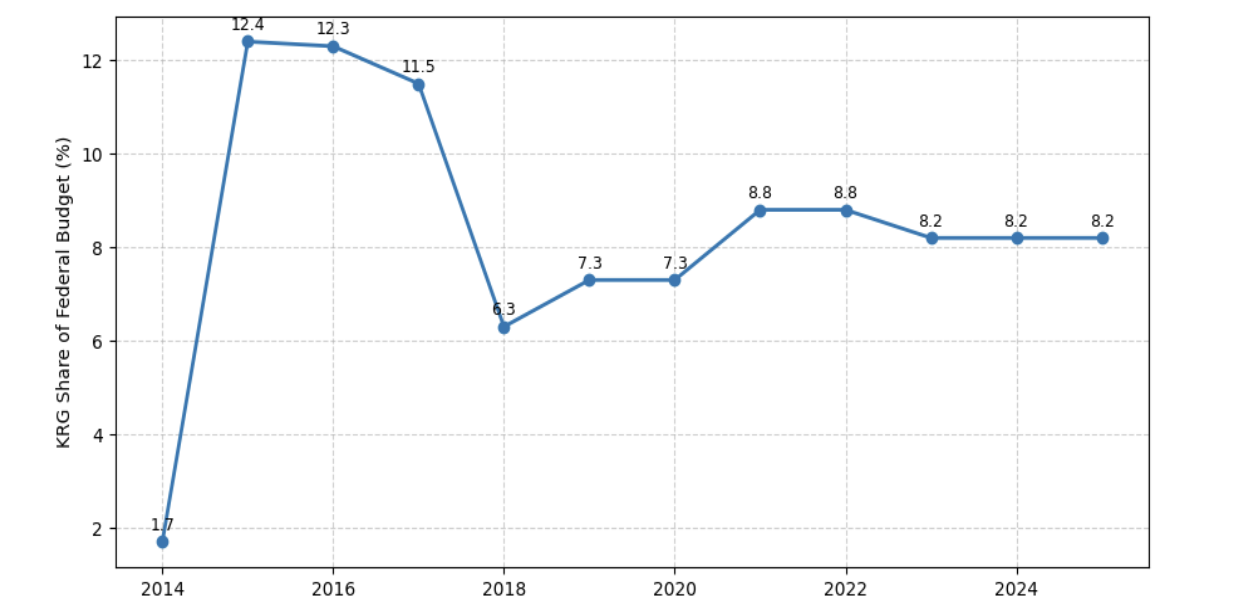
Source: Prepared by the researcher based on the Iraqi Ministry of Finance (2025), Draw Media and Rudaw Research Center, 2024–2025.
Internally, the Kurdistan Region’s political stability deteriorated. Increasing factionalism between the KDP and PUK weakened civil society and reduced public trust, hindering governance. The failure to form a new regional government following the 2024 and 2025 elections exemplifies the broader institutional paralysis.
The 2023–2025 Federal Budget: Macroeconomic Structure and Constraints
After about 5 months and 60 sessions by the Parliamentary Finance Committee, the Iraqi Parliament approved the three-year federal budget law for 2023–2025 on June 12, 2023. The law received support from 229 of 329 members of parliament. Many Iraqis viewed this as a positive step, as it enacted the largest budget in the country’s history, about US$151.9 billion, and, for the first time, set a three-year budget[6].
The passage of the budget law created expectations among citizens and political actors. Many hoped it would resolve longstanding political disputes in Iraq, especially between the FGI and the KRG. Broader optimism grew from a political agreement among Iraq’s main blocs: Shiite, Kurdish, and Sunni parties. However, these expectations were largely undermined by the budget’s practical implementation, especially in financial allocations for the Kurdistan Region. Most budget items were not implemented. The budget also failed to improve economic and social conditions. It was prepared using outdated and conventional methods, without modern public budgeting approaches or proper attention to Iraq’s economic needs. Critically, the federal budget law lacked a strategic framework for necessary structural reforms to enable sustainable economic development. Similar to previous budgets, it primarily addressed the interests of the ruling coalition, especially the Shiite Coordination Framework. The allocation strategy revealed a short-term political vision, prioritizing immediate concerns over long-term sustainability and neglecting key reforms such as economic diversification, bureaucratic reform, improvements in public financial management, tax reform, and reducing Iraq’s heavy reliance on oil revenues. In terms of expenditure, the budget emphasized operating expenditures, which increased by approximately 48 percent, at the expense of investment spending. This expansion was largely driven by the growing public sector, including higher wages and salaries, the creation of approximately 7,027 new permanent positions, the issuance of 200,000 employment contracts, and the recruitment of around 10,000 volunteers into the Iraqi army[7].
On the revenue side, total public revenues were projected at approximately US$102.7 billion, with oil revenues accounting for roughly 87 percent of total revenues and about 42 percent of GDP. The budget assumed an oil price of US$70 per barrel and an export volume of 3.5 million barrels per day, including 400,000 barrels from the Kurdistan Region. However, the break-even oil price required to fully cover expenditures was estimated at US$112 per barrel, resulting in a deficit of approximately US$ 49.2 billion, or about 32 percent of total expenditures and 14.3 percent of GDP[8]. This deficit exceeded the ceiling stipulated in the Financial Management Law No. 6 of 2019, which limits the allowable deficit to 3 percent.
Both revenues and the deficit remained highly sensitive to fluctuations in oil prices and technical disruptions in the oil sector. A reduction of just US$1 per barrel relative to the budget assumption would increase the deficit by approximately US$1.3 billion. To finance the expected deficit, the budget identified balances held by the Federal Ministry of Finance, issuance of national bonds, treasury transfers, borrowing from state-owned banks, and loans from international financial institutions[9]. The budget set the official exchange rate of the Iraqi dinar at 1,300 dinars per US dollar, diverging from the prevailing market rate, which ranged from 1,450 to 1,600 dinars per US dollar. This discrepancy constitutes direct intervention by legislative and executive authorities and underscores the limited operational independence of the Central Bank of Iraq.
Supporters expected the three-year budget to reduce unemployment, which was about 16.5 percent at the time of adoption. They projected 4.5 percent GDP growth for 2023, with inflation between 1 and 5 percent from 2023 to 2025. However, the World Bank warned that higher operating costs could push inflation to 6.6 percent and reduce GDP by 1.1 percent in 2023, mainly due to a 4.4 percent decline in oil-sector GDP. The actual results differed: by 2025, inflation dropped only 1.5 percent, GDP growth stayed below 0.5 percent, and unemployment remained high at around 13 percent. Domestic public debt grew about 6 percent from 2024 to US$67 billion, while external debt remained near US$13 billion. The budget also failed to resolve disagreements over Kurdistan Region oil exports or non-oil revenues, so new agreements were still needed.
Legal Ambiguity and Rule-of-Law Deficiencies
The conflict between Baghdad and Erbil has repeatedly emerged during the implementation of constitutional, legal, and political agreements. At the core are divergent interpretations of constitutional and statutory provisions, often compounded by technical, linguistic, and procedural ambiguities. Some of these gaps appear deliberate, reflecting mistrust and competing claims over political authority and resource control, while others stem from limited legislative experience and insufficient familiarity with legal drafting standards among some lawmakers. Such drafting practices deviate from the core principles of the rule of law and are more in line with the concept of the rule by law[10].
The 2023–2025 federal budget provides illustrative examples of these challenges, particularly regarding the Kurdistan Region’s fiscal obligations:
Oil Delivery Obligations (Article 1/First/B): The law requires the KRG to deliver 400,000 barrels per day (bpd) of crude oil to the FGI. The article does not specify administrative, technical, or logistical mechanisms for receiving and transporting this volume, nor does it clarify cost allocation, which is estimated at approximately US$ 20 – 25 per barrel in the Kurdistan Region versus US$ 4-5 per barrel in some areas in Iraq. During initial implementation, storage and transport limitations prevented the Iraqi Ministry of Oil from receiving the full quantity, leading the Iraqi Ministry of Finance to with hold the KRG’s budgetary share. This gap contributed to delayed civil servant salaries and prompted a separate oil-export agreement in late 2025.
Non-Oil Revenue Transfers (Article 12/Second/D): The KRG is legally obliged to transfer non-oil revenues to the federal treasury. However, there is no clear legal framework that distinguishes federal from regional non-oil revenues, and the KRG estimates that it contributes roughly 81 percent of the non-oil revenues collected at the federal level[11]. The absence of clear and codified legal procedures for classifying, collecting, and distributing revenues between the FGI and the KRG has led to institutional confusion, frequent disputes, and potential risks of mismanagement.
Calculation of the Kurdistan Region’s Budget Share (Article 11/First): The budget determines the KRG’s share based on “actual expenditures,” a formulation unprecedented in Iraq’s federal budget practice. By definition, actual expenditures can only be measured ex post, at the end of the fiscal year, whereas budget allocations are established ex ante[12]. This discrepancy creates uncertainty and makes it impossible to calculate the KRG’s precise budget share at the start of the fiscal year. Jamal Kochar, a member of the Iraqi Finance Committee, noted that such ambiguous phrasing, often present in budgetary laws, complicates implementation and reflects gaps in legislative drafting expertise.
Public Sector Employment Data (Table C): Federal budget law indicates approximately 4,074,697 public sector employees nationwide, including 658,189 in the Kurdistan Region. KRG sources, however, indicate around 1,250,000 employees in the region. These discrepancies, reflecting “ghost employees” and inconsistent personnel records, hinder reliable budgetary planning. They are compounded by the lack of a fully operational federal system, where the FGI directly manages personnel outside the Kurdistan Region, while the KRG mediates employee management within the Region. Beyond these specific articles, disputes persist over security and military structures, tax and customs regulations, public employment policies, and the results of the 2024 population census. These legal and institutional ambiguities exacerbate political tensions, complicate budget implementation, and constrain effective fiscal governance in Iraq.
Temporary Agreements and Structural Constraints
In September 2025, following multiple rounds of negotiations, the KRG and the FGI reached a three-month renewable agreement to export approximately 230,000 barrels of oil per day from the Kurdistan Region through the Iraqi State Oil Marketing Organization (SOMO). These exports had been suspended since March 2023. The agreement provided a provisional resolution to the federal budget impasse and was framed as a preliminary step toward the potential enactment of a comprehensive federal oil and gas law. Similarly, the parties agreed on the management of non-oil revenues for the Kurdistan Region. Under this arrangement, the KRG is required to transfer approximately US$ 91.6 million per month, equivalent to ID120 billion, to the Iraqi Ministry of Finance. In return, the FGI assumes responsibility for financing the salaries of public sector employees in the region. From a constitutional perspective, these agreements raise several concerns. Baghdad’s approach, particularly the direct linkage of KRG public sector employees to the Iraqi Ministry of Finance, strengthens centralized oversight but partially undermines the KRG autonomy guaranteed under Iraq’s federal system.
However, the Iraqi Ministry of Finance has tied the implementation of these agreements to the concept of “actual expenditure.” In practice, the KRG must first deliver the agreed oil quantities and transfer specified revenues to the FGI. The Iraqi Ministry of Finance then audits the transfers and reviews employee payroll data before authorizing salary disbursements. Because this procedure is conducted on a monthly basis and depends on prior verification, it has repeatedly resulted in delays in paying public sector employees in the Kurdistan Region. Both sides face political and institutional constraints in implementing the agreements. Baghdad demands greater transparency in oil and revenue management, as well as, safeguards against misuse or unauthorized sales. It views the agreements as a compromise that addresses the KRG’s financial needs while maintaining federal oversight. At the same time, Erbil considers the arrangements temporary technical measures that allow operations to continue without surrendering its claims to fiscal autonomy and rejects accusations of revenue mismanagement or noncompliance with federal laws.
Nevertheless, political rhetoric and sectarian narratives continue to influence public perception and constrain the practical enforcement of these agreements. During the first session of the newly elected federal parliament in late 2025, for instance, the head of the Iraqi Border Ports Authority accused the KRG of reducing federal revenues through alleged noncompliance with customs and tax regulations, a claim formally denied by Erbil. Overall, while these temporary arrangements mitigate immediate fiscal pressures and provide short-term operational continuity, they do not resolve the structural challenges of Iraq’s federal system, including unclear constitutional mandates, incomplete institutional frameworks, and the persistent use of the budget as a political tool. Their effectiveness remains contingent on both sides’ willingness to institutionalize mechanisms for dispute resolution, transparent revenue sharing, and adherence to the principles of politcal and fiscal federalism.
Socioeconomic Consequences of the Budget Conflict
The ongoing budgetary conflict between Baghdad and Erbil has imposed substantial economic, social, and political burdens on ordinary Iraqis, particularly in the Kurdistan Region. Delays in ratifying and implementing the federal budget have repeatedly disrupted financing for critical sectors, including infrastructure, health, education, and public employment. Since 2016, the KRG has adopted a compulsory savings policy, known as pashkawt, that deducts varying percentages from public sector salaries in response to recurrent federal budget shortfalls. Between 2015 and 2025, public employees in the Kurdistan Region received, on average, approximately 53 percent of their entitled salaries, with the remainder accumulated as arrears or compulsory savings. Salaries were notably unpaid in November and December 2025, reflecting the direct consequences of budgetary disputes.
These fiscal constraints have broader labor market and welfare implications. Surveys conducted by the Ministry of Planning in the KRG estimate the poverty rate at approximately 8.6 percent and project the unemployment rate to reach roughly 17.9 percent by 2025[13]. The disruption of salary payments has also adversely affected public service delivery, contributing to arrears totaling around US$18.7 billion by the end of 2025[14]. The persistent funding shortfall has triggered demonstrations and sit-ins, underscoring public dissatisfaction with the economic and social impacts of the Baghdad–Erbil conflict. These developments have collectively undermined regional development, weakened political stability, and negatively affected living standards, most acutely in the Kurdistan Region.
Conclusion and Recommendations
This study concludes that the federal budget is used as a political instrument. It influences relations and powers between Baghdad and Erbil and delays key constitutional and fiscal decisions. At the same time, the KRG’s dependence on de facto governance has slowed institutional development. It has also weakened democratic accountability in the Kurdistan Region. These dynamics have hurt the rule of law, fiscal governance, and economic stability in Iraq.
Solving these issues needs both constitutional and fiscal reforms. First, the FGI and the KRG should agree on clear power-sharing arrangements, especially regarding oil, gas, and revenue management. To begin with, the Federal Council should be established in accordance with Article 65 of the Constitution. Additionally, a federal oil and gas law should be enacted in accordance with Articles 111 and 112. Equally important, Article 140 also needs a set timetable for implementation. Furthermore, federal institutions, including the judiciary and the security sector, must be free from political influence. Finally, the KRG should adopt its own constitution, as allowed by Article 120, to build accountability and democracy. Second, fiscal governance should be rule-based and transparent. Revenue-sharing arrangements must rely on objective data. This includes population figures, verified expenditures, and public employment records. Program-and performance-based budgeting should link public spending to measurable outcomes. This must be supported by a transparent framework for the sharing of fiscal data between federal and regional authorities. Economic reform and diversification are also essential to reduce dependence on oil revenues and ensure fiscal sustainability. Steps such as establishing a sovereign wealth fund, reforming taxation, rationalizing public spending, and supporting private-sector development, especially for SMEs, can promote job creation and investment. Joint federal-regional initiatives in agriculture, industry, and tourism could further strengthen cooperation and economic resilience. Altogether, these reforms would enhance Iraq’s federal framework, promote inclusive development, and support sustainable economic and institutional stability in Iraq.
Notes
[1] In game theory, the Nash equilibrium, named after the American mathematician John Nash, is a solution concept for non-cooperative games with two or more players. In a Nash equilibrium, each player’s strategy is optimal given the strategies of the other players; thus, no player can improve their payoff by unilaterally changing their strategy. For further details, see: Osborne, Martin J., and Ariel Rubinstein, A course in game theory, Cambridge, MA: MIT Press, 1994.
[2] Arif, Beston. H., KDP-PUK Strategic Agreement and Its Consequences for the Governing System in the Kurdistan Region of Iraq. Journal of Asian and African Studies, 2022, 59(6), 1867-1891.
[3] Khalid, Nijdar, 2023, Ibid. See also: Khalid, Nijdar, 2021, Ibid.
[4] World Bank,2016, Ibid.
[5] Khalid, Nijdar, 2024, Ibid.
[6] Federal Budget Law, 2023, Ibid.
[7] Federal Budget Law, 2023, Ibid.
[8] World Bank, 2023, Ibid.
[9] Federal Budget Law, 2023, Ibid.
[10] Here, the rule of law refers to the principles articulated by Friedrich A. Hayek and Lon L. Fuller,namely generality, clarity, predictability, stability, equality before the law, and effective limits on governmental discretion. This contrasts with “rule by law,” where legislation exists formally but is applied instrumentally to advance particular political objectives rather than to serve as a neutral constraint on public power. For more information see: Hayek, Friedrich, A., The Constitution of Liberty. Chicago: University of Chicago Press, 1960. See: Fuller, Lon,The Morality of Law. New Haven: Yale University Press, 1964. See also: Koyama, Mark; Rubin, Jared, How the World Became Rich: The historical origins of economic growth. Polity Press, 2022.
[11] Draw Media, Non-oil Revenues in the Kurdistan Region Constituted (81%) of the Revenues of (15) Iraqi Governorates, 2023
[12] Musgrave, Richard A., Theory of Public Finance : The Study of Public Economy, McGraw-Hill Inc.,US, 1959.
[13] Kurdistan Region Statistics Office, 2025.
[14] Draw Media, 2025, Ibid.