


In recent weeks, as the new dynamics of Trump’s geopolitics have emerged, attention has largely focused on the major players in the international arena, rather than on third-party countries that are nonetheless equally affected by the global upheaval we are witnessing. Turkey, a NATO member, still a candidate for the European Union (EU), and historically linked to the Western world, has continuously deepened its relations with Russia since the end of the bipolar world, expanding its engagement with its regional environment and other continents such as Africa, even recently applying to join the BRICS. It thus represents an interesting and, in some respects, crucial case for assessing and understanding the ongoing geopolitical transformations.
Turkey Still Caught Between Ukraine and Russia
On February 24, 2025, at the UN General Assembly, Turkey voted in favor of the resolution reaffirming support for Ukraine and commitment to its territorial integrity—a text that the United States, to the shock of its allies, attempted to oppose alongside Russia, Belarus, and North Korea[1]. This seemingly ‘European’ vote echoed Ankara’s stance at the beginning of the war when it supported the General Assembly’s condemnation of the Russian invasion on March 2, 2022. However, its significance is markedly different this time, given the shift in the U.S. position following Donald Trump’s return to power. Moreover, it is worth noting that earlier, on February 18—the same day Russians and Americans met in Saudi Arabia, solidifying their now widely assumed new alignment—Volodymyr Zelensky was warmly received in Turkey. Following the Ukrainian president’s humiliation in the Oval Office on March 1, during a heated confrontation with Donald Trump and James David Vance, a particular photo went viral on social media. It captures Recep Tayyip Erdoğa graciously sheltering his Ukrainian counterpart under his umbrella during Zelensky’s latest visit to Ankara[2]. This image prompted many online commentators to praise Turkey’s traditional hospitality, contrasting it with the perceived harshness of American behavior.
Turkey’s commitment to Ukraine is far from exclusive or unconditional. Just days after Zelensky’s visit to Ankara, Turkish Foreign Minister Hakan Fidan hosted his Russian counterpart, Sergey Lavrov, reaffirming Turkey’s desire to bring an end to the conflict in Ukraine. It is clear that despite its strategic partnership with Ukraine, Turkey is determined to preserve the relationship it has carefully built with Russia over the past three decades[3]. This stance is even more relevant given that the ceasefire Donald Trump seeks to impose could be highly favorable to Moscow. Thus, Turkey continues its delicate balancing act between Ukraine and Russia—just as the United States begins to question its support for Kyiv. At this stage, it remains uncertain whether this tightrope diplomacy will succeed in satisfying both Moscow and Washington or end up displeasing them both.
Is Turkey in a Position of Strength in Syria?
Whatever the case, in Syria, the pressure on Turkey from Russia has eased following the fall of Bashar al-Assad’s regime. The new government led by Ahmed al-Charaa has yet to solidify its ties with Moscow. However, the first visit of a Russian delegation to Damascus failed to secure the future of the Tartous and Hmeimim bases, as the new Syrian leadership has demanded the extradition of Bashar al-Assad and a genuine mea culpa from Moscow for its past actions in Syria [4]. Adding to this, the withdrawal of Iran and Hezbollah further underscores that the Syrian shift represents a true strategic victory for Turkey. Nevertheless, Syria’s situation remains fragile and complex. Recent clashes in Alawite strongholds indicate that stability in the country is far from guaranteed[5]. If another civil war were to break out, the Turkish government would once again face an explosive situation on its borders. For now, however, it can boast of maintaining a strong relationship with Syria’s new leadership, whom it has supported from the outset. Turkey, having quickly reopened its embassy in Damascus, has actively lobbied European countries to lift sanctions imposed on the former Baathist regime and has made numerous offers of civil and military cooperation to Damascus. However, it must also contend with competition from Saudi Arabia, which has been highly active in Syria—evidenced by the fact that Ahmed al-Charaa made his first official visit to Riyadh before traveling to Ankara.
Moreover, other powers remain present in Syria, starting with the United States. While Trump’s desire to disengage and the potential success of the ongoing peace process with the Kurds in Turkey suggest that he may withdraw U.S. special forces from Rojava, there are also indications that the Kurds—both Syrian and Iraqi—are viewed by some of Trump’s advisors as a strategic foothold, or even a leverage point, in the Middle East. This perspective is particularly significant given that it is shared by Israel, which is increasingly concerned about Turkey’s growing influence in Syria.
The Rise of a Turkish-Israeli Rivalry in the Middle East
In this regard, it is important to note that the new geopolitical landscape in Syria is bringing Turkey (still militarily present in the areas it occupies in the north of the country) and Israel (which has taken advantage of Bashar al-Assad’s regime’s collapse to strengthen its grip on the Golan) geographically and dangerously closer. In the fall of 2024, during the traditional speech that opens the parliamentary session in Ankara, at the height of Israeli airstrikes on Lebanon, Recep Tayyip Erdoğan expressed his fears that his country could become ‘the next target’ of the Israeli state[6]. Since then, Israeli officials, particularly the Nagel Commission, have not hesitated to describe Turkey’s new position in Syria as ‘a threat,’ comparing it to the role Iran once played in the country[7]. While the risk of a Turkish-Israeli confrontation in Syria is not highly probable, it is now far from impossible. This is all the more so given the significant deterioration in relations between the two countries since October 7, 2023.
October 7, 2023, indeed marked the end of a difficult process of restoring Turkish-Israeli relations, which had been ongoing after more than a decade of diplomatic incidents, mainly triggered by the numerous IDF operations in Gaza and Turkey’s support for Hamas. Although diplomatic relations between Israel and Turkey were not formally severed, the Gaza war continued to strain their relations, pushing them into a position of growing hostility in the region. Turkey notably supported South Africa’s genocide complaint filed before the International Court of Justice[8].
Turkey Concerned About the Future of Its Relationship with the West
The arrival of Donald Trump in the White House also deepened the Turkish-American disagreement over the Israeli-Palestinian conflict. Recep Tayyip Erdoğan was one of the first leaders to openly and publicly express his disagreement with the U.S. approach to resolving the Gaza conflict, stating that the United States was ‘on the wrong track’ and strongly condemning the plan to resettle Gazans in Egypt and Jordan[9]. On March 4, 2025, Turkey thus supported the Gaza reconstruction plan adopted, at Egypt’s initiative, by an Arab League summit in Cairo—a plan that was immediately rejected by Washington[10].
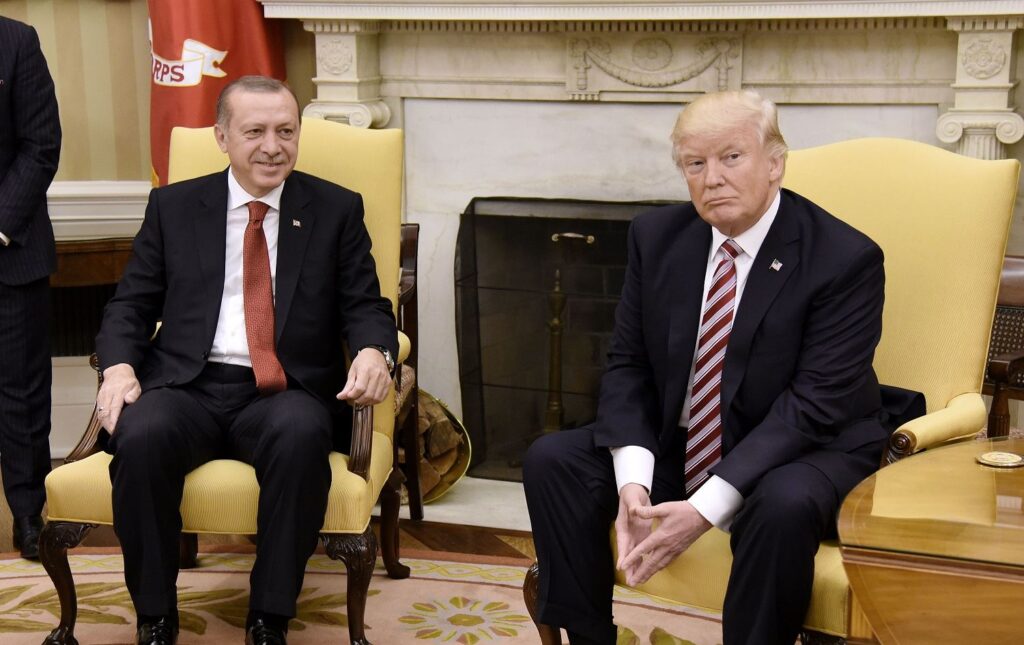
These recent international developments actually amplify the uncertainties regarding the state of Turkey’s relations with the United States after Donald Trump’s return. It had already been noted that the Turks were not invited to act as mediators in the Ukrainian conflict, as they had hoped, with the Saudis taking over that role, further solidifying their diplomatic ascent. Moreover, the United States has been largely silent on the changes that have occurred in Syria. However, these changes seemed to have the potential to bring Turkey closer to the Europeans. Ankara welcomed the gradual lifting of EU sanctions imposed on Syria and, on this occasion, engaged in contacts with several European leaders who emphasized Turkey’s strategic importance. Yet, at the very moment when Europe, under the pressure of events, has embarked on redefining its defense policy, Turkey has the unfortunate feeling of being left out of the changes that are unfolding. On March 4, 2025, in front of foreign ambassadors accredited in Ankara, Recep Tayyip Erdoğan stated in particular that imagining ‘European security without Turkey is unthinkable,’ adding that it was impossible for ‘Europe to survive as a global actor without Turkey taking its rightful place,’ and even declaring that Turkey’s accession to the EU was now ‘a strategic priority’ for the continent[11]. Shortly after, Hakan Fidan, Turkey’s foreign minister, told the Financial Times that Turkey wished to be part of the new European security architecture in the event of NATO’s dissolution[12]. As European leaders consider strengthening and empowering their security, they would be wise not to overlook Turkey in their plans[13].
However, during the visit of the Russian foreign minister to Ankara on February 24, Hakan Fidan reiterated his country’s desire to join the BRICS, lamenting that Brussels had frozen Turkey’s EU candidacy. It is true that the BRICS is not a defense organization, but once again, this balancing act highlights the dilemmas Ankara faces in these uncertain times.
A Place to Define on the International Chessboard
Turkey is currently facing, like many countries, a strategic shift where it holds advantages that do not erase a number of dangers. Despite the gains it has made in Syria [14], it is caught between the ongoing war in Ukraine, which awaits a resolution, and the Israeli-Palestinian conflict, which could worsen further, while the international upheavals caused by Trump’s return shake its alliance with the West. As NATO struggles and Europeans contemplate restructuring their defense systems, Turkey sees the United States favoring Saudi Arabia to host their rapprochement with Russia in the search for a solution to the Ukrainian conflict. Highly active in Syria, the Saudi monarchy is also at the heart of efforts to resolve the Israeli-Palestinian conflict, to which Ankara is not significantly involved, appearing primarily as the ally of Hamas.
Indeed, the Turks have managed to maintain their relationship with the Russians, but it remains ambiguous. Moscow, which has not completely rejected it, has so far delayed its entry into the BRICS and has not appreciated Turkey’s recent actions in Syria. The Russians also remember that Turkey’s strict implementation of the Montreux Convention in the straits has significantly hindered them in the Black Sea and, more generally, in conducting the Ukrainian conflict. For its part, with the Russo-American rapprochement, Turkey fears the restoration of Russian power in the Black Sea, at a time when its alliance with the West is still developing. Because if NATO disbands, what role are the Europeans willing to offer Turkey in the new defense architecture of the continent?
In conclusion…
In this ocean of complexity, it is clear that a potential resolution to the Kurdish issue appears as an attractive prospect for Ankara[15]. The initiative launched in October 2024 to revive the peace process that had been stalled for ten years culminated, on February 27, 2025, with an appeal from Abdullah Öcalan for the dissolution of the PKK and the end of an armed struggle that has been ongoing since 1984[16]. This appeal was supported by the Kurdish Regional Government (KRG) in Iraq but was less well received by the leaders of Rojava, some of whom, including Mazloum Abdi, leader of the Syrian Democratic Forces (SDF), expressed that they were not concerned[17]. However, it should be noted that on March 10, 2025, he signed an agreement with Ahmed al-Charaa, providing for the integration of the forces and institutions of Rojava into the Syrian institutions[18]. In any case, Recep Tayyip Erdoğan believes that he is on the verge of resolving the Kurdish issue in his country, and along its borders…
However, even as Turkey is currently experiencing a resurgence in repression against the opposition, including Kurdish elected officials, it is impossible to ignore that, so far, the roadmap and content of this peace process have not been revealed. Öcalan’s call is being presented by Turkish leaders as a farewell to arms without any counterbalance. While it is likely that they are trying to appease the more nationalist segments of their electorate, it is certain that they will need to take concrete actions and clarify their intentions. This is especially true given that the opposition and many observers believe that, behind this Kurdish initiative, Recep Tayyip Erdoğan has other ideas in mind, notably seeking solutions that would allow him to amend the Constitution in order to run for the presidency again.
Notes
[1] « Le Conseil de sécurité de l’ONU adopte une résolution américaine refusant de soutenir l’Ukraine », Le Monde, 25 février 2025
[2] ALKIS Ali, “This is how we treat a guest!”, Linkedin, March 2, 2025
[3] “Foreign minister Sergey Lavrov’s statement and answers to media questions at a joint news conference with Foreign minister of the Republic of Türkiye hakan Fidan, February, 2025, Turkish Ministry of Foreing Affairs Website, February 24, 2025
[4] GRYNSPAN Emmanuel & MAS Liselotte, “Syrie : le Kremlin et le nouveau pouvoir islamiste échouent à trouver un accord pour maintenir les bases militaires russes », Le Monde, 30 janvier 2025
[5] BRACHET Eliott, « Syrie : après des affrontements sanglants dans le bastion des Alouites, les nouvelles autorités de Damas face à une situation explosive », Le Monde, 8 mars 2025
[6] “Israel’s next target will be Türkiye, Erdoğan says”, Hürriyet Daily News, December 1, 2024
[7] “La commission Nagel met en garde contre une éventuelle guerre avec la Turquie, tout en appelant à la confrontation avec l’Iran », All Israel News, 4 mars 2025
[8] KÖRÖMI Csongor, “Turkey joins South Africa’s genocide case at ICJ against Israel”, Politico, August 7, 2024
[9] “Erdoğan slams Trump’s Gaza Plan as pure brutality”, TRT World, February 13, 2025
[10] “Turkey welcomes arab leaders plan rejected by US”, Middle East Eye, March 5, 2025
[11] “Europe’s security unimaginable without Türkiye: President Erdogan”, Yeni Şafak, March 4, 2025
[12] ENGLAND Andrew and RATHBONE John Paul, “The ex-spymaster shaping Turkey’s rise”, Financial Times, March 6, 2025
[13] BOURCIER Nicolas, “La Turquie partenaire autrefois ‘encombrant’, est devenue incontournable pour une Europe fragilisée », Le Monde, 5 mars 2025
[14] MARCOU Jean, « Syrie. La victoire relative de la Turquie », Orient XXI, 6 mars 2025
[15] MARCOU Jean « Towards the resumption of the Turkish Peace Process with Kurds”, EISMENA-CFRI, 2025, January 10
[16] TESSONNEAU Élise Galle, « Appel d’Öcalan à la dissolution du PKK en Turquie, ce que l’on sait », France 24, 28 février 2025
[17] VAN WILGENBURG Wladimir, « Syrian Kurds say Ocalan’s message’ has nothing to do with us”, Middle East Eye, 2025, February 28
[18] « Syrian government signs agreement with SDF to join national army”, Hürriyet Daily News, March 11, 2025