


[Lyna Ouandjeli] Good morning, and thank you for taking the time to answer our questions.
[Frédéric Encel] Good morning, thank you as well.
[Lyna Ouandjeli] As we’ve seen, the Middle Eastern space was caught off guard by the events of 7 October 2023. Several dynamics have been disrupted or brought back to the forefront, notably Iran’s withdrawal, which had been anticipated beforehand and is now being implemented. We’re also witnessing what some are calling the “decline” or even “end” of Hezbollah: it is attempting to regain influence, but this endeavour is becoming increasingly complex. Moreover, the fall of Bashar al-Assad’s regime and the rise to power of Ahmed al-Charaa raise many questions about the future of this new Syria. Added to this is the intensification of events in Gaza, particularly following the violation of the ceasefire on 17 March.
My questions will therefore focus mainly on the Israeli sphere, a topic long debated and one that often provokes polarised, both positive and negative, opinions. I have, however, noticed that your work adopts a moderate stance, driven by genuine motivation, which I find particularly interesting. How have the events of 7 October 2023 redefined Israel’s place in the regional dynamics of the Middle East, and how have they changed the perception of the Israeli-Palestinian conflict on the international stage?
[Frédéric Encel] That’s an immense question, thank you very much. I’m not a historian by training, but a political scientist and geographer. That said, my doctoral thesis, defended in 1997 in Jerusalem, as well as my accreditation to supervise research, have allowed me to approach the Near East through a long-term historical lens, in the spirit of Fernand Braudel. You’re quite right in saying that a great deal is happening in the region, particularly since the great pogrom of 7 October 2023. In my view, three fundamental elements remain, and although they’re not exclusive to the Middle East, they take on a particular dimension there.
The first is the instrumentalisation of religion for political ends. I’m not referring here to the sincere faith of believers or the devotion of the practising, but rather to the use of religion by politics – an old and deeply rooted phenomenon in the region. The second fundamental is the ontological challenge to borders. The borders of the Middle East, much like those in the Sahel, were drawn by external powers. The sanctity of these borders is therefore weak, if not absent. France and the United Kingdom were not the only ones to contribute to this late cartography: for five centuries, the Ottoman Empire also defined intra-imperial administrative boundaries – certainly imposed from within, but by Turks, not Arabs or Israelis. In the Arabian Peninsula, especially, these borders have often hindered longstanding social practices such as Bedouin transhumance. The third fundamental is geographical. I return here to my mentor Yves Lacoste, who said as early as 1975: “Geography is first and foremost used to wage war.” For me, it is above all a tool to understand war. The Middle East is a geographically fragmented region, marked by three strategic chokepoints that became crucial with the emergence of hydrocarbons in the early 20th century:
- the Suez Canal, now less used due to Houthi attacks, which affect the Egyptian economy more than the Israeli one;
- the Bab el-Mandeb Strait, whose stability determines the economic viability of the Suez Canal and which borders failed states like Yemen;
- and the Strait of Hormuz, a vital route for oil transport.
Added to this is the highly unequal distribution of natural resources (energy, water, minerals), which further complicates the region’s geopolitical landscape. Regarding the Israeli issue, there are two ways to approach it. In international law, Israel is a legal and therefore legitimate state: it was born from the partition plan of 29 November 1947, adopted by a two-thirds majority at the United Nations General Assembly. This plan was accepted by the Zionist movement, and the proclamation of the State of Israel on 15 May 1948 was recognised by all the major powers, including the USSR, the Western powers, and many others since. Does this intrinsic legitimacy permit Israeli governments to breach international law? Of course not – but that is another debate. I’d even go further: by what absurd logic do some activists or fanatics contest Israel’s right to exist based on the policies of its current governments, nearly 80 years after its creation? If a French government were to pursue a policy deemed illegal under international law, would that call into question the very existence of France? Certainly not. It is essential to recall this distinction.
On a political level, Israel represents a unique invention: a minority – in this case, the Jews – becomes the foundation of a state project. This is unprecedented in the region. That said, some nuance is required: in Iraq, for example, from the 1930s onwards, a Sunni minority rose to power. But Iraq was never conceived as a Sunni state. Israel, however, born of a Zionist political project, perceives itself as the state of the Jewish people, not merely of the Jewish religion. That is a fundamental element of Israeli identity. Today, from a geopolitical perspective, Israel exhibits a certain normalcy: it wages war, it makes peace, it defends itself, it sometimes violates international law, it sometimes commits war crimes – all while remaining an imperfect democracy. But I’d like someone to name me a perfect democracy. Perhaps Liechtenstein? And even then. In the region, at any rate, Israel remains an exception. This imperfect democracy is marked by chronic political instability: since the first Knesset election in January 1949, very few Israeli governments have completed their four-year terms. This adds a layer of geopolitical unpredictability that must be taken into account. Yasser Arafat, also known as Abu Ammar, when negotiating the Oslo Accords, wondered how long Rabin would remain in power to actually fulfil the commitments made. But this instability can also bring hope: after an ultranationalist government allied with ultra-Orthodox parties, there is nothing to prevent the emergence of a more centrist executive, more open to negotiation.
As for 7 October, it didn’t create anything new, but it did redefine a new balance of power. The attack carried out by Hamas was not merely military: it had a pogrom-like, murderous nature that profoundly traumatised the Israeli population and leadership. It rekindled the notion that the State of Israel, originally conceived by the left, is not only meant to protect Jews but also to ensure credible deterrence. The massive response that followed was not seen (from the Israeli point of view) as an act of revenge, but as a signal to any future enemy: committing massacres against Israel will come at a tremendous cost. This is not a moral judgement, but a geopolitical reading. And it must be said clearly: in choosing to target civilians so brutally, Hamas knew it was sealing its own fate. The word is strong, but I stand by it. It knew Israel would respond with unprecedented force and that no one would support it. Hamas, born of the Muslim Brotherhood, is widely rejected in the Arab world, particularly in the Near and Middle East.
The rest, I dare say, follows naturally.
[Lyna Ouandjeli] You mentioned power dynamics. It’s true that today, Israel demonstrates a far more assertive military strength than before, particularly in relation to Hezbollah. Its army and arsenal are now among the most formidable in the Middle East. In this context, how should we interpret the assassination of Hassan Nasrallah and the destruction of the headquarters? Is this a form of revenge after years of setbacks against Hezbollah? Or is it a strategic message aimed at showing that, after the 7 October attack, Israel now has the capacity to neutralise Hamas — and potentially other regional militias — just as decisively?
[Frédéric Encel] That’s a very geopolitical question. I believe Nasrallah’s elimination can be explained by two main reasons, and that it significantly weakens Hezbollah. The first reason relates to what is known in geopolitics as a “window of opportunity”. After 7 October, the Israeli army was at maximum mobilisation. Although Hezbollah’s attacks were not particularly dangerous in themselves, they amounted to repeated jabs. The opportunity was therefore there, and Israel was also enjoying unprecedented support from the American administration. Like it or not, the Biden administration has proven to be the most favourable to Israel, in both peace and war, even when facing an ultra-nationalist Israeli government. Israel obtained nearly everything it asked for, both politically and militarily. It’s therefore possible that Israel’s strategic aim is to resolve the Iranian nuclear threat once and for all. Why mention Iran? Hezbollah was founded in 1982 by Hafez al-Assad and Iranian intelligence services to serve Iran’s interests in the region, as part of what I would call a “pan-Shiite axis”. Within this framework, Israel has always served as a strategic punching bag. Hezbollah is geopolitically very powerful, and Nasrallah was a brilliant strategist. His loss is significant — not because he’s irreplaceable, but because he was a strategist of real calibre.
From the Israeli perspective, the time had come to neutralise Hezbollah’s instrumental capacity, which is intended to prevent any Israeli strike on Iran. The strategic set-up can be illustrated with a chess metaphor: two rooks supporting each other on the same file. If Israel strikes Iran, Hezbollah retaliates against Tel Aviv; if Israel strikes Hezbollah, Iran responds. But this model had already shown its limitations. Recall the Israel-Hezbollah war of July–August 2006: Iran didn’t intervene. This time, Israel decided to strike hard. In September–October 2024, they committed all available resources — technical, human, military — to the battle against Hezbollah, unlike their previous approach to Hamas, which partly explains the debacle of 7 October. This time, they’re seeing it through to the end, believing that Hamas no longer has any real military or terrorist projection capacity. Hezbollah, for its part, has been practically decimated.
Two major consequences arise from this. The first is the demonstration by the Israeli Air Force that the airspace is largely open: Israel can operate there freely, without suffering significant damage, despite some retaliations with no strategic impact. Iranian missiles have twice proven ineffective — in April and in September. The second, more structural consequence concerns the forthcoming collapse of the Bashar al-Assad regime. Hafez al-Assad came to power in 1970, shifting the region towards the pro-Soviet camp, notably through the violent Yom Kippur War of 1973, particularly around the Golan region. This enabled the rise of the Syrian Alawites, and later facilitated the creation of the Shiite Hezbollah in 1982–83 in Lebanon. But the end of Assad’s regime, and the rise to power of Islamists who were once violent, anti-Shiite jihadists, will deprive Hezbollah of a key strategic ally — and vice versa. Hezbollah finds itself in a situation of both political and economic isolation. It no longer has strategic depth: neither terrestrial (due to Syrian and Israeli control), nor aerial (controlled by Israel), nor maritime.
This situation reflects a deep vulnerability. Iran is thereby losing its most powerful proxy. It still has Iraqi militias and the Houthis in Yemen, but their influence remains limited — even if Ansar Allah has managed to impact the Egyptian economy. In reality, 7 October likely triggered the opposite effect of what Hamas had hoped. In attempting to weaken Israel, it helped to redefine regional power dynamics in a lasting way — in favour not only of Israel, but also of Turkey. One might even speak of a “Pax Turcana” extending across Syria and perhaps beyond. Finally, Donald Trump recently announced that he would give Iran two months to cease its nuclear enrichment and regional expansion. The potential convergence of leadership between Trump and Netanyahu could well bring about the definitive end of the Islamic Republic of Iran’s capacity to acquire nuclear weapons — whether through negotiation, as in the 14 July 2015 agreement, or through war.
[Lyna Ouandjeli] You’ve already answered several of my questions with great precision, thank you. I’d now like to set aside the issue of Iran and Hezbollah to focus on Israel’s relationships and alliances. Under Joe Biden, Israel didn’t enjoy the same explicit support that Donald Trump seems to offer today. On 4 or 5 February, Trump publicly raised the idea of deporting Palestinians to Egypt and Jordan, which prompted both countries to try and mobilise the Arab world. An emergency summit of the Arab League was held at the end of February, but it led nowhere, notably due to the absence of any discussion about disarming Hamas.
Do you think that Donald Trump’s return to power could enable Israel to pursue its policy of “total victory” in Gaza, and, to use the words of several researchers and specialists, its expansionist strategy in the Middle East?
[Frédéric Encel] I don’t believe that Donald Trump’s return to power will support the emergence of a Palestinian state — quite the opposite. He pushes even further than the positions of the most nationalist Israeli governments. If we take a step back historically, so-called “nationalist” Israeli governments — from Menachem Begin to Yitzhak Shamir, and Netanyahu since 1996 and again since 2009 — have never officially proposed the forced transfer of one to two million Palestinians out of Gaza. Admittedly, there are currently openly extremist, even quasi-fascist, ministers within the ruling coalition, but they do not hold the central executive power. And polls in Israel show that only a small minority of the population supports the idea of a forced exodus of Palestinians, whether from Gaza or the West Bank.
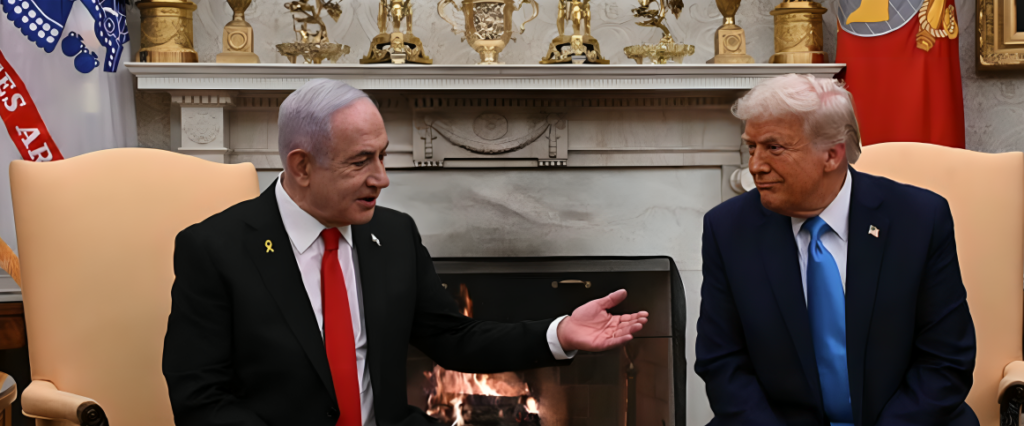
Trump goes further. He surpasses even the demands of the Israeli right. In reality, when you analyse Netanyahu’s long-term policy, you’ll see that his main aim has been to maintain the status quo. What preoccupies him are military threats — like those posed by Hamas — not a sustainable political solution. But if hundreds of thousands of Palestinians from Gaza are pushed into exile in Arab countries — where they will not remain permanently — and are later granted visas to the West, particularly the United States, what will happen in 10, 20, or 30 years? They and their children will become advocates for the Palestinian cause in powerful countries. They won’t disappear — quite the contrary. That’s why, when you see Netanyahu’s frozen expression during the Trump press conference in the Oval Office — the moment Trump mentions turning Gaza into a “Riviera” and calls on Palestinians to leave — it becomes clear that Netanyahu wasn’t on board. This wasn’t what had been discussed. As usual, Trump was making things up. Trump isn’t driven by ideology — not evangelical, far-right, or far-left. He is, above all, a mercantilist. His guiding principle is money: a dollar must bring in two. Before politics, he was a businessman. He had no significant investment in Israel. His business ties were elsewhere — notably in Saudi Arabia and the Gulf petro-monarchies. There was no Trump Tower in Tel Aviv.
What interests him today, after the US has poured tens of billions of dollars into Israel and Egypt since Camp David in 1979, is that this conflict finally starts to bring returns to the United States. The fate of the Palestinians does not concern him. Another point to make is that the current Israeli government is clearly opposed to the two-state solution. But that isn’t set in stone. In June 2009, under pressure from Barack Obama, Netanyahu publicly admitted that the ultimate goal had to be the creation of a Palestinian state — albeit under conditions: demilitarisation (already agreed upon in the Oslo Accords, then by Yasser Arafat and surrounding Arab countries), and without really addressing Jerusalem as a capital, etc. But he did express this view. Even the most nationalist figures have at times been capable of compromise. Begin, who in 1977 swore never to give up an inch of the Sinai, signed the Camp David Accords a year later and withdrew all settlers from Sinai. Ariel Sharon, Prime Minister in September 2005, ordered the forcible evacuation of 8,500 Israeli settlers from Gaza. Trump isn’t an ideologue — if he decides Israel is too expensive, purely in economic terms, he could shift course. Once again, he follows money, not ideology.
Moreover, it’s worth noting that this Israeli government might not last. It has about a year and a half left in its mandate, and opposition is strong: in the streets, among reservists, and in the polls. So we shouldn’t give in to total pessimism. Those who say everything is lost may be wasting their time — but I’m not, and neither are others here. In my view, and that of the UN, there is a real, albeit difficult, possibility of achieving the two-state solution and a redefinition of borders. I support borders — not as front lines, but as frameworks to be built. There are two national identities: a Jewish national identity, embodied by Zionism and the State of Israel, which is completely legitimate; and a Palestinian national identity, equally legitimate, and I’ve seen both on the ground. Two nations, two peoples, two states. History isn’t over: this solution may yet come to pass.
[Lyna Ouandjeli] I will combine my last two questions. The first concerns Syria. We have witnessed the fall of Bashar al-Assad’s regime and the rise to power of Ahmed al-Charaa. This poses a problem not only for Israel but also for other countries, particularly due to Ahmed al-Charaa’s Islamist past. He has been involved with Al-Qaeda, Daesh, Jabhat al-Nosra, and now Hayat Tahrir al-Sham (HTS). It is also noticeable that Turkey is trying to strengthen its control over Syria, and what happened in Idlib is an example of this, partly made possible by Ankara’s intervention. So, what will the Israeli dynamics in Syria be, knowing that Israel already exercises a certain degree of control over the Golan region? One might also mention the specific situation of the Druze in this area, who, like the Kurds of Rojava, are claiming an autonomous territory.
My second question is about Israeli civil society, which is increasingly at odds with Benjamin Netanyahu. Many believe that he will remain in power until the end of the war, particularly due to the arrest warrant against him, which he is trying to avoid. The population, which is becoming more and more critical, accuses him of neglecting the hostages, especially after what happened on 17 March 2025. Many think he will not be re-elected. What role and influence does Israeli civil society have in this conflict? Does Israeli public opinion still support the two-state solution?
[Frédéric Encel] Two quite distinct questions. Let’s start with Syria — a classic topic in geopolitics, both diplomatic and military. The new regime cannot survive without Turkish support: it is a Turkish-Qatari creation. It is not a movement that originated in Syria but rather an Unidentified Political Object, led by former Islamists who have renounced their jihadist identity. They are not seeking to export their ideology. The neighbouring countries see an advantage in this. Jordan, for instance, wants Damascus not to impose this regime on it. Iraq is in a similar position. Lebanon is a special case: exchanges of fire have taken place between the Lebanese army and this new Syrian regime. Hezbollah is currently isolated, and these new leaders don’t mess around with it — which could reduce its ability to cause harm.
Israel is a different matter. Militarily, it is an unmatched regional power, and that won’t change — especially with Trump or his vice-president in office. The Golan Heights, captured in 1967 and annexed in 1981 — as I analysed in my book Géopolitique du Golan (Flammarion, 1999) — are now irreversibly integrated. Even during the Oslo Accords era, I did not believe that Yitzhak Rabin or Shimon Peres could have convinced a majority of Israelis to give up that territory, which is both hydro-strategic and military-strategic. Today, with Assad’s fall, that question no longer arises. Israeli polls confirm that no significant percentage of the population wishes to return it, and the same goes for the Arabic-speaking side. Israeli Druze are now central to the Israeli army, and those in the Golan have also rallied to Tel Aviv.
Israel has recently extended its presence in the buffer zone (the no man’s land) between 2400 and 2800 metres in altitude, offering better visibility over the Daraa plain (and thus Damascus), as well as over the Beqaa Valley, where Hezbollah is based. Furthermore, Israel is strengthening its protection of the Druze in the Jebel (southern Syria). In my most recent thesis at Paris 8, devoted to the Druze, I highlighted their constant fear of being swept aside by power dynamics, being a small and lightly armed minority in each of the countries they live in. We’re seeing a certain rapprochement with Israel, as it is the only regional power with a real interest in protecting them. This isn’t an official protectorate, but part of the Israeli Druze population and some members of the general staff actively support them. The Israeli government is even considering a form of protection — symbolic, or perhaps one day military — similar to what happened during the Daesh caliphate, when Syrian Druze were under threat. At that time, Israeli Druze warned the government that they would fight themselves to protect their brethren, in Israeli uniform. It is therefore a very complex situation. We are moving towards a de facto protectorate, but without annexation, because the Syrian Druze remain very attached to their country.
The Europeans, for their part, view this new Syrian regime favourably, as it poses no terrorist threat or risk of border spillover for its neighbours (Jordan, Turkey, Israel). Now, regarding the Israeli population — we could speak at length about it, so fractured and mosaic-like is this society, with complete freedom of expression. Since 7 October, the majority of the population would now reject Netanyahu, except for his perceived ability to confront Hezbollah. He is still seen as responsible for the context that led to the catastrophe. The international arrest warrant doesn’t concern Israelis much, but the corruption cases do: he has been indicted in three major cases, and both the centre and the left strongly oppose him. He is also linked to the ultra-Orthodox parties, most of whose members refuse to serve in the army. However, the Tal Law (which exempted them) has been abolished, and protests are multiplying. These groups are even threatening to withdraw their support from Netanyahu if their youth are forced into military service.
In summary: the current Israeli population is largely opposed to Netanyahu, opposed to returning to the Gaza Strip (fewer than 5% support this), but remains very attached to sovereignty over Jerusalem and the Golan — the latter no longer even being debated. Notably, despite the failure of the Oslo Accords in 2000, neither Israelis nor Palestinians have officially renounced mutual recognition. Admittedly, today, after months of violence, most no longer support that perspective. But faced with the current deadlock and regional realignments, a significant minority still believes in it. That makes me cautiously optimistic: in the medium or long term, a solution remains possible.