

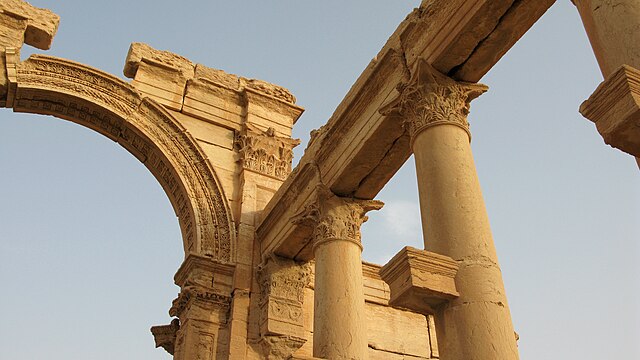

Located at the heart of the country and on the edge of the Syrian desert, Palmyra is the most strategic and valuable location on the Syrian map. It connects the desert to the main urban places. While the place is known for its archaeological sites, it has never lost its strategic importance throughout ancient and modern history. It was key for the Roman Empire[1], as well as for the modern colonial and post-colonial Syrian state. In 1930, the French[2] built a big stable for horses, which indicates it was used as a base to access and explore the wider area. The stable was later turned into a prison by the Syrian government. The desert, similarly to the mountains, has always challenged the level of state hegemony in the Middle East. As the writer Ibrahim Al-Koni puts it, the desert is equated with freedom and with the absence of the state: “We cannot talk or write about freedom as creatures conditioned by authority.”
There is no doubt that Palmyra has strategic depth for any regime that governs in Damascus. In addition to connecting the ungovernable desert to urban places, it is a trade route to the east and provides the possibility of dwelling; therefore, as Paul Veyne puts it, it is a place of ‘An Irreplaceable Treasure[3]’. These days, the place is even more geopolitically significant than it is just an archaeological site. As said on the news, the Turks are becoming the new foreign power in the area. This neither delights Israel nor the Gulf countries. However, before reflecting on the current development, we had better have a glance at Palmyra’s rich past.
Palmyra is Tadmur in Semitic languages, potentially referring to palm dates. For long, it has been a place of fascination and stories. As German poet Friedrich Hölderlin said, “Euphrates’ cities and/Palmyra’s streets and you. Forests of columns in the level desert. What are you now?” No doubt this Western fascination has played a big role in shaping the geopolitical significance the location has today, especially in capturing worldwide attention. And as recently showcased, attention is one of the most important aspects and drivers behind politics and economics. This was one of the motivators for ISIS’s destructive actions in the areas they controlled[4].
Palmyra also has a painful past. After the establishment of modern Syria, the city became infamous for its desert prison, massacres, and unbearable heat, which was also used as a form of torture, as vividly described by Mustafa Khalifa’s novel The Shell.
At the moment, to reach Palmyra, you have to take a long road, dotted with the remnants of the many previous wars. Traveling from Homs, the road was built as a straight line cutting through the desert, resembling many post-colonial borders in the region. Regardless, Palmyra’s significance has never diminished. Since the Syrian revolution, the area has fallen into the control of many different actors and attracted too much attention. Most notably, it captured the world’s attention when ISIS started to demolish the ancient Roman theater. Later on, when the Iranians came to Syria, the Islamic Revolutionary Guard Corps (IRGC) settled there. The east part of the town was used by the Fatemiyoun Brigade, the armed groups who were drawn from Shia Afghan refugees in Iran and led by General Hamdani, as expressed in his Letters from Fish Memoirs. Later on, it was handed over to the Russians, and regained attention when Russian president, Vladimir Putin, appeared on video on Palmyra’s stage, projecting himself as “the Savior of Syria.” Throughout these events, Israeli airstrikes repeatedly targeted the nearby airport as part of a strategy known as the Campaign between Wars.
In post-Assad Syria, while Palmyra carries many scars from war, evidenced by its distractions, eeriness, and Persian-written graffiti by the IRGC, it is now taking on new shades of significance. Notably, the Palmyra airbase is a theater of squabble between Turkey and Israel, the two regional powers, trying to reshape the Middle East with two very different plans for the country. Since Bashar Assad’s fall four months ago, Israel has launched almost eight hundred airstrikes and more than a hundred ground incursions into the country, hoping to destroy all of Assad’s weapons. At the beginning of the Syrian revolution, Israel’s view of any post-Assad regime was that “any new regime in Syria will take a stance that is hostile to Israel because it will need domestic legitimacy”. This has proved to be the opposite so far.
Israel sees Syria as a weak country with a high potential to collapse. In that case, the weapons will end up in the hands of many Jihadi groups that regard Israel as an enemy and therefore might try to destroy them. In addition to that, Israel is also trying to prevent the current Syrian state from building a strong military force. Probably more importantly, Israel wants to maintain its free access to the Syrian airspace, as it enjoyed during the Russian reign. Politically, Israel pushes for a decentralized Syria so the decision-making and capacity for war and peace can be divided among Syrian decentralized groups, and ensure that the new Syria doesn’t become a threat. In addition to these, Israel is trying to fine-tune Turkey’s role in Syria to a tolerable level. In contrast to Israel, Turkey believes Syria should be centralized in the hands of its ally, i.e., Ahmed al-Sharaa, to allow Turkey to indirectly meddle in Kurdish, Alawite, and Druze affairs. In fact, a Turkish base in Palmyra will enable the Turks to surround the Kurdish areas and empower them to besiege them if needed. Additionally, Turkey aims to control and guard the Syrian airspace, something that concerns Israel more than anything else.
As Turkey and Israel try to reshape Syria, Iran and the Gulf countries are watching the situation closely, albeit with different agendas. Therefore, the new Syrian political elites are not only caught between Turkey and Israel but also between Turkey and a number of the Gulf countries. The Gulf countries do not want Syria to confront Israel even rhetorically, as they try to lobby for Sharaa in Washington. In this regard, it is said that U.S. President Trump will meet with Syrian President Ahmed al-Sharaa during his upcoming visit to Saudi Arabia in mid-May.
Israel knows that Turkey’s project for Syria will come to an end with the end of Erdogan’s reign. It is also known that the two countries will not go to war. For Turkey, the war with Israel will be challenging as “NATO would seek to avoid being drawn into any Turkey-Israel conflict”, according to NATO expert Andrew Cottey. Therefore, Israel is targeting Erdogan’s government rather than the Turkish state. Turkey might have a policy of “enabler, state builder, and protector” in Syria, according to Saban Kardas[5], research professor at the Gulf Studies Center of Qatar University, but protecting the new Syria will prove challenging, as Damascus tries to compromise with others, and Turkey alone cannot rebuild Syria. Meanwhile, Palmyra is just adding another layer of conflict and competition to its rich history, which might delay its return to the heydays, when singers like Fairuz sang in the Roman theater.
Palmyra is micro-Syria, if not the Middle East. It is the crossroads of empress and failed dreams. But alas, above all, it is the space of pain.
Notes
[1] S. Thomas Parker, 1995. Palmyra and its Empire. Zenobia’s Revolt Against Rome by Richard Stoneman (review), Echos du monde classique: Classical news and views. University of Toronto Press. Volume XXXIX, n.s. 14, Number 2.
[2] Neep D (2012) Occupying Syria Under the French Mandate: Insurgency, Space, and State Formation. Cambridge: Cambridge University Press.
[3] Paul Veyne. 2017. Palmyra: An Irreplaceable Treasure. University of Chicago Press.
[4] Paul Veyne. 2017. The Oasis of Palmyra. Unearthing the history of the ancient city-state. University of Chicago Press.
[5] Şaban Kardaş. 2025. Turkey’s Long Game in Syria: Moving beyond Ascendance. Middle East Policy. Volume 32, Issue 1.