

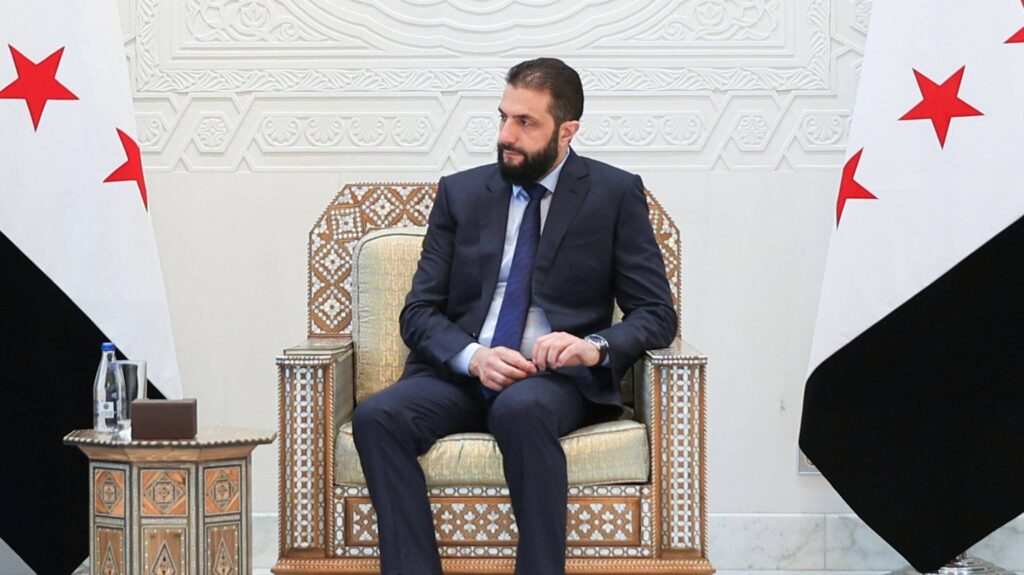
[Lyna Ouandjeli] My first question to try to understand a bit more the challenges faced by Ahmad al-Sharaa and his transition government is the following: which transitional justice mechanisms is Ahmad al-Sharaa’s government considering to respond to the crimes committed during the war, including those perpetrated by the Assad regime and the armed groups?
[Akram Kachee] It is difficult to name what is currently happening in Syria given the unprecedented nature of the events. For the first time, a Salafi jihadist group ideologically affiliated to Al-Qaeda seems to have reached power. This transformation takes place in a turbulent regional context where, for a year now, Benjamin Netanyahu works to weaken the “axis of resistance”[1]. The weak link of the latter was Bashar al-Assad’s Syria, impaired by years of corruption, clientelism[2] and war. Since 2019, while we thought he was emerging victorious from the conflict, his army and economy kept on degrading. Despite international attempts to reintegrate Syria in the diplomatic game, notably with the reopening of embassies in the United States, Russia, Turkey, Iran, Europe or the Arab League, Assad’s regime seemed exhausted. Many actors were already considering a transition to a new leadership. It is in this context that former U.S. diplomat Robert Ford is said to have met, as of 2023, Ahmad al-Sharaa, a rising figure in Hayat Tahrir al-Sham (HTS), with the idea of transforming “the jihadist emir into a politician.” Some scholars already saw HTS as an example of “deradicalisation from above,” trying to evolve towards a form of political governance. In Idlib, the embryo of a state was born. In Damascus, however, a growing gap emerged between the official discourse and reality on the ground. While progress had been noted – partial lift of sanctions, foreign investments – structural problems remained: endemic corruption, lack of democracy, seizure of power. This pattern, inherited from the Assad regime, reproduced itself. Power remains patrimonial, confused with private interests, as in other authoritarian regimes in the region (Iraq, Libya, Egypt). The new regime in the making is reproducing the errors of the past. Power is concentrated in the hand of al-Sharaa through a “constitutional declaration” that has installed an ultra-presidential system. The position of Prime Minister has been terminated, and the link between the people and the government has been broken. Key posts are allocated to figures close to al-Sharaa – his brother proposed as vice president. There is no legitimate electoral mechanism to underpin this power.
Worse even, foreign combatant members of HTS – between 20 and 30% of its forces – should be obtaining Syrian citizenship, be integrated within the military, and occupy posts within the administration. We are witnessing a militarisation of power and a reproduction of the mistake made in 2003 Iraq with de-Baathification: massive purges replace competent civil servants with individuals loyal to the new regime. The institutions of the future regime raise serious concerns. Parliament will not be elected through universal suffrage: a third will be named by al-Sharaa himself, the other two-thirds by a commission also designated by him. Furthermore, he is planning on creating an “Islamic Jurisprudence Council” made of fifteen members, including eight who will come directly from Idlib and be affiliated to HTS. Their mission: to control conformity to Sharia rules. Far from deradicalisation, this heralds a new phase of rigid islamisation of power, even within the Sunni majority, where discontent is growing. Authoritarian centralisation collides with the growing demands from minorities: Alawites, Druze, and Kurds request a decentralisation of power. This project is supported by some foreign countries: Turkey supports al-Sharaa, hoping to avoid Kurdish federalism, while Israel seems to see the break-up of Syria as a strategic opportunity. Finally, the question of transitional justice remains a source of tension. Al-Sharaa was initially opposed to it, fearing that his own militias might be targeted. But facing international pressure, particularly following the massacres in the south of the country, commissions have been created – without any real effect so far. The lack of commitment to justice could lead some communities to call for foreign intervention. As for the army, it is now nothing more than an aggregate of militias. These armed groups are not paid by the Syrian state but through parallel circuits – often fueled by foreign powers or the war economy. This undermines the very idea of a unified Syrian state.
[Lyna Ouandjeli] How is the Syrian state planning on transforming its war economy into one that is productive, fair and turned towards sustainable investment? Just a few days ago, a Gulf company expressed an interest in investing in Syria’s telecommunications sector, giving the regime until 10 June to respond to this offer. This example illustrates attempts to economically revive the country where the formal economy remains fragile. At the same time, a central question may arise from my main question. How do you get out of an informal economy structured around captagon trafficking, among other things? This illicit trade constituted a source of revenue for the regime, allowing it to finance part of its civil servants’ salaries and maintain the illusion of economic stability. Moreover, another major challenge is the reconstruction of an agricultural economy, once Syria’s pillar. How can the government revive this strategic and sustainable sector?
[Akram Kachee] Since 2011, Syria has structured itself around what is today called a true war economy, based on violence, criminality and the exploitation of informal networks. Checkpoints, drug trafficking (particularly captagon), weapons and other illicit practices were means for the regime to finance its war effort. In this framework, Syria functioned as a narco-state, while also suffering from the massive destruction of its cultural and economic heritage. This dynamic has not yet ended. Today, a new paradox emerges: the regime, particularly in the zones under Hayat Tahrir al-Sham’s control, in Idlib, for instance, has adopted a neoliberal logic[3]. It has installed a market economy, liberalised prices (including bread, a highly sensitive product) and lowered customs duties, paving the way for the import of Turkish goods, often cheaper than local ones. This policy is extremely risky: in a post-conflict context, states generally pass protectionist measures to rebuild (as did France after 1945 or even the U.S. under Trump). This is not the first time Syria has adopted this type of policy: in 2006, the free trade agreement signed with Turkey had already led to enormous economic loss (from $3 to 4 billion), generating a wave of mass unemployment. Numerous licensed workers had joined informal neighborhoods and social anger had gradually turned into violence. We are risking the reproduction of the same pattern today. The agricultural sector, once the pillar of the Syrian economy, has been abandoned. It is neither protected nor subsidized, while it is already weakened by violence, particularly alongside the coast (wheat, citrus) where lands are being targeted by militias coming from the peripheries. This cycle of rural marginalisation has been ongoing since the 1960s. Moreover, the regime seems to concentrate its efforts on international diplomacy – seeking to lift the sanctions – instead of genuinely reviving the internal economy. The most recent investments, such as the contract attributed to a Syrian company linked to the old regime (Mohammed Hamsho, close to the Assad family), illustrate this return to crony capitalism: lack of transparency, lack of calls for tenders, clientelist practices. The $7 billion contract for the renovation of electric power plants, clearly overestimated, shows that the Syrian people will pay the price without reaping the benefits. Finally, the social and economic policies that have been put in place remain vague and unbalanced: mass dismissals without social protection, replacement with staff recruited with much higher salaries (notably coming from Idlib or HTS networks), lack of vision for the central banks, currency or the job market. This lays the foundation for renewed social instability, in a context already tensed from a sectarian and political perspective.
The regime appears to be reproducing the errors of 2011: marginalisation of the cities, mass unemployment, and rising inequalities. And yet, the Syrian people today, deeply exhausted from the war, seem willing to move on. A historical opportunity for Ahmad al-Sharaa, assuming he opens the political arena and takes social demands into account. Why insist on the political dimension? Because in Syria, the economy cannot be differentiated from politics. There cannot be any economic revival without a clear political transition.
[Lyna Ouandjeli] What are the main axes of political transition initiated under Ahmad al-Sharaa, and how are they breaking with the authoritarian logic of the old regime? I am asking you this question, despite the fact that by the looks of your answers, we are under the impression that there is no deep cut with the ways of the old regime. So maybe according to you, how can it distance itself from the harmful practices of its predecessors?
[Akram Kachee] You are absolutely right: what we are witnessing today in Syria is a continuity of the authoritarian regime. Past practices continue. Democracy has never been a priority, and indeed the word itself has never been uttered. Postponing elections for five years confirms this logic: the regime is trying to win time to consolidate its control, without initiating any real transition. From the very first months, a rift appeared among the Syrians. On the one hand, some estimate that time is required for the new power to stabilise itself, given the complexity of the situation. On the one hand, those like me consider that on the contrary, now is precisely the time to negotiate spaces for freedom: freedom of speech, judicial guarantees, a clear institutional frame for political transition. For now, no law on multipartism, nor an electoral framework, fits Resolution 2254. The “national dialogue” recently launched was nothing more than a show, reduced to half a day of empty discussions, with no real willingness to listen. This gives the feeling that the power simply wants to tick all the boxes imposed by the outside, to give an illusion of a political turning point without any substantial change.
On the ground, facts speak for themselves. Many judges, particularly women, have been dismissed – not for professional misconduct but for political reasons. The country remains deeply fragmented, and the Kurdish question remains unresolved despite symbolic engagement. A certain maturity nevertheless seems to exist on both sides with a willingness to avoid armed confrontation. But no one is laying down their weapons because mistrust is still absolute. The regime, for its part, continues to assert that the state must regain its monopoly on force and is therefore demanding general disarmament. But it is coming up against well structured armed groups, hardly manageable, and that are impossible to pay or integrate due to a lack of a clear fiscal system. Tax collection, funding for infrastructure, basic services reconstruction: all of that remains uncertain. More broadly, the current power lacks political legitimacy. And this legitimacy will only be able to materialise through the polls and credible elections – something the regime still seems opposed to. On a day-to-day level, life for Syrians has not improved: electricity remains available for only a mere half hour a day, abductions, ransom requests, murders and violence have not disappeared. The country is still locked in a war economy. There are a number of possible dynamics and explanations for this situation, but what is striking is that the authorities seem deaf to these warning signs. It remains focused on the idea of “victory,” the lifting of sanctions and international diplomatic tours – but outside of this, no substantial changes can be observed. The political arena is still locked, arbitrary arrests keep taking place, as do extrajudicial executions.
[Lyna Ouandjeli] To come back to the Kurdish question, it is a matter of central importance for Syria’s reconstruction. Since the 2011 Arab Spring and the war against the Islamic State, the Kurds have acquired a form of de facto autonomy, as well as significant military capacities. Discussions have taken place between the Syrian Democratic Forces (SDF) and Ahmad al-Sharaa, leading to a deal that many experts have described as rushed – notably because it took place right after the Alawite massacre in Latakia. Subsequently, the government backtracked, creating persistent uncertainty about its true intentions, especially as Hayat Tahrir al-Sham (HTS) is taking an inflexible stance on this issue. There are plans to integrate the Kurds into the Syrian army, but the fundamental question remains: will they really agree to lay down their arms? And how does Ahmed al-Sharaa’s administration intend to integrate the Kurds’ political, cultural and linguistic demands into a new Syrian social contract?
[Akram Kachee] Among the elements you have mentioned, the social contract issue appears to be central. Yet the latter does not seem to constitute a priority for the new government which adopts a rather more Hobbesian approach, assuming that a leader must concentrate absolute power. Armed with his winning position, he is trying to impose this vision. The Kurdish question remains both crucial and complex. The Kurds are currently facing difficult choices. On the one hand, they are facing groups like the Syrian National Army, partially made by Hayat Tahrir al-Sham (HTS), trained in and affiliated to Turkey. These groups, located in northern Syria, prevent the territorial continuity of Rojava and receive orders from Erdogan to regularly bomb Kurdish positions to push them to lay down their weapons. On the other hand, Ahmad al-Sharaa adopts a different stance. He has engaged in a dialogue with the Kurds, an initiative firmly rejected by Ankara. Moreover, the historical Kurdish leader Abdullah Öcalan has announced a review of the doctrine of violence, calling for the surrender of arms. This leaves the PKK without clear guidelines. If the ideological centre of gravity of the movement in Turkey evolves, it is impossible to indefinitely maintain the current positions.
The dialogue between the Kurds and the al-Sharaa administration has nevertheless been restrained by the Alawite massacre, a key event. For the Kurds, a sincere commitment to the reconciliation process can only take place within a democratic framework and the respect of the rule of law. However, they note that impunity persists: crimes committed against Alawites who have laid down their arms remain unpunished, and those responsible continue to act freely. Moreover, the Kurds still manage the open camps where former jihadists are being detained, without a clear solution regarding decentralisation, the issue of weapons, the fight against jihadism or resource sharing – particularly oil. On this matter, Ahmad al-Sharaa has offered a 50/50 split, while the Kurds consider such an allocation premature and prefer a share of 10 to 15% to start. Discussions are making steady progress, addressing issues such as the economy or energy. Each stage is based on observation of the regime’s behaviour and its ability to modify its doctrine. But if the regime continues along the path of authoritarian recentralisation, there is a risk of fuelling a new wave of radicalisation.
[Lyna Ouandjeli] A few days ago, Damascus sustained terrorist attacks from ISIS against the government, that were claimed shortly after. How can we interpret ISIS’s latest attack against a government position: a sign of resurgence or an isolated act? And so, does al-Sharaa’s government have a counter-insurrection strategy different from the Assad regime’s, particularly in relation to human rights and local cooperation?
[Akram Kachee] Excellent question. The deradicalisation strategy from above initiated by Ahmad al-Sharaa shows that he has been able to impose himself thanks to a solid, disciplined and centralised security apparatus, allowing him to collaborate effectively with certain countries, including France and the U.S., on the issue of foreign combatants. U.S. and Turkish intelligence services have praised his sharpness, his intelligence and his pragmatism. He has understood that he had to equip himself with a nuisance capacity sufficient to become an invaluable partner, forcing the start of negotiations. This nuisance capacity is based on land control, which implies not only economic resources allowing to pay salaries, but also an effective security hold. It was in this context that he provided key information to Western services on the whereabouts of Abu Bakr al-Baghdadi, Al-Qaeda cadres and former members of the Islamic State, leading to drone strikes and targeted assassinations. Since he has adopted this deradicalisation from above approach, he has had to face internal resistance. Some of those close to him have accused him of betraying the movement’s principles, which is said to have led him to eliminate some of his former allies. While he seems prepared to show flexibility towards most of the armed groups, he remains intransigent towards the Islamic State, a demand also made by his international partners.
This posture however generates an ambivalent dynamic: it fuels both rejection and suspicion, notably because of his perceived collaboration with foreign services. His current legitimacy relies more on clientelist mechanisms than on real political membership, which makes his position fragile and unstable. It is a form of governance that we can describe as “balance management”: he argues that staying in power avoids an even more chaotic scenario. In this context, the resurgence of ISIS pockets reminds of the case of 2003 Iraq. The absence of a clear political integration process and the repetition of past U.S. strategy mistakes – namely the management of the sectarian and identity question – contributed to instability. Contrary to Lebanon, Syria does not have an institutionalised sectarian system. Al-Sharaa is however trying to create one by posing as the representative of a minority in the face of a majority system, which is a contradiction in terms. Because in Syria, the cleavage is not just sectarian: it is also social, economic, political and regional. Reducing tensions to a simple sectarian grid is an error of analysis. This leads to segmented visions, such as the partition of the country in three zones – a logic that already failed in Iraq.
Today, Al-Sharaa seems to want to institutionalise communitarianism by relying on traditional figures: notables, imams, sheikhs, patriarchs, etc. But this strategy could open the way to new and dangerous dynamics and lead Syria into a perilous turning point in its history.
Notes
[1] Editor’s note: The axis of resistance designates an informal political and military alliance between Iran and Syria and armed movements/militias like the Lebanese Hezbollah, Iraqi militias (e.g. the Popular Mobilisation Forces), the Houthis in Yemen, the Palestinian Hamas (among others) and to a certain extent Afghan Fatimid divisions.
[2] Editor’s note: Clientelism as a political term refers to an operating mode in which political officials distribute political resources (jobs, social support…) in exchange for electoral support or political loyalty. This system is based on personalised, often informal, relationships between “patrons” and “clients,” and tends to weaken democratic institutions, transparency and equal treatment before the law.
[3] Editor’s note: The neoliberal logic is a political and economic orientation based on the primacy of the market, deregulation, the reduction of the role of the state within the economy, and the promotion of competition and individualism. This logic aims at transferring some public functions to the private sector, in the name of efficiency and budget rationalisation. It tends to consider citizens as economic actors responsible for their own risks.