

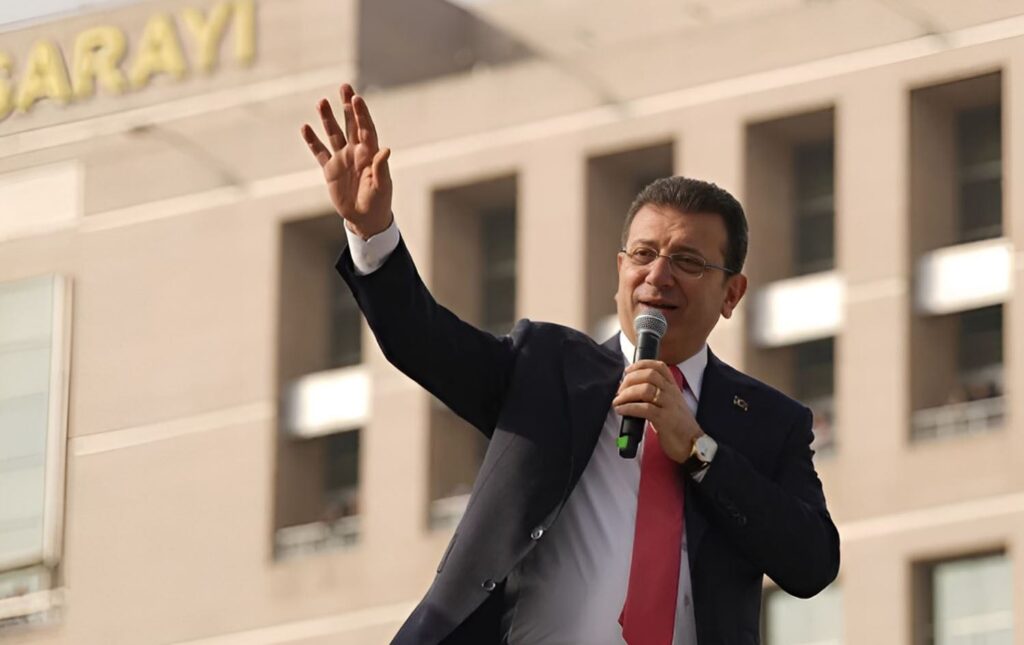

Let’s be clear: The arrest of Ekrem Imamoğlu on March 23, 2025, following the annulment of his university degree and his pre-trial detention over the previous four days, constitutes the most severe blow to democracy observed in Turkey since the AKP came to power—especially since its regime took a sharply illiberal turn. Even the purges that followed the failed coup attempt of July 15, 2016, did not directly target opposition parties, which had been invited to mass rallies alongside the ruling party to celebrate the failure of the military intervention.
The deliberate attack against the mayor of Istanbul, just as he was about to be officially nominated through a primary election as the presidential candidate of the main opposition party (CHP), marks a new authoritarian shift in Recep Tayyip Erdoğan’s regime. However, this time, it is far deeper and more radical than any seen before. There is growing concern that this break with liberal democracy may be irreversible, steering the country down an autocratic path whose full extent remains difficult to gauge.
A Formidable and Feared Rival
The charges against Ekrem Imamoğlu accuse the mayor of Istanbul of leading a corruption network (which led to the arrest of several dozen of his collaborators) and of having ties to the PKK—that is, to “terrorism”—by allegedly approving the hiring of sympathizers of the Kurdish organization within the municipality of Turkey’s largest metropolis. For those who follow Turkish politics, these charges come as no surprise. Not long ago, several prominent figures of the CHP, particularly in Istanbul, were subjected to similar proceedings based on equally baseless accusations. In October 2024, Ahmet Özer, the mayor of Esenyurt, was arrested for alleged “links to terrorism,” and in January 2025, Rıza Akpolat, the mayor of Beşiktaş, suffered the same fate, accused of irregularities in municipal procurement processes. In hindsight, these arrests now appear to have been a dress rehearsal for what is happening today. However, the detention of Ekrem Imamoğlu carries far greater significance.
Twice elected with resounding success (in 2019 and 2024) as the mayor of metropolitan Istanbul—where Erdoğan himself began his political rise—the CHP’s rising star presents a profile that deeply unsettles the AKP leader. Secular but not ostentatiously so, he openly acknowledges being a practicing Muslim and avoids religiously charged controversies. Hailing from the Black Sea region (just like Erdoğan), he enjoys an implicit presumption of nationalism and loyalty to traditional values, allowing him to appeal to Erdoğan’s voter base—particularly those disillusioned by his successive presidencies, a strategy he fully embraces. This political figure, who has successfully tempered his Kemalism in the same way Erdoğan once moderated his Islamism, has also seized control of Istanbul—the regime’s showcase. For the Turkish president, stopping this formidable rival in his seemingly unstoppable march toward the presidency became an absolute necessity.
The Decline of the AKP
As early as March 18, 2025—the day before Ekrem Imamoğlu’s arrest—the regime made its intentions unmistakably clear by annulling his university degree through Istanbul University, effectively blocking his path to the highest office. The Turkish Constitution requires presidential candidates to hold a university degree. The urgency for the AKP to act was all the greater because, in the previous year, Imamoğlu’s reelection as mayor of Istanbul was accompanied by a sweeping victory for his party, which, for the first time, gained more influence nationwide than the AKP. This comes against the backdrop of an ongoing economic and social crisis. Despite its efforts, the government has been unable to curb inflation, stabilize the currency, or attract sufficient investment. Erdoğan’s strategic successes, particularly in Syria, have not been enough to offset the electoral damage caused by this economic turmoil. The fall of Bashar al-Assad’s regime has not led to the return of the three million Syrian refugees Turkey has hosted for over a decade. So far, only 145,000 have returned, and it is likely that the majority will not go back to Syria at all.
Finally, Erdoğan’s assertive regional diplomacy has raised concerns among parts of the Turkish public, particularly as Israel intensifies its strikes in the region and speculation grows about the emergence of a Turkish-Israeli rivalry in the Middle East.
The Scale of the Response
For now, the response to Imamoğlu’s arrest is taking shape. Despite an extended ban on demonstrations following the announcement of his continued detention, his supporters have taken to the streets in large numbers. The Istanbul Municipality building and the surrounding areas in Saraçhane are becoming the epicenter of a growing movement across the country, reminiscent of Gezi Park during the 2013 protests. Launched by traditionally dissident universities, boycott operations are now affecting most campuses, while an inter-university solidarity network is emerging. Every evening in Turkey’s major cities, the sound of banging pots and pans signals the end of the day in protest. With each passing night, the number of arrests increases—more than 300 people were apprehended between Friday and Saturday night alone.
Speaking on the occasion of Newroz/Nevruz, the Kurdish and Turkish spring festival, Recep Tayyip Erdoğan declared that he would not give in to “street terrorism,” while condemning CHP leader Özgür Özel’s calls for protests. If the situation continues to deteriorate, the AKP leader will likely attempt to position himself as the defender of law and stability in an increasingly uncertain international climate following Donald Trump’s return to power. But does he still have the legitimacy and charisma to play that card?
And the Kurds?
In this complex process, a crucial question is how the Kurds—particularly their parliamentary party, the DEM Party—will position themselves. The party recently negotiated with Abdullah Öcalan, calling for the dissolution of the PKK. Imamoğlu’s arrest directly impacts the ongoing resolution of the Kurdish issue, a process initiated by the regime in October 2024 under the influence of Devlet Bahçeli, the leader of the far-right MHP. This situation mirrors how the Gezi movement in 2013 disrupted a previous attempt at resolving the Kurdish question.
While many Kurds—who voted for Imamoğlu in Istanbul—are inclined to join the protests, others fear they would be the first victims of such a move, as the government could brand them “terrorists.” If the DEM Party openly supports the demonstrations, the authorities could use this as evidence of an alliance between the CHP and the Kurds, reinforcing accusations of “complicity with terrorism” against the Istanbul mayor. Conversely, if the Kurds remain on the sidelines, Erdoğan may succeed in dividing his opponents and breaking the political convergence that contributed to his defeat in the last local elections. The Kurds’ cautious approach could also be an advantage for the opposition, as it would prevent Erdoğan from using the “terrorist threat” narrative to justify repression and emergency measures. On March 20, 2025, DEM co-leader Tülay Hatimoğulları publicly expressed support for the mayor of Istanbul. However, the following day, the DEM Party’s website primarily focused on celebrating the Kurdish spring festival and Öcalan’s call.
Government Nervousness, the Strength of Mobilization, and Shifting International Geopolitics
Regardless of the regime’s belief that it still has the means to suppress this protest movement, its direct attack on its main opponent is a clear sign of growing nervousness. Despite its brutality, this strategy exposes the weakness of a government that can no longer ensure its survival through constitutional means, especially in a context of economic crisis, political fatigue, and recurring challenges to fundamental freedoms. The continuation of the primary elections for the upcoming presidential race—held on Sunday, March 23, 2025, between 8 AM and 7 PM—allowed 15 million people to participate in an informal vote (organized by the CHP across Turkey’s 81 provinces and 973 districts) in support of Ekrem Imamoğlu. This massive turnout strengthens the opposition’s call for official early elections, a demand it has been pushing for months. The government will struggle to quell such a widespread and multifaceted movement—comprising protests, voluntary elections, and initiatives across various sectors of society. Recep Tayyip Erdoğan has every reason to be concerned…
However, the evolving international situation must not be overlooked. While the shift in Syria initially seemed to bring Turkey and the European Union (EU) closer together, Erdoğan had struggled to establish direct contact with the U.S. president—until last week. Their primary discussion centered on the potential supply of F-16s and even F-35s to Turkey, which has been unable to modernize its combat air fleet for over a decade. These Turkish-American negotiations were further confirmed yesterday. Beyond the acquisition of fighter jets, these talks also reflect Ankara’s strategic positioning amid widening rifts between the U.S. and Europe. Turkey remains a crucial partner for building an integrated and autonomous European defense, which might explain why EU leaders have remained relatively quiet regarding the arrest of Ekrem Imamoğlu. Erdoğan is also well aware that his American counterpart is unlikely to be concerned with Turkey’s violations of the rule of law, even if relations between Washington and Ankara continue to deepen. Understanding Turkey’s current crisis, therefore, requires a broader view of the rapidly evolving international geopolitical landscape.