


Since the fall of Syria’s Assad regime in December 2024, the country has entered a new phase of political and military reconfiguration. This period is marked by the gradual expansion of Damascus’s authority over territories that were previously controlled by the Syrian Democratic Forces (SDF), which are predominantly Kurdish. This phase has been accompanied by official announcements of ceasefires, declarations emphasizing national unity, and symbolic measures directed at Kurdish populations, mainly located in the country’s northeast. However, a cross-analysis of regional and international sources highlights a far more complex dynamic, demonstrating that this new phase cannot be understood solely as a post-conflict transition. Rather, it reflects a reconfiguration of Syrian state power characterized by a reduction of Kurdish autonomy, a restructuring of security arrangements, population displacements, and an uncertain management of the issue of detainees affiliated with the Islamic State.
Revisiting the March 10, 2025 Agreement between Damascus and the SDF
The agreement of March 10, 2025 constitutes the formal framework for the integration of northern and northeastern Syrian territories into the central state apparatus. It provides the legal and political foundation for incorporating these territories into the authority of the central government.
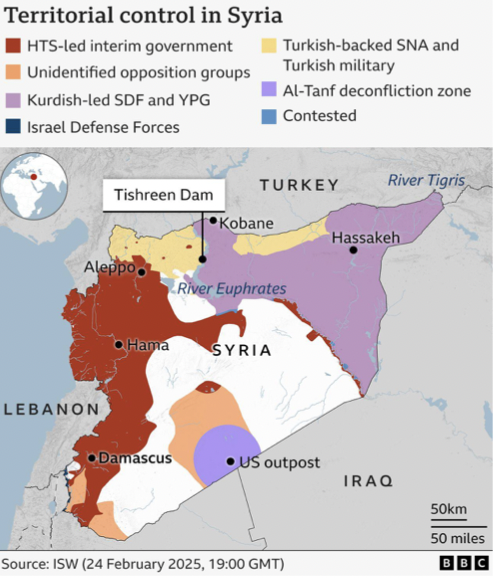
Territorial control in Syria – BBC
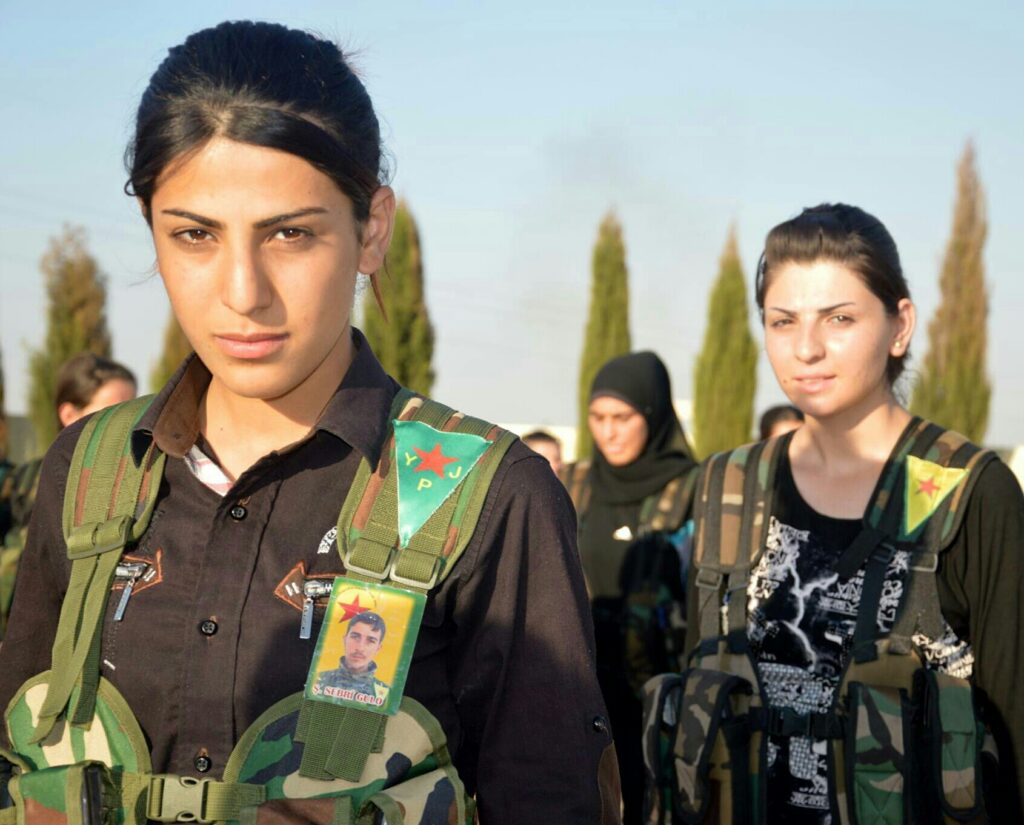
Since 2012, Rojava has developed autonomous civilian and military governance structures through the Syrian Democratic Forces (SDF) and local administrations. The fight against the Islamic State strengthened the legitimacy of these Kurdish forces, which became allies of international coalitions, particularly the United States, in efforts to contain ISIS. Beginning in 2024-2025, the Syrian regime under Ahmed al-Charaa sought to reassert its authority over the entirety of Syrian territory, particularly over strategic areas controlled by the Kurds: the Euphrates Valley, Hasakah, and several localities in Aleppo. Public statements made by the Syrian president prior to the agreement indicated his intention to regain full control over Rojava, including Kurdish neighborhoods in Aleppo such as Sheikh Maqsoud.
Reminder of the Provisions of the Agreement
Among other elements, the agreement provided for:
- a redeployment of the Syrian army in the north and northeast (Rojava) to ensure control over key territories;
- a gradual withdrawal of the SDF from strategic urban and rural areas, with a reduced presence limited to local security functions;
- recognition of certain Kurdish administrative and cultural structures, within a framework subordinate to the Syrian state;
- joint management of prisons and detainees, particularly those affiliated with ISIS.
This agreement was reached in a context of relative U.S. disengagement. While the United States remained a partner of the SDF in the fight against ISIS, it prioritized stabilization and Syrian unity over the direct protection of Kurdish structures.
Territorial Reassertion and Military Dynamics (January 2026)
Following the March 2025 agreement, the phase of military implementation began in early January 2026, with the redeployment of Syrian forces in Rojava. This sequence reflects a strategy of gradual but firm recentralization, aimed at bringing Kurdish territories under the direct control of Damascus. Initial operations focused on the Kurdish neighborhood of Sheikh Maqsoud in Aleppo, identified as a strategic area due to its proximity to the city center and to major logistical and strategic routes. At the same time, Syrian forces advanced in eastern Aleppo and the Euphrates Valley, targeting key localities previously under direct SDF control. The offensive was subsequently extended to northeastern Syria, including Hasakah and several rural areas, with the objective of regaining full control over territories under Kurdish administration. This operational phase corresponded to a coordinated plan prepared after months of negotiations and preceded by public statements by al-Charaa justifying the reassertion of control over Rojava. The military advance took place despite a widespread sense of abandonment expressed by Syrian Kurds, who denounced the loss of guarantees regarding their autonomy and security. This sentiment triggered demonstrations by the Kurdish diaspora in Europe.
A significant dimension of the offensive involved the takeover of prisons and detainees affiliated with ISIS. The withdrawal of the SDF and the entry of Syrian forces led to releases, escapes, and transfers, increasing security risks in certain rural areas—for Kurdish populations, the region as a whole, and even at the international level. This situation prompted the Kurdistan Regional Government in Iraq to deploy Peshmerga forces along the border to prevent a resurgence of violence and to control population movements. Consequently, security risks intensified in several rural areas of northeastern Syria, with implications extending beyond the strictly national framework. In this context of rising tensions, the Syrian government adopted, a few days after the attacks in Rojava, a decree recognizing certain Kurdish cultural and linguistic rights. The main measures included:
- official recognition of the Kurdish language;
- legal regulation of certain cultural celebrations (notably Newroz).
These measures are often presented as political concessions embedded in a strategy of symbolic conflict management. They appear primarily as responses to military escalation and reported violence in Kurdish territories, aiming to legitimize the reassertion of state control and to limit the risk of local and international contestation.
Violence, Abuses, and Persistent Insecurity against Kurds: An International Law Perspective
The territorial reassertion of control over northern and northeastern Syria by the Syrian army in January 2026 was accompanied by documented violence against Kurdish populations, as well as a rapid deterioration of the security situation—particularly linked to the release or movement of former ISIS-affiliated fighters. Multiple sources report abuses committed by Syrian forces upon entering areas formerly controlled by the SDF. These practices include arbitrary arrests, sweeping security operations, and pressure exerted on Kurdish civilians, especially in urban neighborhoods and strategic rural areas. In Aleppo, in the Kurdish neighborhood of Sheikh Maqsoud, the entry of government forces was marked by clashes, movement restrictions, and testimonies reporting intimidation of the local population. In the northeast, particularly around Hasakah, military operations were accompanied by intensified security checks, often perceived as disproportionately targeting Kurds, fueling feelings of marginalization and mistrust toward central authority. The reassertion of control by Damascus occurred in a context of fragmented security authority, involving multiple armed actors (regular forces, pro-government militias, and reintegrated or released former combatants). Several analyses indicate that certain abuses against Kurdish civilians were carried out by militias affiliated with or tolerated by the regime, without clear accountability mechanisms.
This dynamic has contributed to a climate of chronic insecurity, despite official declarations announcing ceasefires and stabilization. Independent organizations and media outlets also point to the existence of hostile discourse toward Kurds within certain segments of Syrian society, reinforcing communal tensions and perceptions of discriminatory treatment. From the perspective of international humanitarian law, these practices raise several concerns. As the power exercising effective control over reconquered territories, the Syrian state is bound by obligations arising from the Geneva Conventions, notably the protection of civilians, the prohibition of arbitrary arrests, and respect for the principle of proportionality in security operations. Violence perpetrated by pro-government militias or former ISIS fighters, when tolerated or left unpunished, may also engage state responsibility under international law.
The release or circulation of former ISIS-affiliated fighters has further contributed to a resurgence of attacks against Kurdish civilians, documented by local sources and social media networks. This situation highlights a structural inability to ensure the protection of populations, as guaranteed by international human rights law—particularly the right to life and security. These military operations must therefore be examined in light of Common Article 3 of the 1949 Geneva Conventions, applicable to non-international armed conflicts. This article prohibits, inter alia:
- “violence to life and person,”
- “cruel treatment,”
- “outrages upon personal dignity,” against persons not taking direct part in hostilities.
In addition, Additional Protocol II to the Geneva Conventions (1977), relating to non-international armed conflicts, provides in Article 13 that “the civilian population and individual civilians shall enjoy general protection against the dangers arising from military operations.” It prohibits acts or threats of violence whose primary purpose is to spread terror among the civilian population. Detention practices observed during the reassertion of control over Kurdish territories must also be assessed under international human rights law, which continues to apply during armed conflict. Article 9 of the International Covenant on Civil and Political Rights (ICCPR) prohibits arbitrary arrest and detention and guarantees the right of any person deprived of liberty to be informed of the reasons for arrest and to challenge the lawfulness of detention. Article 14 of the ICCPR guarantees the right to a fair trial. In a context of military redeployment and heightened security control, the absence of effective procedural safeguards for arrested or detained Kurdish civilians raises serious questions regarding compliance with these obligations.
The security situation in northeastern Syria is characterized by fragmented authority, involving regular forces, pro-government militias, and armed former combatants, including those affiliated with ISIS. Under the Articles on Responsibility of States for Internationally Wrongful Acts adopted by the International Law Commission (2001), particularly Articles 4, 8, and 11, a state may incur responsibility for:
- acts of its organs,
- acts of groups acting under its direction or control,
- or acts it acknowledges or adopts as its own.
Accordingly, abuses committed by affiliated or tolerated militias, in the absence of effective prosecution, may be legally attributable to the Syrian state. Moreover, the insufficiently controlled escape or transfer of ISIS-affiliated detainees raises an additional legal dimension. Attacks carried out by former ISIS fighters against Kurdish civilians call into question the state’s capacity—and obligation—to protect populations under its control. Article 2 of the ICCPR requires states not only to respect the rights enshrined in the Covenant but also to ensure them, including a positive obligation to prevent serious violations of the right to life (Article 6 ICCPR). Where non-state actors commit foreseeable violence and the state fails to take reasonable preventive measures, state responsibility may arise for breach of this duty of protection.
Finally, the internal displacement of Kurdish populations observed in certain areas must be assessed in light of Article 17 of Additional Protocol II, which prohibits forced displacement of civilians unless required for imperative security or military reasons. Similarly, customary international humanitarian law prohibits arbitrary displacement of civilian populations. Where displacement results from violence, threats, or a climate of insecurity generated by military or security operations, its compliance with IHL becomes legally questionable. Thus, beyond the official discourse of stabilization and national unity, practices observed in Kurdish territories raise substantial questions regarding Syria’s compliance with its international obligations. Damascus’s territorial “victory” comes at a significant legal and human cost, revealing persistent tensions between state recentralization, security imperatives, and the protection of civilian populations.