

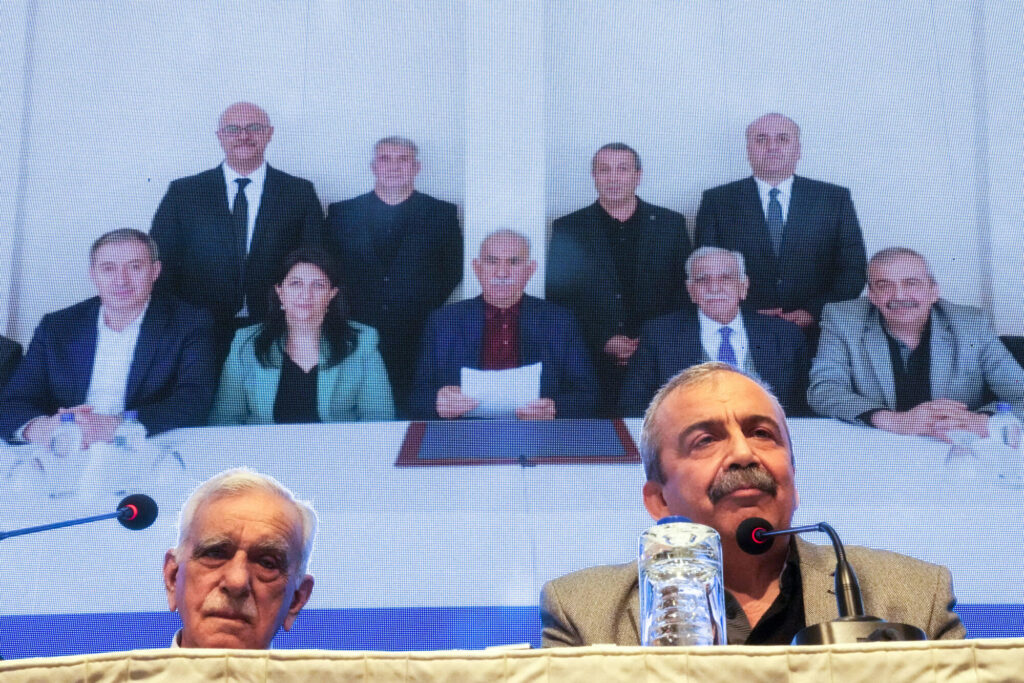
From May 5 to 7, 2025, the 12th Congress of the Kurdistan Workers’ Party (PKK) took place in Qandil, also referred to as the “Medya Defence Zone” by the PKK[1]. This congress follows the call for peace and the dissolution of the group made by its founder, Abdullah Öcalan, on February 27, 2025[2]. After several waiting days, the decision to dissolve was announced on Monday, May 12, 2025. This historic decision will have notable consequences on the Turkish political scene, but also on the Kurdish transnational movement and regional geopolitical equilibria.
The peace process in Turkey
On October 1, 2024, the leader of the Turkish ultra nationalist party MHP (Milliyetçi Hareket Partisi), Devlet Bahçeli, shook hands with several MPs from the pro-Kurdish DEM party (Halkların Eşitlik ve Demokrasi Partisi) at the end of a session at the TBMM (Türkiye Büyük Millet Meclisi), the Turkish National Assembly[3]. This scene quickly made the headlines, given Devlet Bahçeli’s history of invectives against the pro-Kurdish party he accuses of being linked to the PKK[4]. This symbolic episode enabled the fourth negotiation attempt between the Turkish state and the PKK since 2009 to be made public[5]. Indeed, in 2009, between 2010 and 2011, and between 2013 and 2015[6], three settlement attempts had been made but ultimately resulted in failure. The new negotiation process initiated in October 2024 made it possible for three meetings to be organised between the İmralı Delegation, made up of several DEM MPs, and PKK founder Abdullah Öcalan, on İmralı Island, where the latter has been imprisoned since 1999. This led to a call for peace and the dissolution of the PKK, written by Abdullah Öcalan and read in a press conference by the delegation[7].
The Kurdistan Workers’ Party
The PKK was founded in 1978 in Lice, the city and district capital of the Diyarbakır Province, by Abdullah Öcalan. The organisation launched an armed struggle against the Turkish state in 1984, giving way to localised confrontation in the Southeastern Anatolia region. A minimum of 3,000 villages have been completely evacuated and/or destroyed in the 1990s[8]. Since 1984, the fighting has caused at least 40,000 deaths[9]. In the 1990s, a decade marked by a counter-guerrilla strategy led by the Turkish state that reached its highest point, the majority of PKK officials fled to Syria and Iraq.
With their general staff in exile, the PKK found itself in a phase of silence, hiding a significant recomposition on the ideological and organisational levels. This recomposition gave birth, in 2005, to the KCK[10], a parent organisation charged with the management of postnational ideological evolution[11]. Following the three negotiation processes from 2009 and 2015, the “war of the cities”[12] between 2015 and 2016 confirmed the resumption of the armed conflict between the Turkish state and the PKK in several cities of southeastern Turkey, including Cizre, Silopi, and Diyarbakır[13]. In these conditions, an asymmetrical conflict localised around Qandil took place, opposing the Turkish army, bombing PKK positions[14], to the PKK, which carried on with its rocket attacks and ambushes.
The process initiated in October 2024, therefore, stands as the political response to a forty-year-long war between the Turkish state and the PKK. On October 23, 2024, however, when the peace process had just been made public, the PKK claimed an attack on the headquarters of the public company Turkish Aerospace Industries (TUSAŞ)[15]. Turkish reprisals in the night from October 23 to 24 targeted forty-seven targets in northern Syria and Iraq[16]. Despite these renewed tensions, the PKK responded favourably to Öcalan’s call by announcing a unilateral ceasefire on March 1, 2025[17]. The organisation of the 12th PKK Congress and the decision to dissolve the group are part of this chronology of commitment to respect the call of Öcalan, Apo (“uncle” in Kurdish).
The regional consequences of the PKK’s dissolution
The consequences for Turkish internal politics
The DEM, to an extent, benefited symbolically from its mediation between the Turkish state and Abdullah Öcalan, in an initially highly unfavourable context for opposition parties, and in particular a pro-Kurdish one. Since 2016, many MPs from the DEM (and its ancestor, the HDP) have been prosecuted or removed from office at the municipal level[18], generally on charges of association with a terrorist organisation. Selahattin Demirtaş, MP from 2007 to 2018 and president, then co-president of the pro-Kurdish party, was arrested in November 2016 and found guilty several times, including in May 2024 in the Kobané trial, where he was sentenced to 42 years of imprisonment[19]. The DEM was also impacted by the fragmentation of the opposition to the AKP, unable to secure an alliance with the CHP (Cumhuriyet Halk Partisi), the main opposition party to the AKP in Turkey. During the March 2024 municipal elections, the two parties agreed on “urban consensus” (the inscription of DEM names on CHP municipal lists, in several districts of Istanbul, for instance). The lack of a formal alliance in a context of mutual distrust, linked with conflicting ideological aspirations from certain fringes of both parties, nevertheless further contributed to the DEM’s “cornerisation.” The participation in the negotiation process, having given way to the PKK’s dissolution, therefore constituted a political opportunity for the DEM to free itself from its infrequentability and reposition itself in the national political arena.
Meanwhile, the AKP is also benefiting symbolically from the PKK’s dissolution. Internally, it is now the party that succeeded in partially resolving the “Kurdish question.” Externally, the PKK’s dissolution will improve Turkish-Iraqi relations and facilitate Turkish-Syrian relations that are already very good.
Consequences on the transnational Kurdish movement: fragmentation or recomposition?
The Kurdish transnational movement refers to a multitude of political parties, cultural organisations, media, and others, whose transnational impact makes the existence of a “Kurdish sociopolitical space” beyond Turkish borders possible [20]. The connection between “apoist” [21] political actors results in a more or less systematic consensus at the strategic level, reflecting the still strong influence the PKK holds on this “Kurdish sociopolitical space”[22]. The PKK is indeed the only Kurdish organisation that has maintained a presence, different depending on national contexts, in the four countries that include a Kurdish minority (Turkey, Syria, Iraq, Iran).
The PKK’s dissolution has an air of fragmentation about it, given the centrality of the movement in the nebula of organisations that are more or less clearly affiliated to it. In Syria, Kurdish actors from Rojava are about to obtain legalisation and institutionalisation following the signature of an agreement in principle by Mazloum Abdi, commander of the Syrian Democratic Forces (SDF), and Ahmad al-Sharaa, new president of the Syrian Arab Republic, on March 10, 2025[23]. In Turkey, the PKK’s dissolution could lead to the decriminalisation of the pro-Kurdish legal opposition, although no guarantee has been given so far. The PKK’s dissolution could thus permit the national inclusion of certain actors until now associated with the organisation and marginalised on the political level for this reason. The demilitarisation of several conflict zones could also facilitate the restructuring of Kurdish-Kurdish networks, as was the case at the Kurdish Dialogue Conference, which took place on April 26, 2025, between officials of the DAANES (Democratic Autonomous Administration of North and East Syria), marked by the presence of the PDK[24] and 400 other sympathisers from Syria, Turkey, and Iraq[25].
The PKK’s dissolution does not necessarily imply the end of its political struggle and more broadly of “apoist” ideology. The transition from the military register to the civilian one, already in place in Turkey for a few years now, will favour the transfer of the movement’s human, political, and material resources to social, humanitarian, and cultural organisations. The PKK has indeed shown a degree of organisational resilience through the creation of new entities that oversee its development and ensure its continuity on the political level.
The dissolution of the PKK is therefore a means for the organisations that are more or less clearly linked to it to rectify their image outside its fold and to fit into their respective national contexts. The dissolution of the PKK nevertheless does not seem to signal the end of its ideology, which has spread beyond national borders.
Notes
[1] ANF News, « PKK successfully held its 12th Congress », ANF News, May 9, 2025.
[2] DEM Parti, « Barış ve Demokratik Toplum Çağrısı », DEM Parti, February 27, 2025.
[3] Hürriyet Daily News, « Handshake with DEM Party shows ‘national unity’: Bahçeli », Hürriyet Daily News, October 8, 2024.
[4] The Kurdistan Workers’ Party is listed as a terrorist organisation by Turkey, the United States, and the European Union.
[5] According to some testimonies, the discussions between Ankara and the PKK have been ongoing since March 2024. See Turkey Recap, “The PKK disbands: Implications for Turkey with Selim Koru”, Turkey Recap, May 12, 2025.
[6] In 2009, the democratic opening (demokratik açılmı) marked the launch of parliamentary discussions on the “Kurdish question.” Between 2010 and 2011, the Oslo process (Oslo görüsmeleri) consisted of several discussions between the MIT (Millî İstihbarat Teşkilatı, the Turkish intelligence service) and the PKK in Oslo. Between 2013 and 2015, the Solution process (çozum süreci) was based on indirect negotiations between the Kurdish state and Abdullah Öcalan through visits of HDP (Halkların Demokratik Partisi) MPs on İmralı Island.
[7] See footnote no. 2. “In this climate created by Mr Devlet Bahçeli’s call, the will of the President and the positive approach of other political parties, I call on you to lay down your arms, and I take historical responsibility for this call. Have your congress convened and take the decision to integrate yourselves into the state and society, as any modern society and any party whose existence has not been interrupted by force would do voluntarily; all groups must lay down their arms, and the PKK must dissolve itself.” Translation from Turkish to French by the author, and French to English by the editorial staff.
[8] Jongerden, Joost. « Village Evacuation and Reconstruction in Kurdistan (1993-2002) », Études rurales, no. 186, 2010, pp. 77-100.
[9] Mandıracı, Berkay. « Turkey’s PKK Conflict: The Death Toll », International Crisis Group, 2016.
[10] KCK, Koma Civakên Kurdistan, Kurdistan Communities Union.
[11] This evolution built upon Abdullah Öcalan’s writings, inspired by the publications of Murray Bookchin. The PKK’s postnational shift distances the organisation from classical nationalism to bring it closer to the founding ideology of democratic confederalism, at the heart of which lie direct democracy, ecology and women’s liberation.
[12] Benhaïm, Yohanan. « 12. Connexions et compétitions dans l’espace transfrontalier. Mouvement kurde et réaction de l’État turc dans la crise syrienne (2012-2018) », in G. Dorronsoro, Le Gouvernement des Kurdes : gouvernement partisan et ordres sociaux alternatifs, 2023, pp. 327-356.
[13] Gosse, Mathieu. « Urbicide en cours au Kurdistan : Diyarbakır, de la ville-refuge à la ville-cible », Urbanités, 2016.
[14] List of Turkish operations led in northern Iraq in the last five years: Claw-Eagle, Claw-Tiger (2020), Claw-Lightning, Claw-Thunderbolt (2021), and Claw-Lock (2022), Operation Winter Eagle (2022) et Claw-Sword (2022).
[15] Le Monde, « Turquie : au lendemain de l’attentat près d’Ankara, le gouvernement confirme que les auteurs sont “des membres du PKK” », Le Monde, October 24, 2024.
[16] Ibid.
[17] L’Orient-Le Jour, « Le PKK prêt à embrasser la paix avec la Turquie », L’Orient-Le Jour, March 1, 2025.
[18] Tutkal, Serhat. « Trustees Instead of Elected Mayors: Authoritarian Neoliberalism and the Removal of Kurdish Mayors in Turkey », Cambridge University Press, no. 50, vol. 6, 2022, pp. 1164-1186.
[19] BBC News Türkçe, « Kobani davasında Selahattin Demirtaş’a 42 yıl, Figen Yüksekdağ’a 30 yıl 3 ay hapis cezası verildi, Kışanak tahliye oldu », BBC News Türkçe, May 15, 2024.
[20] Çiçek, Cuma. « La formation d’un espace sociopolitique kurde sous le pouvoir d’AKP en Turquie », Anatoli, no. 8, 2017, pp. 151-181.
[21] Regarding the term “apoist,” Patrick Haenni and Felix Legrand provide the following explanation: “When it comes to central PKK command based in Qandil, the relation of authority that links it to Syrian leaders claiming allegiance to Abdullah Öcalan is complex. Using the concept of ‘apoist movement’ allows us to take into account the ideological and historical affiliation of the militants, their continuous movement between Syria and the Kurdish Middle East, without presuming total subordination to Qandil – which cannot be demonstrated, even if it can be assumed. Haenni, Patrick et Felix Legrand. « 9. La greffe du projet apoïste en Syrie », in G. Dorronsoro, Le Gouvernement des Kurdes : gouvernement partisan et ordres sociaux alternatifs, 2023, pp. 229-257. The term “apoist” comes from Abdullah Öcalan’s nickname “Apo” which means “uncle” in Kurmandji.
[22] Çiçek, Cuma, op. cit.
[23] ANF News, « Mazloum Abdi and Ahmed al-Sharaa sign agreement », ANF News, March 10, 2025.
[24] PDK, Kurdistan Democratic Party.
[25] Medyanews, « Kurdish conference in Syria sets stage for national unity congress », Medyanews, April 28, 2024.