


An Arena of Indirect Confrontation Between Washington and Tehran
Since the US–Israeli attacks against Iran more than two weeks ago, Iraq has been on the verge of becoming a space of confrontation in a conflict that is intensifying and expanding at the regional level, even though the Iraqi state itself is not officially involved in the war. This situation is rooted in a structural configuration dating back to the 2003 US invasion, after which the country gradually became a field of rivalry between American interference and Iranian influence. However, the Iraq of 2026 is no longer that of 2003: the country is now characterized by deep political and security fragmentation, marked by the significant presence of armed groups and by the partial integration of certain militias into the state’s security structures. This form of state hybridity increases Iraq’s vulnerability to the logics of proxy confrontation. Combined with the fact that, from both a geographical and geopolitical perspective, Iraq is a pivotal state in the Middle East, it explains why regional and international rivalries tend to manifest themselves there rapidly.
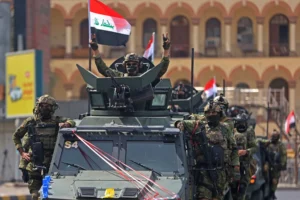
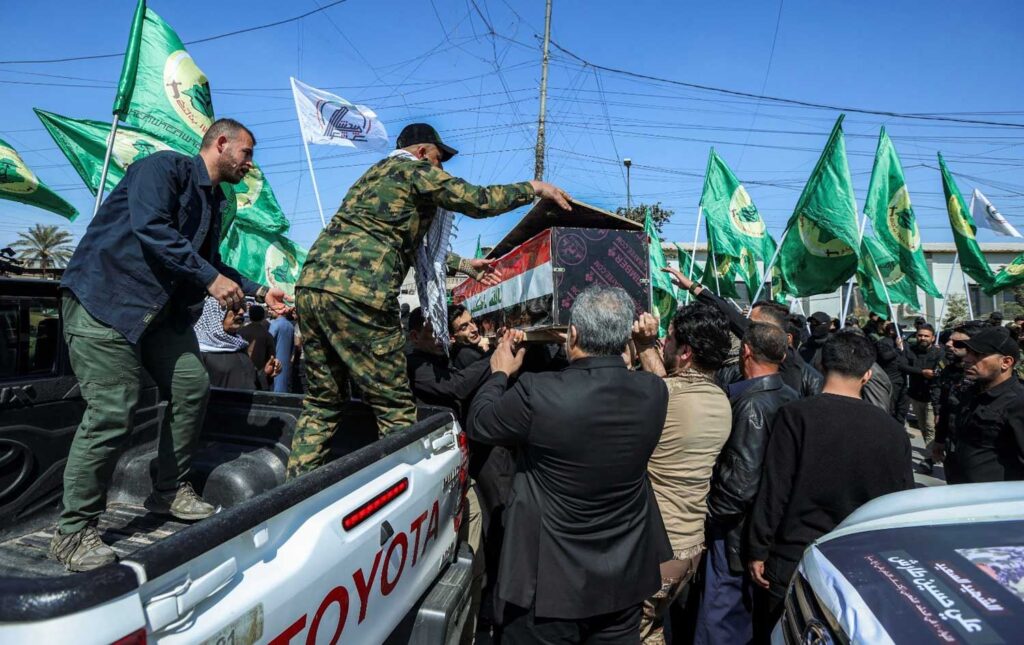
Today, Iraqi territory is exposed to strikes from both sides. Iran acts primarily in an indirect manner through pro-Iranian Iraqi armed groups operating under the banner of the “Islamic Resistance in Iraq,” which brings together several factions of the Popular Mobilization Forces (PMF), the Hashd al-Shaabi. These militia attacks are part of a broader regional strategy pursued by Iran: in this largely asymmetric war, Tehran mobilizes all the instruments at its disposal in order to compensate for the gap in military power with its adversaries. The actions carried out by these pro-Iranian Iraqi factions on Iraqi territory thus form part of a wider framework of Iranian pressure and strikes targeting other countries in the region, particularly the Gulf states, with the aim of hitting American interests at the regional level. In response, the United States has conducted retaliatory strikes against militia positions inside Iraq in order to neutralize their military capabilities following attacks against American forces. This cycle of attacks carried out by pro-Iranian Iraqi militias, followed by American counterstrikes, creates a real risk that Iraqi territory could be transformed into an indirect front in the broader conflict between Washington and Tehran.
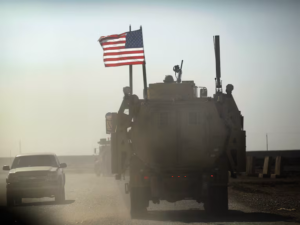
Strikes and attacks have been reported in Baghdad and in other parts of the country, although most of them have been concentrated around Erbil, the capital of Iraqi Kurdistan, where the US consulate, the international airport used by American forces, and the Harir military base, where US troops are stationed, are located. Several attacks have targeted these facilities as well as positions held by the Peshmerga[1] and Iranian Kurdish opposition groups present in the region. Iraqi authorities have condemned these strikes and announced measures to contain the situation, but these have not prevented further attacks targeting Erbil airport, energy infrastructure, and certain civilian sites.
Iranian Influence in Iraq as a Vector of Escalation in the US–Iran Confrontation
Iran’s influence in Iraq can be understood across several dimensions: security, political, economic, and religious. While the religious ties between the two countries are rooted in a long history linked to Shiite clerical networks between Najaf and Qom, the security, political, and economic dimensions have been significantly strengthened following the structural transformations triggered by the 2003 US invasion. The overthrow of Saddam Hussein and the subsequent collapse of the Iraqi state apparatus created an institutional vacuum that allowed Iran to expand its influence through networks of Shiite political parties, religious actors, and armed groups. This influence was further reinforced after 2014 with the creation of the PMF, formed to fight the Islamic State alongside the Iraqi army and the US-led coalition. At the time, these groups enjoyed strong popular legitimacy due to their role in the fight against ISIS, although this legitimacy has since eroded. Today, many of these armed groups are no longer simply auxiliary forces but have become an integral part of the Iraqi state. While attached to the official security apparatus, they retain autonomous political and economic structures and form a complex network linking political leaders, senior officials, religious authorities, economic actors, and civil society organizations. Through these networks, they exercise local authority, control both formal and informal economic circuits, and participate fully in political life through institutionalized parties and alliances. In this sense, their influence extends far beyond the military sphere and constitutes a structural component of Iraq’s post-2003 political order.
In this context, Iranian influence manifests itself primarily at three levels. On the security level, Tehran maintains close ties with several factions of the PMF and other armed groups belonging to the “Axis of Resistance,” providing Iran with an indirect security presence in Iraq as well as a lever of pressure against US military forces stationed in the country. On the political level, Iran maintains close relations with several Iraqi Shiite parties and influential political figures, giving it significant influence within Baghdad’s political system. Finally, on the economic level, Iraq remains highly dependent on Iran for its imports of gas and electricity, as well as for cross-border trade flows, providing Tehran with an additional means of influence and pressure.
Despite strong Iranian influence and American interference since 2003, Iraq has managed to maintain a certain degree of relative stability between these two powers, as illustrated by the electoral process initiated during the legislative elections of 11 November 2025, during which Iraq respected the constitutional timetable in the first phase of the parliamentary process, even though the country has still not succeeded in forming a new government. The process had nevertheless begun well, but the fragmentation of the political system, combined with strong American pressure aimed at reducing Iranian influence, particularly through demands to dismantle militias and attempts to influence the designation of the prime minister, ultimately brought it to a halt. Indeed, the nomination of former prime minister Nouri al-Maliki as a candidate for the post by the Coordination Framework[2] in January 2026 reignited tensions between Baghdad and Washington. The United States warned that it could withdraw its political, economic, and security support for Iraq because of Maliki’s close ties to Iran and to pro-Iranian militias, warnings that were immediately rejected by a large part of the Iraqi political class, which denounced them as foreign interference in the country’s sovereignty. This stance reflects a broader shift in American strategy, which now aims less at rebuilding a strong centralized Iraqi state than at containing Iranian influence in Iraq.
In this context, Iran’s influence does not necessarily push Iraq directly toward open confrontation, but it clearly increases the risk that Iraqi territory could become a space of indirect confrontation between the two powers. Pro-Iranian armed groups operating in Iraq provide Tehran with the ability to exert pressure on US forces without triggering direct interstate escalation. At the same time, the Iraqi government must manage these actors while attempting to preserve its fragile balance between the two countries. The period of political transition in Iraq, pending the formation of a new government, could further complicate the situation and heighten concerns about the country’s ability to contain the spillover effects of the confrontation between Tehran and Washington. However, the presence of Prime Minister Mohammed al-Sudani should serve as a factor of relative stabilization since he has so far managed to maintain a balance between the United States and Iran and to sustain relations with both sides.
The Stakes and Risks of Kurdish Involvement in the Conflict
In practice, it is above all the autonomous region of Iraqi Kurdistan that currently appears particularly exposed. During the first ten days of the conflict, it was targeted by more than 200 drone and missile strikes aimed at American bases, civilian and energy infrastructure, as well as positions held by the Peshmerga and training camps for Iranian Kurdish fighters opposed to the regime in Tehran. These strikes were claimed by pro-Iranian Iraqi armed groups, which accuse the Kurds of supporting the United States and Israel and seek, in particular, to deter any Kurdish cooperation with Washington. They occur in a context of rumours suggesting that the United States could arm certain Iranian Kurdish forces based in Iraq in order to facilitate a potential offensive against the Iranian regime. Such an operation would reportedly be accompanied by US–Israeli bombings in Iran’s Kurdish regions in order to prepare the ground and trigger a popular uprising inside the country. These speculations were fuelled by a statement from President Trump referring to a possible Kurdish military action, although he later walked back these remarks a few days afterward. They were further reinforced by his phone conversations on March 3 with Mustafa Hijri, secretary-general of the Democratic Party of Iranian Kurdistan (PDKI), as well as with the leaders of the two main parties of Iraqi Kurdistan, Masoud Barzani (Kurdistan Democratic Party, KDP) and Bafel Talabani (Patriotic Union of Kurdistan, PUK).
In this perspective, a Kurdish offensive would fit into a broader US-Israeli strategy aimed at regime change in Iran, which would require either the deployment of ground troops with local Kurdish support or the participation of Kurdish forces providing a ground component to an intense aerial campaign. The Kurds indeed appear to be among the few actors capable of providing such a capability in the event of an operation aimed at overthrowing the Iranian regime. This is due to their military experience acquired during the wars in Iraq and in the fight against the Islamic State, the relative organization of their armed groups, and their geographical position along Iran’s western flank. Moreover, US and Israeli strikes on security infrastructure in western Iran, particularly in Kurdish-majority provinces, are fueling speculation about the creation of an operational buffer zone that would allow Kurdish armed groups to enter Iran.
Historically divided, several Iranian Kurdish organizations came together on February 22 within the Coalition of Political Forces of Iranian Kurdistan, intended to coordinate the actions of Iranian Kurdish opposition parties against the regime in Tehran. This coalition brings together the Democratic Party of Iranian Kurdistan (PDKI), the main Iranian opposition group based in Iraqi Kurdistan, the Party for a Free Life in Kurdistan (PJAK), considered the Iranian branch of the PKK, the Kurdistan Freedom Party (PAK), the Komala of the Toilers of Kurdistan, and the Khabat Organization, joined on March 4 by the Komala Party of Iranian Kurdistan. These organizations maintain military bases and camps in the Kurdistan Region of Iraq, near the Iranian border, which largely explains why this region has become particularly exposed to strikes related to the conflict. As these parties are illegal in Iran, their leadership and infrastructure are based in exile in the autonomous Kurdistan region, while their presence inside Iran remains clandestine and militarily more limited. However, any coordinated military action among these organizations would require an unprecedented level of cohesion among groups that have historically been fragmented.
In this context, arming Iranian Kurdish groups would also imply logistical involvement from Iraqi Kurdistan, particularly for the transit of weapons and the use of its territory as a staging base. A confrontation between these armed groups and Iranian security forces could then mobilize part of the regime’s military resources and encourage the emergence of broader unrest in certain regions of the country. In some scenarios, Kurdish forces could also seek to control border areas in northwestern Iran in order to establish an operational buffer zone.
However, such involvement would involve extremely high risks for the Iraqi Kurds themselves, as the strikes already targeting them demonstrate, and it would likely occur only in exchange for significant and written political guarantees, such as support for the creation of an independent Kurdish state. Yet Kurdish political memory is marked by past strategic alliances with external powers that abruptly ended once those powers had achieved their geopolitical objectives. The example of the 1975 Algiers Agreement constitutes one of the major traumas in Kurdish political memory in this regard. In the 1960s and early 1970s, the Kurdish insurgency in Iraq led by Mustafa Barzani benefited from covert support from the Shah’s Iran, the United States through the CIA, and Israel, mainly with the aim of weakening the Iraqi Baathist regime and influencing the regional rivalry with Baghdad. This support ended abruptly when Iran and Iraq signed the Algiers Agreement in March 1975: deprived of external backing, the Kurdish movement quickly collapsed, and the Iraqi army regained control of the insurgent areas, leading to massive population displacements and repression against the Kurds. This episode has durably reinforced the idea of the Kurdish cause being instrumentalized by external powers, a perception further strengthened by other events such as the violence exercised by Saddam Hussein’s regime in the 1980s, the Kurdish uprising of 1991, and, more recently, the uncertainties surrounding American support for Syrian Kurdish forces after the fight against the Islamic State.
As for the Iranian Kurds, estimated to represent around 10% of Iran’s population and constituting one of the country’s largest ethnic minorities, their demands for autonomy, cultural rights, and decentralized governance have been violently repressed both under the Pahlavi monarchy and under the Islamic Republic. Most Kurdish parties state that they seek a federal model within Iran rather than secession and view accusations of separatism as a political campaign directed against them, particularly by certain Persian nationalist circles, including within pro-monarchist factions. Tensions surrounding Kurdish aspirations therefore extend beyond the Islamic Republic itself and also involve parts of the opposition camp. Reza Pahlavi, for instance, publicly condemned the initiative of the coalition formed on February 22, arguing that such discourse on Kurdish self-determination could threaten Iran’s territorial integrity. He accused the coalition of promoting a separatist logic and of weakening the Iranian opposition by dividing the anti-regime front. In response, leaders of Kurdish opposition parties reiterated that the objective of Iranian Kurds is the recognition of Kurdish political and national rights within a future post-Islamic Iran, and that Kurdish participation in a democratic Iran is not incompatible with national unity. They also recalled the historical mistrust toward the Pahlavi dynasty, whose regime had pursued policies of repression and assimilation toward the Kurds.
In the event that Iranian Kurdish opposition forces operating from Iraqi Kurdistan were to participate, alongside Iraqi Kurdish forces and with American and Israeli support, in a ground operation against the Iranian regime, the mobilization of other Iranian ethnic minorities, particularly the Baluchis or the Azeris, could also be encouraged. However, these groups are currently poorly armed, weakly organized, not unified, and geographically dispersed, which limits the likelihood of a coordinated uprising. Nevertheless, the prospect of such a scenario, which could fuel territorial fragmentation, is a source of concern for neighbouring states, particularly Turkey, Azerbaijan, and Pakistan. The Turkish factor is especially sensitive: Ankara considers the PKK and its Iranian affiliate, the PJAK, to be existential threats and closely watches any Kurdish dynamics that could strengthen them. This concern was illustrated when Turkish Foreign Minister Hakan Fidan spoke on March 4 with Masrour Barzani, Prime Minister of the Kurdistan Regional Government. The presence of PJAK within the recent Coalition of Political Forces of Iranian Kurdistan further fuels these concerns, especially since the disarmament process announced by the PKK following calls from its imprisoned leader Abdullah Öcalan has not yet begun and could lead some fighters to redeploy toward PJAK.
The Position of the Iraqi Government and Iraqi Kurdistan
In response to this situation, the Iraqi federal government has attempted to maintain an official position of neutrality and has repeatedly stated that Iraq does not wish to be drawn into the conflict. Prime Minister Mohammed Shia al-Sudani has affirmed that Iraq rejects any war against Iran and will not allow its territory to be used as a launching ground for attacks against the country. During a conversation with Iranian President Massoud Pezeshkian, he emphasized that Baghdad is determined to prevent any use of Iraqi territory for operations against Iran and also condemned the strikes carried out on Iraqi soil as violations of national sovereignty that undermine efforts to restore diplomatic dialogue. However, the government finds itself in a delicate position, as several of the armed groups involved in these attacks are formally integrated into the PMF, which legally form part of the Iraqi state’s security apparatus.
The question therefore arises: does Baghdad wish to become a rear base for operations aimed at regime change against its neighbor? It is also important to consider the bilateral security agreement signed between Iran and Iraq on March 19, 2023, in Baghdad, which notably aims to secure the shared border and neutralize the activities of Iranian Kurdish opposition groups present in Iraqi Kurdistan. The agreement stipulates that no actor, armed group, or third party should use the territory of either state to launch attacks against the other. Since its signing, several Iranian Kurdish organizations have been relocated to camps farther from the border and their military activities have been restricted.
For their part, the authorities of Iraqi Kurdistan firmly oppose any involvement in the war and have repeatedly stated that their territory must not be used as a platform for attacks against Iran. Several Kurdish leaders, including Masoud Barzani, former president of the Kurdistan Region and leader of the Kurdistan Democratic Party (KDP), have called for avoiding any escalation and for maintaining a role aimed at easing tensions. Many Kurdish voices have thus spoken out against the idea of involving Iraqi Kurdistan in this conflict. On March 4, Qubad Talabani, Deputy Prime Minister of the Kurdistan Regional Government (KRG), stated on X that “the Kurdistan Region of Iraq is not part of the current regional conflict and remains committed to neutrality.” On March 5, Iraqi First Lady Shanaz Ibrahim Ahmed issued a statement titled “Leave the Kurds alone. We are not guns for hire”, calling for the Kurds not to be drawn into another war. The spokesperson for the Iraqi Kurdistan government, Peshawa Hawramani, also categorically denied any participation by the Kurdish authorities in a plan aimed at arming and sending Kurdish opposition parties into Iran, stating that the region does not wish to expand the conflict and instead calls for peace, stability, and the protection of Kurdistan from attacks. In the same spirit, Masoud Barzani reaffirmed the Kurdish authorities’ intention to prioritize a role of stabilization and de-escalation in the region.
Iraqi Kurdish leaders have historically adopted a pragmatic approach in their regional relations and have maintained relatively cordial ties with the Islamic Republic of Iran. It is therefore likely that figures such as Masoud Barzani or leaders within the Talabani camp will remain cautious as long as Tehran remains resilient and the Iranian regime stays in power, for fear of reprisals. A central question nonetheless remains: will Kurdish leaders truly believe that Washington would support them if the escalation intensifies? Three factors are likely to be decisive in this strategic calculation: the resilience of Iran’s security apparatus, the credibility of American commitments, and the unity of the Kurdish factions themselves.
More broadly, within the Iraqi population, a growing sense of frustration and concern is emerging. Many Iraqis fear that the relative stability achieved after decades of conflict could be undermined by a war that is not theirs, and that Iraq could once again become a proxy battlefield in a broader regional confrontation.
Notes
[1] Official armed forces of the autonomous region of Iraqi Kurdistan under the authority of the Kurdistan Regional Government.
[2] The Coordination Framework currently constitutes the largest parliamentary bloc and brings together a coalition of Iraqi Shiite political parties, several of which maintain close ties with Iran and with the PMF.