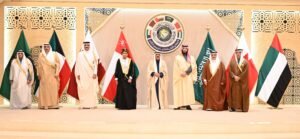


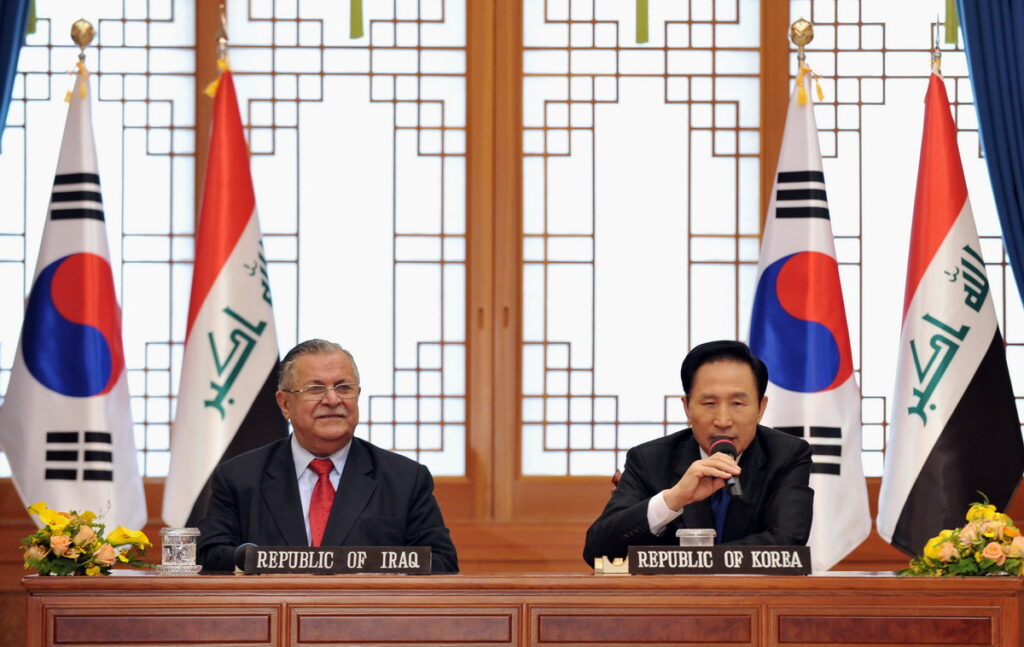
On September 22, 2023, Mohammed Shia al-Sudani, Prime Minister of Iraq, received for the first time Yoon Suk-Yeol, President of South Korea. The meeting, held on the sidelines of the United Nations General Assembly in New York, offered the two leaders an opportunity to reaffirm their economic partnership and discuss the “Development Road Project,” a corridor intended to connect Europe with the Arab-Persian Gulf via Iraq.
While China has become a major partner for Iraq over the past decades, South Korea has recently reoriented its development and trade strategy toward Iraq, particularly due to the country’s vast oil reserves. Since the 1970s and 1980s, during the Cold War[1], the Middle East has emerged as both an economic and diplomatic arena for Seoul. South Korea’s industrialization in the 1960s–1970s required a constant flow of petroleum resources, of which the country had none. The oil shocks of 1970–1973 only reinforced this dependence. Being a key ally of the United States also played a decisive role, as Washington sought to counter Soviet influence in the region by leveraging its Asian partners. Furthermore, Seoul’s participation in the Vietnam War (1955–1975) underscored the importance of securing energy resources and diversifying partners at a time when the United States had just suffered a major defeat in Asia.
The simultaneous rise of the chaebol (재벌), South Korea’s powerful conglomerates, and the political elite’s determination to reduce economic dependence on the United States, pushed the country to diversify its economy by establishing ties with emerging markets. Reducing U.S. economic influence was a strategic priority for Seoul, which sought not to rely too heavily on its American ally. Several companies—including Hyundai, Dong Ah Industrial, and Daewoo[2]—thus began setting up operations in various Middle Eastern states. Access to resources such as oil was crucial for a country rebuilding itself after the Korean War (1950–1953), which had divided its North and South geographically and politically. The Middle East therefore became a strategic zone for Seoul in its search for oil-exporting partners.
Iraq was integrated relatively late into South Korea’s economic expansion strategy. As Seoul was consolidating its domestic economy, it found it more advantageous to turn toward politically stable, U.S.-allied countries, which guaranteed continuous trade and diplomatic stability. As a result, South Korea’s trade with Saudi Arabia or the United Arab Emirates far exceeded its limited exchanges with Baghdad. In 1978, Hyundai built a water desalination plant in Basra, and that same year Iraq exported oil worth $23.6 million to South Korea[3].
With the establishment of formal diplomatic ties under Saddam Hussein (1979–2003), South Korea gradually invested in Iraqi infrastructure, particularly in the energy sector, though such exchanges remained limited due to trade embargoes on Iraq. Seoul’s strategy mainly involved sending equipment to facilitate oil extraction, enabling diversification of its Middle Eastern partners and circumventing Iran’s 1979 revolution. Since the United States and its allies had become Tehran’s enemies, the Korean government and industries turned westward toward Iraq. However, the Iran-Iraq War (1980–1988) forced South Korea to temporarily suspend its investments in the country. During Iraq’s reconstruction phase after the war, South Korea secured less than 1% of all rehabilitation contracts.
As a U.S. ally and rival of China, South Korea’s growing investment and trade in Iraq is worth close attention. Baghdad has increasingly regarded Seoul as a strategic trade partner. This article explores the consequences of intensified economic ties between the two countries and analyzes how South Korea’s involvement could reshape Iraqi markets, particularly in the oil sector.
The Progressive Development of Economic Relations between Baghdad and Seoul
After the Gulf War in 1990 and the U.S.-led invasion of Iraq in 2003, Seoul began strengthening its ties with Baghdad. In 2008, the Korea Gas Corporation (KOGAS) signed a €1.1 billion deal to develop oil fields in Mesopotamia. The following year, in 2009, Iraqi President Jalal Talabani (2005–2014) visited South Korea and signed a memorandum of understanding along with commercial agreements worth approximately $3.55 million, including the construction of power plants and oil fields in Basra. The memorandum specifically guaranteed Korean companies access to Iraqi resources and obliged the transfer of Korean technological expertise in oil extraction to Iraqis.
For South Korea, this paradigm shift toward Iraq was part of a broader strategy to deepen relations with Middle Eastern countries. Seoul sought above all to diversify its energy partners to avoid relying solely on Saudi or Iranian supplies. Iraqi Kurdistan and the Basra region, both rich in oil, soon became priority investment hubs for chaebol, notably Hyundai Heavy Industries (HHI) and SK Oil Group[4]. South Korea also sought to build strong diplomatic partnerships with key regional players to compete with China, its main rival, which has been steadily increasing investment in the Middle East.
The drastic rise in investment flows over recent decades has materialized through mega-projects primarily aimed at resource extraction. Crude oil accounts for more than 95% of Iraq’s exports to South Korea. On the other hand, Seoul has gradually carved out a place in the Iraqi automobile market through partnerships with local distributors such as GK Auto and Altsak Company, which handle distribution and after-sales services. GK Auto also works with the Trade Bank of Iraq (TBI), allowing installment-based vehicle purchases. In 2022, motor vehicles represented over 30% of South Korea’s total exports to Iraq. KIA and Hyundai ranked first and third, respectively, in terms of sales volume in 2023–2024, with Hyundai sales alone increasing by 35.6% year-on-year[5].
The lifting of international sanctions on May 22, 2003 enabled Korean firms to invest in Iraqi markets and to distribute their electronic goods and vehicles on a large scale. Cumulative investment flows reveal that South Korean companies invested $1.7 billion between 2003 and 2010, and then $10 billion between 2010 and 2024—a staggering 488.2% increase in just one decade. Large-scale construction projects have also been a strategy for Korean firms to both secure the favor of local political elites and establish a territorial presence beyond oil exploitation, which remains confined to specific regions of Iraq.
For instance, the new city of Pasmaya, located in southern Baghdad’s suburbs, has been under construction since 2012 and is set for completion in 2027. Covering 18.3 million m², it will include 100,000 housing units to accommodate 600,000 residents. The entire project was entrusted to Hanwha Construction—an unprecedented arrangement in Iraq’s history.
Iraqi Kurdistan as the Driver of Diplomatic and Economic Relations
During the intensification of economic ties between the two countries, Iraqi Kurdistan emerged as a strategic territory for Korean companies. Oil is the primary export from Iraq to South Korea and the main factor motivating Seoul to deepen economic engagement with Erbil, the capital of Iraqi Kurdistan.
After the 2003 U.S. invasion, South Korea was among the first countries to restore trade ties with Iraq. In 2007, the Baizan refinery in Iraqi Kurdistan was inaugurated. Numerous construction projects, often led by chaebol, were launched in the region. For more than a decade, Korean companies have concentrated their activities in northern Iraq. Among them are POSCO Engineering & Construction and the Korea National Oil Corporation (KNOC), which, despite partially withdrawing from southern oil fields in Sulaymaniyah, remain active investors in the region. While oil remains the most sought-after resource, other factors have encouraged economic activity in Kurdistan. The region’s relative autonomy and investment transparency allow chaebol and other companies to avoid Baghdad’s heavy restrictions, which typically require foreign firms to partner with local actors and secure numerous licenses and permits.
By contrast, the Kurdistan Regional Government (KRG) has established an attractive framework for foreign investors. Firms are not required to have local partners and face no major legal or economic restrictions. Political stability in Iraqi Kurdistan is another key advantage for Korean conglomerates, which prioritize operating in secure environments. Infrastructurally, the region is well-served by Erbil and Sulaymaniyah international airports, a digitizing Kurdish administration, and well-maintained road networks—all of which enhance its appeal to Korean firms.
In 2012, POSCO, in cooperation with the Kurdistan Ministry of Electricity, built a $700 million thermal power plant in Erbil. The opening of a South Korean consulate in Erbil in 2016 reflects Seoul’s recognition of the region’s strategic and political importance. Since then, ties between Kurdistan and South Korea have only deepened. In less than a decade, 59 schools, 15 health centers, a library, and a hospital have been built[6].
Broadly speaking, the three pillars of Iraq–South Korea economic relations are oil exports, infrastructure construction, and energy cooperation. Iraqi Kurdistan has become the backbone of these ties to the extent that one could even speak of an “Erbil–Seoul axis,” given the intensity of their rapprochement in recent years. While Seoul continues to seek Baghdad’s inclusion in its Middle Eastern economic diplomacy strategy, it is likely that in the near future Korean companies will increasingly gravitate toward the country’s north—a genuine regional hub whose economic potential continues to attract Asian investors.
Notes
[1] Levkowitz, A. (2010). The Republic of Korea and the Middle East: Economics, diplomacy, and security. Mideast Security and Policy Studies No. 106
[2] Lie, J; Unbound, H (1998) The Political Economy of South Korea.Stanford University Press
[3] N/A. (2019,4 Septembre ). The Iraqi Embassy in Seoul organizes a ceremony marking the 30th anniversary of Korean-Iraqi relations. Yonhap News
[4] Jeong, H. W. (2022). South Korea’s middle power diplomacy in the Middle East: Development, political and diplomatic trajectories. In Changing dynamics in Asia-Middle East relations. Routledge.
[5] N/A (2024, 27 mars)Iraq’s car market grows by 18.4% in 2023, Kia maintains lead despite Toyota’s gains. Shafaq
[6] Choi, K.-J. (2020). Searching for a new roadmap for Korea and the Kurdistan Region in the coronavirus pandemic. Rudaw.net.