

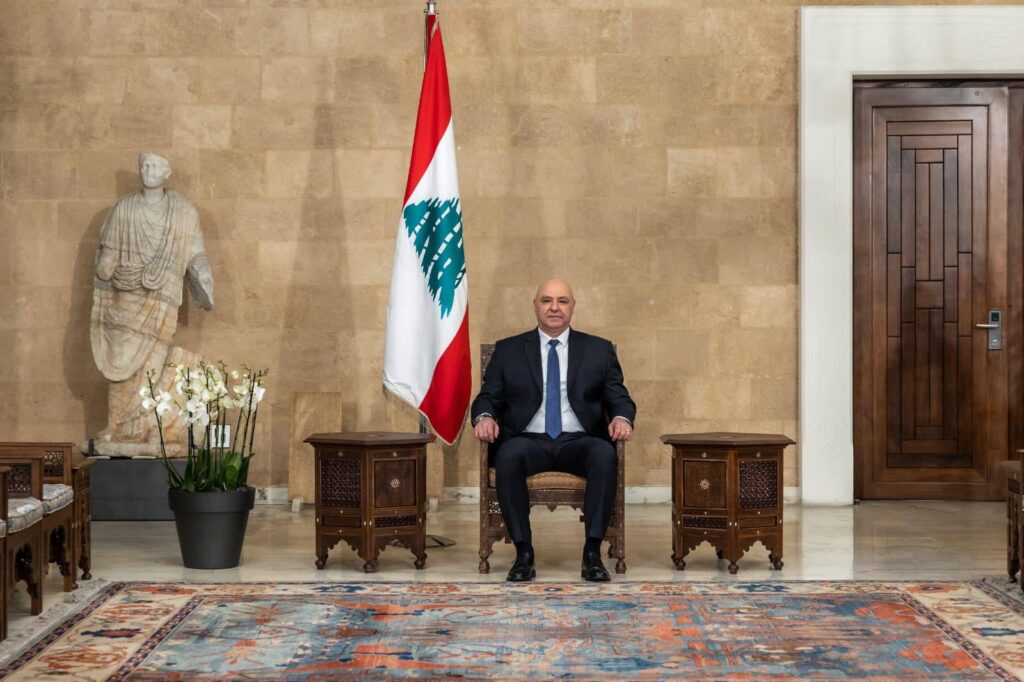

[Lyna Ouandjeli] Lebanon possesses a rich and fascinating history, but the country has also been through a great deal of tragedies. Among them, the Sykes-Picot Agreement[1] has a lasting impact in the region. Lebanon was plunged into a major civil war between 1975 and 1990, during which time Hezbollah was created in 1982. Moreover, the country underwent a Syrian occupation which lasted until 2005[2]. The Lebanese government is characterised by power sharing between different religious and ethnic communities, a feature that constitutes the very identity of Lebanon. This system can also be found in other countries like Iraq, but with a Lebanese specificity. Lebanon has often been entangled in regional tensions, particularly with Israel, with key episodes such as the civil war, the conflicts in the 2000s, the attacks against the Palestinians and the presence of Hezbollah in the south of the country. In 2020, the devastating Beirut port explosion profoundly affected the country and exacerbated the mistrust of the Lebanese people towards their banking system. More recently, the events of 7 October 2023 have put Lebanon back in the spotlight, but in a complex situation: constant bombings, targeted strikes, destruction of Hezbollah’s HQ and the assassination of Hassan Nasrallah. Joseph Aoun today attempts to rebuild the country, while the government could pave the way for a global peace process and a political reconstruction.
My first question is therefore the following: according to you, which main factors – political, economic, social – have led to Lebanon’s collapse?
[Amin Elias] Lebanon’s fragility, like that of the entire Middle East region, is rooted in a deep-seated failure, based on complex historical, ideological, and geopolitical dynamics. One of the major challenges lies in the way society perceives time and governance. Many populations in the region struggle to live fully in the present or imagine a concrete future, because their collective vision is often embedded in fantasies or nostalgia rather than in a rational and pragmatic understanding of current issues. This phenomenon is linked to a collective difficulty in transitioning from the imperial model, in which power was often concentrated in one place, to the modern state, which is based on a constitution, a social past, and citizen participation. In short, it is a philosophical problem: how can one think about sovereignty, freedom and citizenship in a context where these concepts are still blurred or misunderstood? Arab societies, through their history, diversity and experiences, have often been torn apart by strong collective identities – such as the Arab nation or the Islamic umma[3] – which remain for some dreams or at least idealised visions, rather than concrete realities. These fantasies, reinforced by historical and colonial divisions, have often prevented the emergence of a true feeling of unity. The region is marked by a variety of identities and interests, which, poorly matched, can sometimes fuel tensions.
Furthermore, geopolitics play an essential role. The 1947-8 creation of the State of Israel and its repercussions have had a profound impact on the region. The Palestinian crisis, border conflicts and foreign power interventions have often complexified the situation, dispersing national energy and feeding recurrent crises. The region has also been confronted with strategic mistakes made by some Arab leaders – whether it is Jordan, Egypt, Syria or Palestine – which failed to anticipate or effectively manage these challenges, or sometimes privileged temporary alliances. It is also important to highlight that many populations in these countries do not always have the opportunity to critically reflect on their history or their failures, which would have allowed them to draw lessons from them to build more stable trajectories. History has instead been marked by impulsive reactions, such as the coup in Damascus, or strategic alliances that have sometimes reinforced divisions. What is often lacking is a true culture of democratic governance, self-management and recognition of the other. Instead of promoting these values, much of the discourse remains locked within ideological struggles or past claims, such as the Palestinian cause or the fight against the West. This tends to maintain a clear inertia and limit the capacity of societies to evolve towards more inclusive and enlightened forms of governance.
This context partially explains why certain recent events, such as the tensions or conflicts in Lebanon, are taking such an explosive turn. For instance, the war launched by Hezbollah against Israel in 2023, without prior consultation with the whole of Lebanese society, illustrates this tendency to react impulsively to accumulated crises. The war lasted for a year, wreaking havoc across the south of the country and culminating with the assassination of Hassan Nasrallah in September 2024, which shows how much this region needs a new impulse towards rationality and mutual comprehension. It is becoming urgent to carefully study the past to better understand these dynamics in order to adopt more thoughtful strategies and avoid relapsing into cycles of violence and uncertainty. The key to a more stable future lies in the unity of the Arab world, in its capacity to exchange ideas, to develop common projects and build a real cohesion, while respecting its diversity at the same time.
In short, Lebanon and the region’s fragility not only depends on external factors and punctual errors, but also on a collective necessity to rethink the way the future is built, integrating rationality, mutual recognition and a long-term vision.
Lyna: How has the nature of the confessional system aggravated or crystallised the crisis?
[Amin Elias] The confessional system in Lebanon is both a fundamental feature of its society and a source of vulnerability. It is important to understand that historically Lebanon has not experienced true citizenship in the way that other countries have. Most Lebanese mainly identify in relation to their faith or their religious community, reflecting a deep social reality. It is this configuration that has been institutionalised as part of the national pact, making confessionalism the foundation for governance. This system responds to a social reality: it allows to structure political representation, to ensure short-term stability to some extent, and manage confessional diversity. This same structure however becomes fragile because it crystallises divisions instead of favouring unified citizen integration. The management of confessionalism is a delicate matter: if it is poorly balanced or manipulated by some actors for particular interests, it can reinforce tensions, fuel distrust and weaken social cohesion.
From a strategic perspective, it is essential to adopt a rational approach which recognises this reality while also seeking to widen it towards a more inclusive citizenship. This implies strengthening civic education, creating spaces for interfaith dialogue, and promoting a common Lebanese identity going beyond sectarian cleavages. Some are offering to establish a form of Lebanese secularism which would respect diversity while at the same time favouring stronger national unity. Since 1969[4], and particularly with the multiplication of conflicts in the Middle East region, this dynamic has been profoundly disturbed. The civil war, followed by various episodes of violence and political crisis, have weakened trust between communities and prevented the emergence of a sustainable national consensus. The fragmentation of forces, notably with the emergence of armed militias, has reinforced this vulnerability.
Today, the major challenge is to ensure that the state regains its full sovereignty, in particular by dismantling the militias so that the state becomes the sole legitimate holder of the monopoly on violence. This fundamental step could pave the way for national reconciliation, reconstruction of mutual trust, and a more balanced handling of the confessional system. If this were to happen, it would be possible to build a future where confessional diversity, instead of being a source of division, becomes a shared wealth within the republican framework, allowing the Lebanese people to live together in stability and peace.
[Lyna Ouandjeli] You have underlined a key point: sovereignty. This is a fundamental principle for international law, which guarantees that a state cannot be invaded or transgressed without violating its sovereignty. Beyond its territory and its population, a state must also have an authority capable of managing its affairs. For a long time, Lebanon has not fully exercised its sovereignty, but today Joseph Aoun’s government is seeking to regain it and strengthen the authority of the state.
[Amin Elias] This is a long process. To succeed, militias and some Lebanese linked to foreign forces, such as Hezbollah or those having relations with Syria, Iraq, Libya or Palestine, must lay down their arms. The goal is that the state becomes the one and only security provider, allowing Lebanon to unite and move forward. Otherwise, in the years to come, the country risks sinking back into a cycle of violence, with conflicts in Syria, Israel and Lebanon.
[Lyna Ouandjeli] Do you think the current collapse – political, social, economic – can lead to a refounding of the Lebanese social contract? If so, on which bases?
[Amin Elias] The overhaul of the national project must be based on a lesson learned over the last fifty to one hundred years: the acceptance that the Lebanese state is the common project of all. Acknowledging that the state is the sole entity responsible for internal and external affairs is essential. The Lebanese people must recognise itself as a mosaic of languages, faiths and religions, which constitutes the country’s wealth. It is important to enhance this diversity to reconstruct the Lebanese social fabric, currently fractured. Moreover, it is necessary to renew the political model by elaborating a collective conception of life together, integrating a form of Lebanese secularism. The final objective is to establish a unified Lebanese citizenship. Despite the many years this ideal could take to materialise, this project depends on its integration within education and national consciousness. Finally, this transformation must take place in harmony with Lebanese society. It is therefore fundamental to avoid any compulsory approach relying on constraint and privilege a participative and progressive approach.
[Lyna Ouandjeli] How can we reconcile the attachment to community identity with the need for a common national project?
[Amin Elias] The reconciliation of attachment to community identity with a common national project requires a nuanced understanding of the notion of identity. Identity is not a fixed concept, but an evolving intellectual and cultural construct. Lebanese history, particularly the periods preceding 1969, includes successful examples of sectarian cohabitation, offering potential lessons. The weaknesses demonstrated after 1969 however underline the necessity to critically analyse these historical models. Intellectual and educational work is essential to rebuild a national consensus. The revitalisation of the Lebanese state is essential, serving as a reference point and a foundation for developing a process leading to an inclusive national identity.
[Lyna Ouandjeli] Lebanon is constantly affected by regional transformations, whether it likes it or not. So how do recent regional transformations (the Abraham Accords, the repositioning of major powers such as Iran, the new Syria, Saudi Arabia which is becoming the new mediator in the region etc.) influence Lebanon’s future?
[Amin Elias] Regional geopolitical evolution has and will continue to have an undeniable impact on Lebanon. The emergence of increased influence from powerful Arab states like Saudi Arabia, Egypt, the United Arab Emirates, all U.S. allies and signatories of agreements for peace or normalisation of relations with Israel, will profoundly alter the Lebanese context. The strategy of normalisation and openness advocated by certain regional actors, particularly Saudi Arabia under the leadership of Crown Prince Mohammed bin Salman, aimed at promoting a moderate Islam adapted to contemporary realities, could ultimately influence Lebanon’s sociopolitical dynamics. The analogy with the evolution of Christianity, in its adaptation to historical transformations, could provide a relevant framework for analysis. However, the implementation of these strategies and their consequences for Lebanese society remain to be studied in greater depth.
[Lyna Ouandjeli] Is it appropriate to strengthen control over Hezbollah and include it in the political negotiations?
[Amin Elias] Integrating Hezbollah within the Lebanese state framework is problematic due to its organic links to Iran and its integration within the Iranian military and security apparatus. This situation constitutes a major obstacle to its membership in the Lebanese political and institutional configuration. Hezbollah’s involvement in Lebanese politics requires an explicit willingness on its part to take part in the country’s political game, which implies demilitarisation and the renunciation of a logic of action alien to the state. Hezbollah’s capacity to evolve towards political participation in line with Lebanese state norms depends solely on its own will and responsibility.
Notes
[1] Editor’s note: The Sykes-Picot Agreement, signed in 1916, constitutes a secret agreement between France and Britain, two colonial powers, aimed at dividing up areas of influence in the Middle East in anticipation of the fall of the Ottoman Empire. Under the terms of the agreement, France was attributed Syria, Lebanon and a part of Anatolia, while Britain received Mesopotamia (current-day Iraq), as well as Palestine and Transjordan (current-day Jordan). An international zone including Jerusalem was placed under joint administration. This agreement has since been widely criticised as emblematic of the arbitrary division of the region by the colonial powers.
[2] Editor’s note: The Syrian occupation of Lebanon started in 1976 with the Syrian intervention in the Lebanese civil war, and lasted until 2005. This period impacted the country’s military, political, social and economic landscape.
[3] Editor’s note: The term Islamic umma refers to the community of Muslim believers, seen as a single body united by faith in Islam. In some political and ideological contexts, it refers to the ideal of transnational solidarity between Muslims and possibly an Islamic political unity.
[4] Editor’s note: Before 1969, the presence of Palestinian refugees in Lebanon, living in camps since the events of 1948, fuelled growing tensions between the Lebanese state and armed Palestinian factions. From the early 1960s onwards, particularly after the PLO’s expulsion from Jordan to Lebanon, fedayeen groups started launching military operations against Israel in the south of Lebanon, without any coordination with national authorities. These actions led to Israeli retaliation on Lebanese soil, causing civilian casualties and destabilisation in the border regions from a security perspective. The Lebanese army repeatedly sought to limit the activity of Palestinian fighters, but faced internal opposition, particularly from Lebanese political factions in solidarity with the Palestinian cause. This situation of political and security crisis eventually led to Egypt’s diplomatic intervention under Nasser, finishing with the signing of the Cairo Agreement in November 1969.