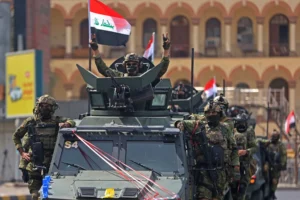


The ruling Shi’ite alliance in Iraq drafted a law to provide a legal shield for the Iraqi Popular Mobilization Forces (PMF). The latter faces pressure as a result of the geopolitical shifts in the region, namely the empowerment of Israel and the weakening of Iran, after the seventh of October 2023. The draft law faced a challenge both domestically and internationally. Within Iraq, Kurds and Sunnis were not in favor of the law. They were emboldened by open US objections. Reportedly, the U.S. Secretary of State Marco Rubio reiterated, during his call with the Iraqi PM, “serious U.S. concerns with the Popular Mobilization Commission (PMC) bill.” The government source clarified that the message included a clear warning about the sanctions, a position also conveyed by the American Chargé d’Affaires in Baghdad, Steven H. Fagin, during a meeting with an official of the Iraqi National Security Advisory. David Schenker, the former Assistant Secretary of State for Near Eastern Affairs, argued that “permanently enshrining Iran-backed terrorist groups inside the Iraqi state would be a massive blow to U.S. interests, so Washington’s reaction should be clear.”
These new developments resulted in the suspension of the efforts to pass the legislation. This failure of the Iraqi Shia elites and their backer, Iran, to pass the law that would have granted sweeping institutional powers to the PMF is seen as a shift in the region, especially as it is affecting not only Iraq but also Syria and Lebanon. Against this background, one may ask whether Militias in the Middle East (armed non-state actors more largely) are in decline? Especially as Hezbollah in Lebanon faces significant weakening and Kurdish guerillas in Turkey lay down their arms. I seek to reflect on this new development through a state framework approach. By this, I mean that the emergence of non-state actors and militias is dialectically intertwined with the state in the region. Accordingly, it is therefore difficult to grasp the nature, trajectory, and future of militias without understanding the types of states in the region.
First of all, it is assumed that both the militia and the states are modern phenomena, and not rooted in the region’s tradition. As Azmi Bishara argues, the origins of the military in the region can be traced to the Ottoman Janissaries:
They were prisoners and youngsters kidnapped from their families (in the European parts of the empire) who were provided with physical and military training and religious indoctrination in dedicated camps. Hence, people who were uprooted from their environment and trained mentally and physically to be soldiers with full loyalty to the Sultan.
However, it would be a mistake to attribute the emergence of armies and militias in the Middle East to this particular development. How did the empire fight before the Janissaries? And for that matter, were the Janissaries the only form of armed group in the empire? Obviously not. The tribal armed groups have long existed. For instance, within the Kurdish tribes and others, there was a system known as pshatamalla, as I was told by a number of local experts. A system in which each clan was required to contribute some fighters to the chief tribe, which in turn provided part of this armed contingent to the Sultan for campaigns. The existence of this form of non-state armed groups throughout centuries helped normalize their role in the region. This was further reinforced by chronic instability, which contributed to the persistence of the militia system, as Janet Klein argues in The Kurdish Militias in the Ottoman Tribal Zone[1].
Theoretically, when it comes to militia partnerships with states, there are generally two main approaches: the proxy warfare approach and the essentialist approach. In the proxy warfare[2] approach, states use a combination of diplomatic, military, and economic support to advance the state’s political objectives. While the essentialist approach, emphasizes that states back militias that share similar socially constructed identities, national, ideological, ethnic, or religious.
In the Middle East, the relationship between militia and states, as well as militias and anti-actors, are far more complicated and historically layered. First,states often create their own militias. Generally, Middle Eastern states are either run by family or the military, with exceptions such as Turkey, Iran, and Israel, however, the military remains central to state authority. The countries that are run by families, such as the Persian Gulf countries, often lack a strong local military and rely primarily on external protection and mainly from the U.S.. In republics such as Iraq, Syria, Lebanon, and Egypt, the prevalence of coup-based regimes has fused the military and the state into a form of symbiosis. In Iraq and Syria, these regimes gave rise to pro-state militias. In Baghdad during the 1960s, such groups were known as the Nation’s Guard. Initially affiliated with the Ba‘ath Party, they later evolved into government militias, wielding extensive authority and operating with impunity.
In 1963[3], my uncle was tied to a tank and killed simply because he had gone to fetch water from the river that afternoon. He was not the only victim that day. It is important to note that dragging bodies behind cars or tanks was a common form of punishment in Iraq, the most notorious instance being the public display of Prime Minister Nuri Sa‘id in 1958.
Militias typically abhor being labeled as such, often themselves instead as portraying defenders of the people, the nation, or the country. Therefore, the term”militia” carries a pejorative connotation within the Middle Eastern sociopolitical lexicon. This reflects the dynamics of the emergence of the modern political system, where features such as democracy, legitimacy, and the role of ordinary people are becoming more and more significant. Thus, the armed forces are increasingly concerned with projecting their image rather than merely serving as a tool in the hands of a leader. During the recent clashes in Sulaymaniyah, PUK president Bafel Talabani labeled his cousins’ faction a militia, thereby implying that they could legitimately be targeted and arrested.
From the above, it is clear that militias have a long history in the region and often seek to align themselves with the people rather than the state, as seen today with Iraq’s popular mobilization groups. Pro-state militias emerge as extensions of the state itself. As long as states in the region remain non-democratic, governed by clan-based systems, and characterized by instrumentalized, non-inclusive institutions, these patterns are likely to persist.
Over the past two decades, after the fall of Saddam Hussein, the military has morphed into militia structures, and family-based rule has pluralized, giving rise to private armies within the states. The necessity of paramilitary or militia emerges when ruling elites distrust the official army or need unofficial armed groups to break rules. Therefore, loyalty and the capacity for violence are central to state-built militias, which are often cheaper, more mobile, and less legally restrained than professional militaries. In addition to these, pro-state militias highlight the weakness of actors in the region, not only in Iraq and Syria but also in Turkey and Iran. As Evren Balta[4] puts it, the village guard system [in Turkey] is a sign of the actual weakness of the state.
Weak or troubled states not only create pro-state militias but also give rise to anti-state militias. Middle Eastern states, in general, exhibit what can be described as a Weberian paradox[5], i.e., although they aim to monopolize the legitimate use of force over territory and populations, they often fail to achieve effective control and struggle with legitimacy. Anti-state militias, in turn, rely on a deeply rooted culture of clan rule. Clans—among humanity’s oldest political organizations—may have evolved in the Middle East, but have not disappeared. They persist through institutional practices and customs that prevent societies from descending into Hobbesian chaos, as Mark Weiner notes.
The state cannot coexist with the clan and its structure; instead of being overtaken or destroyed, clans often opt to coexist with state structures. As a result, in the Middle East, the state and the clan have historically cohabited. The clan is a system of governance as well as an old institution and way of life. Every Middle Eastern state, to some extent, operates along clan lines. For example, the recent appointment of the Iraqi news ambassador was dominated by members and relatives of the ruling families. Such practices illustrate how resources, positions, and opportunities are distributed along kinship lines. In a clan-based system, blood feuds and mutual distrust become normalized, justifying individuals or groups to act according to clan logic. Clans typically do not form armies; they form militias.
This dynamic becomes particularly evident during crises, when clans and militias grow more powerful as states weaken. In these contexts, militias may adopt modern tools but remain guided by traditional ideals. Clan rule inherently conflicts with the rule of law, creating a reciprocal relationship: the clan shapes the state, and the state reinforces the clan—a Middle Eastern echo of Tilly’s famous dictum. However, unlike Tilly’s European example, where warfare unintentionally produced centralized state structures, clan governance has hindered the emergence of similar state consolidation in the region. Tilly’s framework emphasizes that states arose as unintended consequences of competition among coercive actors[6], with two key processes: first, warfare compelled political leaders to centralize control over coercive means and financial resources; second, it drove the creation of state apparatuses to administer these increasingly centralized instruments of power. In the Middle East, by contrast, the persistence of clans has complicated these processes, limiting the development of the state as envisioned in the European model.
Because of the persistence of clan structures and their modes of governance, Tilly’s framework does not fully apply to the Middle East. When the state itself operates as a clan, it fails to serve as an inclusive container for society as a whole. In this context, militias emerge to defend the interests of specific groups, whose members are bound by shared beliefs, cultural ties, and communal identities. Regional and international interventions have further reinforced this clan-based order and the fragmented nature of both society and state. For these internal reasons (clan structures and mentalities) and external factors (geopolitical manipulation), the region is unlikely to change unless one of these dynamics is radically transformed. Within such conditions, militias—whether pro-state or anti-state—are self-organizing entities that operate semi-or fully autonomously while remaining linked to, or in opposition to, regular state militaries. This produces not only a deregulation of military force but also an active delegation of the state’s coercive authority, amounting to a partial suspension of sovereignty itself.
I have developed the concept of Al-Ladaula (“non-state”) to capture the complexity of militia–state relations. In this framework, a wide variety of actors, both inside and outside the state system, coexist and interact. Beyond their access to arms, militias acquire enduring political and military significance by building popular bases and cultivating legitimacy. The persistence of militias and their incorporation into formal military structures reflects this reality. Reform efforts often fail precisely because they privilege an institutional approach while neglecting a sociological one. The institutional approach highlights two interconnected processes that can limit military interference in domestic affairs. First, political institutions and bureaucratic structures work to instill democratic norms and professional values within the military, ensuring its loyalty to the state rather than to any individual or political faction. Second, as the military becomes more professionalized, this process, in turn, reinforces the authority and stability of these political institutions and bureaucratic bodies, creating a mutually reinforcing cycle that helps maintain civilian control. While the institutional approach emphasizes formal structures, the sociological category highlights its limitations and explores new ways of understanding civilian control, including its constraints and facilitators. It argues that institutions alone cannot ensure effective oversight without accounting for the sociological aspects influencing civil–military relations.
From the foregoing, we may deduce that it would be hard to envision the Middle East’s militias becoming extinct as long as armed and state organizations are established inside clan culture and use militia and state to strengthen that structure. According to the above-mentioned, militias may not necessarily disappear as a result of political and geopolitical pressures that develop against certain groups, particularly if states and political parties become more focused on family and clan. Like the Iraqi state, which is Shia, the new Syrian state is pro-Sunni. They are not so much an individual liberal state as they are a clan state. They are thus not based on institution and the rule of law. Such a state creates its own militia, which in turn forces other communities to do the same, as we witness in Syria.
As long as there are no signs that the states in the region are shifting toward inclusive, transparent, and democratic governance, militias—both pro- and anti-state—will continue to exist. They would also be exploited by the outsiders. Furthermore, the current state-society relationship dynamics, particularly in the West, as Andrew Mumford argues, such as the decline in public and political support for large-scale counter-insurgency “quagmires” against the backdrop of a global recession, the growing significance of Private Military Companies (PMCs) in modern warfare, the growing use of cyberspace as a platform for indirect warfighting, and the rise of China as a superpower, may encourage states to employ proxy tactics. Militias might rise and fall based on many factors. But it is hard to see the Middle East without the militia.
Notes
[1] Janet Klein. The Margins of Empire: Kurdish Militias in the Ottoman Tribal Zone. Sandford UP. 2011
[2] Navin Bapat, A. “Understanding State Sponsorship of Militant Groups.” British Journal of Political Science Vol. 42. 2011
[3] Batatu, Hannah. The Old Social Classes and the Revolutionary Movements of Iraq, Princeton University Press, 1979.pp. 1011-1012.
[4] Evren Balta, the village guard system. In The Routledge Handbook of Turkish Politics. 2019 Routledge.
[5] Andreas Anter, the Modern State and Its Monopoly on Violence. 2019. In the Oxford Handbook of Max Weber. Edith Hanke (ed.), Lawrence Scaff (ed.), Sam Whimster (ed)
[6] Anna Leander. Wars and the un-making of states: Taking Tilly seriously in the contemporary world in Contemporary Security Analysis and Copenhagen Peace Research. 2003. Routledge