


One of the defining features of the modern Middle East is the influence, not only of external actors, but also of individuals who played decisive roles (directly and indirectly) in shaping the region’s map. While Tom Barrack shares certain traits with these influential figures, he also differs from them in many ways.
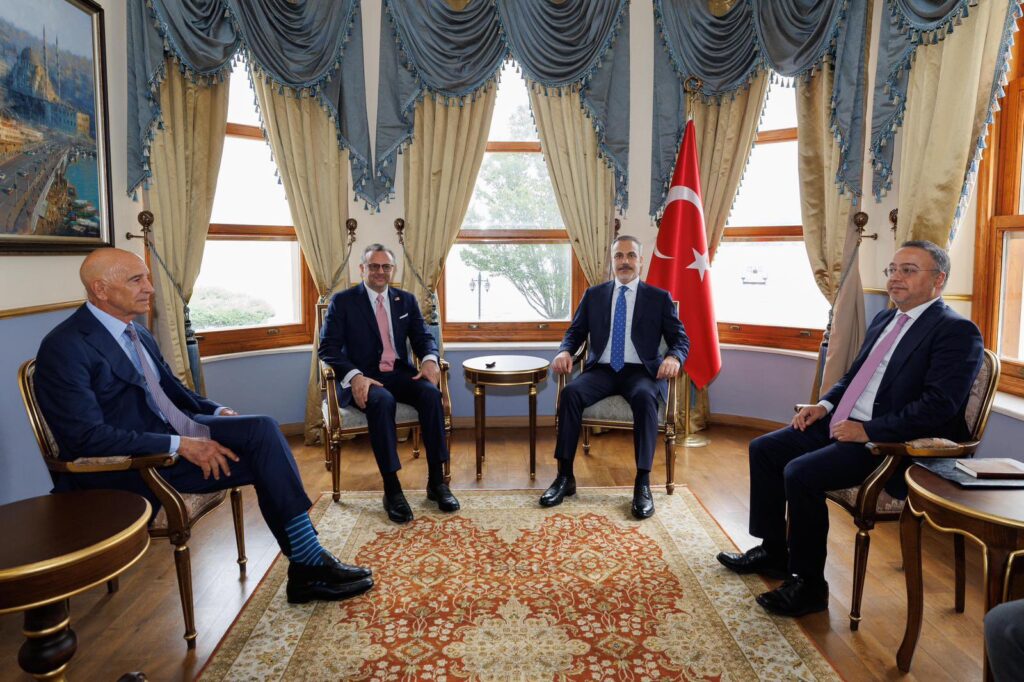
President Trump nominated Tom Barrack to serve as the U.S. Ambassador to the Republic of Türkiye in March 2025 and confirmed by the Senate in April 2025. He later became the Special Envoy for Syria and Lebanon. Today, Ambassador Thomas J. Barrack is a ubiquitous figure in the Middle East. Unlike most diplomats, he appears on television, meets officials in multiple countries, tweets regularly, and travels extensively throughout the region. He is not a career diplomat; his appointment rests largely on a 40-year friendship with the U.S. president. In his frequent public engagements, Barrack avoids the conventional language of diplomacy. He addresses historical and controversial topics and often presents himself as a local insider. This profile seeks to understand this atypical diplomat and his influence in a critical moment for the region. His informal approach resonates differently with various stakeholders, fostering both trust and skepticism. As he navigates complex political landscapes, his approach offers opportunities and challenges for U.S. foreign relations.
Drawing on Bertrand Badie’s A Subjective Approach to International Relations, we view other actors as products of their cultural contexts and political traditions–shaped by narratives, memories and emotions. Understanding Tom Barrack requires understanding his origin, his worldview, and how he perceives himself in relation to the world.
A Diplomat Unlike Others
In modern Middle Eastern history, many Western diplomats who played a significant role in shaping the region were escaping personal difficulties at home. This circumstance applies to figures like Mark Sykes–scarred by an appalling childhood–and to recent U.S. envoy Brett McGurk, who described a fractured relationship with his alcoholic father. For them, the high-intensity life of “war zones, foreign capitals, the White House, and the State Department” was partly an escape. Thomas Barrack’s trajectory is different. He may have “escaped” to the East–he may have returned to it. In the mythic tradition of the hero’s homecoming, the journey ends with a return.”[1]
However, in the myth, the return home usually marks the end of the hero’s adventure. For Tom Barrack, however, the journey begins only after his arrival. In this sense he is a homecoming figure–but one for whom homecoming is inevitably tragic, because the home that exists in memory no longer exists in reality. One can return close to the place of origin, yet the origin itself is gone. To understand this paradox, we must look back to his family’s early departure from the Levant.
When Barrack’s family left the Levant in the late nineteenth century, the modern Middle East as we know it had not yet taken shape. It was part of the Levantine province of the Ottoman Empire. His family lived in the Mount Lebanon Mutasarrifate, a political subdivision of Greater Syria. As he puts it, “My grandfather went to America in the early 1900s with an Ottoman passport and 13 liras in his pocket.”
He made this remark on a hot summer day in Izmir in Turkey, speaking in the manner of an immigrant revisiting ancestral ground. Yet, the “home” he encountered was fundamentally different; its political structures, identity, and sense of belonging had all changed. The home of his family belonged to an empire that no longer exists. Strikingly, Barrack still harbors a fascination with that Ottoman past and entertains the idea of its viability as a model. Formally, after his family arrived in America, his grandfather was registered as a “Turk”.[2]
Reflecting on his father’s journey, he said, “All of us in the world want the same thing; we want a better life for our children, and we want hope.” This is a classic migrant mantra–an attempt to leave the past behind and place trust in the future. Yet, such an immigrant outlook may conflict with the mindset of much of the Middle East, where there is often a reluctance to part or to face the future with optimism.
When elaborating further, Barrack remarked, “To me, Izmir is the example of how you blend all of these communities. Where you have Jews living side by side with Muslims, living side by side with Christians.” Here, it becomes clear that his perspective is more imperial than migrant. What is an integrin? It is that Izmir is not an ordinary city, neither in the past nor in the present. During the Ottoman period, it was known as Gavu İzmir (Infidel İzmir), a cosmopolitan port city inhabited by diverse communities and home to a significant international diplomatic presence. Geographically and socially, it differs even from Istanbul. Izmir’s Jewish and Christian histories stretch back millennia; the Roman orator Cicero mentioned the Jewish community in the region. Choosing this city as a backdrop–walking through its market accompanied by Turkish state broadcaster TRT– was a highly choreographed gesture. Barrack was deliberately invoking Ottoman nostalgia to make a statement about the present Middle East. In fact, he seems amused by the idea of considering himself an Ottoman subject.
When he arrived at the airport, he made an emotional declaration: “I think it’s a really monumental day for me, feeling the echo of this land from which my ancestors came. The taste, the sound, the vibrations, and the aspirations of hope that both nations have for each other. And I’m so honored to have the DNA of the great region with the liberty, peace, and prosperity of America to allow me to come.”
This homecoming sentiment makes Barrack vulnerable to what John Bolton–writing in The Room Where it Happened [3], about former U.S. Ambassador to Turkey Jim Jeffrey–described as a “clear warning signs of an advanced case of ‘clientitis,’” a State Department afliction in which the foreign perspective becomes more important than that of the US. In Barrack’s case, the mixture of imperial nostalgia, migrant worldview, and billionaire status in the Trump era makes him a very different diplomat from his predecessors.
Ambassador of a Different America
The fact that Barrack is an ambassador is a sign that America is no longer the same country. The Trump administration, while centered around Donald Trump’s personality, was far from monolithic. One can think of it as a spectrum, including nativists, represented by Vice President JD Vance, who promote a family-tribe-nation ethos similar to the ideas of Israeli political theorist Yoram Hazony in his book The Virtue of Nationalism. Another faction, the white-blue-collar nationalists, was led by figures like Steve Bannon, who opposed tech billionaires, viewing them as globalists rather than nationalists. Critics have dubbed this divide the MAGA and Big Tech Divide. Perhaps the most distinctive feature of the current administration was the number of billionaires in its ranks; having a net worth in billion was practically a qualification for office, as Timothy Noah observed.
It was, in effect, a “parliament of billionaires”. Donald Trump himself was the first billionaire to serve as U.S. president. Barrack comes from this ecosystem. He is not just a billionaire but a close friend of Trump. At a 2016 event in Cleveland, Barrack told the crowd, “I’m here because Donald Trump has been one of my closest friends for 40 years.” Friendship, business, and politics are the holy trinity of this demonstration.
As an ambassador, Barrack rejected the old style of military intervention and nation-building. Instead, his process began with establishing security and stability, followed by developing government systems and ultimately fostering enterprise and prosperity, an approach he explained to a Damascus business group.
No Shortage of Critics
Criticism of Tom Barrack comes from across the political spectrum. Even among Trump allies, in Washington, including some in the MAGA movement, he attracts strong opposition, MAGA influencer, Laura Loomer declared: “His [Barack’s] appointment to high-level diplomatic posts is alarming, given that his primary expertise lies in leveraging political connections for financial gain” later adding: “For the sake of US national security, Tom Barrack should face immediate removal from his diplomatic roles.” Right-wing broadcaster Mark Levin voiced similar concerns.
Former National Security Advisor John Bolton criticized Barrack for “publicly making excuses for al-Sharaa’s reluctance to open full diplomatic relations with Israel. It is not generally a US ambassador’s job to justify another country’s actions.” In Washington, the Israeli, Greek, and American lobbies have opposed Barrack’s action in the region. Inside Turkey, while the Erdoğan government has welcomed him, the Turkish opposition has been far less kind. When Barrack referenced the Ottoman millet system during his Izmir visit, secular Turkish nationalists reacted sharply. As columnist Arslan Bulut wrote in Yeniçağ: “Osmanlı’nın millet sistemi’ (Ottoman Millet System) might end the Turkish nation and Turkish secular state”.
The strongest criticism comes from the Syrian minorities, such as the Druze and Kurds. At the core of their objections is Barrack’s opposition to federalism and decentralization in Syria, in favor of a strong centralized state–mirroring the stance of the current interim government. Speaking to Rudaw TV Channel he stated that “the difficulty is, in all of these countries, what we’ve learned is federalism doesn’t work, you can’t have independent non-nation states within a nation.” The wording is telling. Barrack uses the term “non-nation state” for Kurds and other minorities within Syria and Iraq–classifying them as communities rather than nations, thereby denying them the right to independence or even federal self-rule.
At first glance, this seems paradoxical. In Izmir, Barrack praised the Ottoman millet system, which preserved diversity within an imperial framework; in Damascus, he supported a strong nation-state that suppresses such diversity. The former is an imperial feature, the latter a nation-state one. The latter’s drive for manufactured unity–often through violence-is a major reason for the failure of modern Middle Eastern states. It was the nation-state model that replaced Ottoman imperialism, in part through the machinations of European powers and figures like Lawrence of Arabia. In fact, for many in the region, Tom Barrack is embodying ‘the ghost of Lawrence.’
Where is He Heading?
Barrack strives for charisma. He appears frequently in the media, expresses emotion openly, revives provocative historical concepts, and often issues clarifications to his remarks. His style reflects his background and ecosystem. As Syrian expert Fabrice Balanche has said, “Tom Barrack is just a small Trump.”
Like Trump, Barrack relies on personal connections, downplays institutions, and leverages relationships with both Trump and Gulf elites—particularly his close ties to Erdoğan—to bypass political realities. This approach is undemocratic and dismissive of ordinary people in the region, perpetuating a chronic problem in Middle Eastern politics. It also aligns with current U.S. policy, as a leaked State Department cable instructed diplomats to avoid commenting on the “fairness or integrity” of foreign elections. Barrack operates in contradictions. He claims non-interference while pressuring local actors in Syria and Lebanon. He criticizes, supports, and influences different sides in pursuit of a clear goal aligned with certain regional powers, notably Turkey and Gulf states. Recently, he has adopted the role of “mediator”.
Yet despite Barrack’s hyperactivity, the U.S. lacks a coherent vision for the Middle East. For the first time, America is a participant in regional projects rather than their leader. The central unresolved question is Syria’s future: will it become a strong centralized state—backed financially by the Gulf and militarily by Turkey—at the expense of minorities and much of the population? Or will it transform into a democratic, decentralized state, reminiscent of an America that once sought to promote democracy abroad?
The longer Barrack serves, the more he learns that there is little real connection between the region’s ruling elites and its majority populations. Any attempt to “fix” the Middle East, he may find, will be temporary and likely bloody. In avoiding reality, Barrack risks becoming quixotic rather than visionary—and may eventually confront the truth that the reality will remain, regardless of his ambitions.
Notes
[1] Joseph Campbell, The Hero with a Thousand Faces, Princeton, 2004.
[2] Sarah M. A. Gualtieri, Between Arab and White: Race and Ethnicity in the Early Syrian American Diaspora, Berkeley: University of California Press, 2009
[3] John Bolton, The Room Where It Happened: A White House Memoir, Simon & Schuster, 2020.