


Despite the upheaval and uncertainty surrounding the recent “12-Day War” between Iran and Israel, a central question remains: why did neither the United States (U.S.) nor Israel adopt regime change in Iran as an explicit objective, despite widespread expectations to the contrary? This analysis addresses that question. Since the Islamic Republic’s establishment in 1979, the 12-Day War arguably ranks among the most consequential episodes to create, even if only marginally, conditions under which the theocratic state could be closer to collapse. In the lead-up to and during the crisis, public debate frequently invoked the prospect of regime change. Yet it became obvious that, at least for now, toppling the ruling order was not the operative policy. A combination of global, regional, and domestic U.S. political constraints; escalation-management concerns; alliance politics; and broader geopolitical risk calculations led Washington and Tel Aviv to refrain from pursuing that objective.
At present, it appears that the U.S. and to some extent, Israel, do not seek regime change. Rather, they aim to alter the regime’s behavior and actions by limiting Iran’s capabilities. More precisely, Iran’s power is to be reduced in three specific domains so that, if its conduct does not change, its capabilities will be so constrained that it can be more easily contained. These domains are limiting the operational scope of its proxy networks, reducing its missile capabilities, and delaying its capacity to produce nuclear weapons.
A Shift in U.S. Strategy
If, in the past, U.S. policy toward engaging with other states, such as the intervention and control of Afghanistan and Iraq, was shaped by the pursuit of American economic and geopolitical interests through military intervention and nation-building, today President Donald Trump has adopted different tools and methods: transactional diplomacy, maximum pressure and sanctions. Trump does not act like Republican George W. Bush, who pursued regime change through military force, nor like Democrat Barack Obama, who sought to advance policies and influence through the promotion of American ideals. There is thus a fundamental difference between Trump’s America and the America of previous presidents, whether Republican or Democrat.
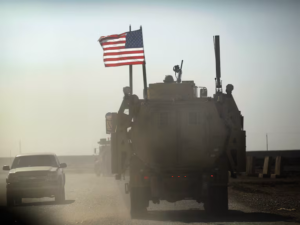
Following the setbacks in Afghanistan, Iraq, and Libya, U.S. policy in the Middle East has shifted toward a “no boots on the ground” approach. This policy reflects a general American stance against deploying U.S. troops directly into wars and conflicts. It is intended to reassure the American public that the country will not again commit itself to extensive military engagements, particularly in the types of prolonged conflicts Trump has repeatedly referred to as “endless wars.” This marks a fundamental change in the philosophy of U.S. foreign policy. Washington’s support for the Kurds in Syria, deploying only a small number of troops while relying on local forces, such as the Syrian Democratic Forces, to fight and dismantle ISIS from 2014 to the present, represents a clear expression and implementation of this new strategic underpinning.
At the same time, American policymakers believed that any attempt to topple the Iranian regime could turn into yet another costly quagmire akin to Vietnam, 1955–1975; Iraq, 2003–2011 or Afghanistan, 2001–2021, from which withdrawal would be extraordinarily difficult. This is especially the case because, in comparison with all those other countries, Iran’s size, composition, topography, geography, demographics, and historical complexity make it far more challenging. Added to this is the fact that Iran is embedded within a dense network of strategic partnerships with a number of states, such as China, Russia, and India, some of which are staunch opponents of U.S. hegemony.
Moreover, Trump, as the leader of the “Make America Great Again” (MAGA) movement, whose electoral victory was heavily supported by this bloc, aligns himself with a powerful interest group that seem to be not in favor of foreign interventions. Both before and during the war, MAGA-aligned actors repeatedly voiced opposition to regime change in Iran and to direct U.S. military involvement there.
An eye on the Nobel Peace Prize
Trump’s actions and rhetoric suggest that he wishes to position himself as a candidate for the Nobel Peace Prize. In this presidential term, he seeks to present himself as a “peacemaker,’’ending wars rather than starting new ones. This aspiration, however, largely originated from Trump himself as early as 2018, when he told reporters “everyone” thought he deserved a Nobel for North Korea diplomacy and rallies chanted “Nobel” during that period. He often framed the prize as unfairly awarded to Obama in 2009 and claimed bias against himself, remarks he repeated over the years. The case he made for himself centered first on North Korea and later the Abraham Accords, which the White House itself highlighted when publicizing his 2021 nomination. In addition, this was a central promise of his election campaigns, and he is now actively pursuing an end to the war in Ukraine while also pledging to bring the Gaza conflict to a close. Previously, he claimed to have played a key role in ending the final phase of the war between India and Pakistan, while also asserting that he was instrumental in resolving the internal conflict in Congo, with Rwanda’s indirect involvement. If Trump’s peacemaking role in these various conflicts was at times more rhetorical than substantive, it was nonetheless under his auspices that a peace agreement between Armenia and Azerbaijan was publicly signed in the White House. On that occasion, the Prime Minister of Armenia and the President of Azerbaijan jointly announced that they would submit an official appeal to the Nobel Peace Prize committee, formally nominating President Trump for the award.
It appears that Trump has his eye on the Nobel Peace Prize, a point he has openly mentioned on several occasions. From that perspective, the outbreak of a new regional war would run counter to the very initiatives and policies he claims to champion.
The Strategy of Power Balancing in the Middle East
The reasons behind Washington’s decision not to pursue regime change in Iran extend beyond U.S. domestic politics and Trump’s personal preferences. They also relate to the broader strategic goal of maintaining a balance of power in the Middle East, a factor arguably more significant than any previously discussed. U.S. policymakers appear to have concluded that preserving a regional balance of power, and thereby safeguarding American and allied interests, requires an Iran that is neither so strong as to become defiant nor so weak as to eliminate the dependence of Saudi Arabia and the Gulf states on U.S. protection. This means both preserving U.S. strategic interests and maintaining the equilibrium between Sunni and Shia powers in the region. The overthrow of Saddam Hussein’s regime in Baghdad in 2003 disrupted this balance for years, strengthening Iran in ways that created serious challenges for both Gulf Arab states and Israel. By weakening, rather than toppling, the Iranian regime, the balance could be restored to a more favorable state.
From another angle, Turkey poses its own strategic complications in the region. It appears that the U.S. recognizes that removing Iran’s Islamic Republic would primarily benefit Turkey, just as Ankara gained strategically from the collapse of Bashar al-Assad’s regime in late 2024. The fall of Iran’s current government would grant Turkey greater direct or indirect strategic depth through its “linguistic kin” in Azerbaijan. This scenario would alarm both American and Israeli policymakers, who are already concerned about Turkey’s assertive role in Libya, the Horn of Africa, the Caucasus, and the Middle East.
The Turkish advantage aside, a collapsed Iranian regime would leave Iran fragmented and fragile, if not a complete failed state. In such instability, the U.S. might feel compelled to intervene to prevent Russia, China, or Turkey from gaining excessive influence, potentially through direct or indirect support for one of Iran’s internal factions, such as the Kurds, Arabs, or Baluchis, or some coalition of them. Such an undertaking would entail significant military and financial costs, exactly the type of burden the U.S. has sought to avoid recently.
Another layer of this equation is the E3’s “snapback” mechanism, a provision under the 2015 nuclear deal (JCPOA) that allows the automatic reimposition of United Nations and European Union (EU) sanctions should Iran violate its commitments. In August 2025, France, Germany, and the United Kingdom invoked this clause, leading to the full reinstatement of EU nuclear-related sanctions on Iran. The move revived sweeping restrictions on trade, finance, and energy, reflecting Europe’s preference for legal enforcement over direct confrontation and further reinforcing Washington’s calculated caution in avoiding regime-change rhetoric.
Terrorism and Migration
Moreover, the collapse of the Iranian regime would likely produce scenarios similar to those seen earlier in Syria, Iraq, and Libya: in the absence or weakness of a central government, extremist and terrorist groups may resurge as ISIS did in Syria and al-Qaeda in Iraq. Such instability, characterized by the reemergence of violent actors and intensified sectarian and ethnic conflict, could directly undermine the political, economic, and commercial environment that both Trump and Gulf states such as Saudi Arabia and the UAE seek to cultivate for large-scale investment projects, such as those agreed upon during Trump’s last visits to the region. Only a few months before the escalation of tensions with Iran, Trump announced investment agreements worth over a trillion dollars with Saudi Arabia, Qatar, and the UAE, projects that require a stable and secure Middle East, not one mired in war.
From a humanitarian and international relations perspective, the regime’s collapse could almost certainly trigger a major refugee crisis. As in Syria, large numbers of people could be expected to flee toward Europe, the U.S., and Australia. Such a development would be politically untenable for many countries already struggling with migration management. This factor becomes even more significant when considered in light of the recent rise and strengthening of right-wing parties and movements in Europe and the U.S.
Geopolitical Implications
As noted earlier, regime collapse in Iran would ignite uprisings among its subjugated ethnic groups. In such a scenario, Iran would fragment into several parts: Azerbaijan would come under Turkish influence; Kurdistan, Khuzestan, and Baluchistan would fall under U.S. sway; and the central region, largely inhabited by Persian Iranians, would remain. However, there would be a high probability that this Persian-dominated core could come under Russian or Chinese control; or both.
From Washington’s perspective, it might be acceptable for Kurdistan, Khuzestan, and Baluchistan to fall under U.S. influence, particularly given these regions contain much of Iran’s oil and gas reserves and hold significant geostrategic value. Yet it should not be forgotten that these ethnic groups lack the military capacity to defend their territories against Persians or Azeris. Consequently, the U.S. would need to provide them with protection, an undertaking that would involve extensive political and economic commitment, running counter to the preferences of Trump and the MAGA movement.
In short, for these reasons, the new U.S. policy of avoiding military intervention and regime change; the strategic imperative of maintaining the regional balance of power while keeping Iran intact but contained; the persistent instability and terrorist threats that have emerged across the region in recent decades; the economic interests that demand less, not more, conflict in the Middle East; the risk that regime change would open Iran to greater Russian and Chinese influence; and the likelihood of a new refugee crisis, the U.S. is unlikely to seek regime change in Iran, at least in the foreseeable future.