

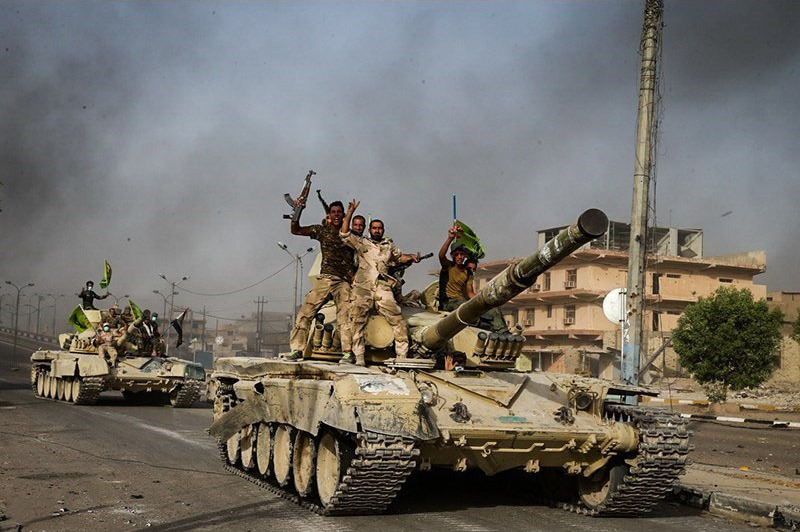

As the legislative elections approach, debates on the future of the Iraqi state resurface around the role of the Popular Mobilization Forces (PMF / Hashd al-Shaabi) and their ability to redraw the boundary between state and non-state power in post-2014 Iraq. Understanding their nature is essential to grasp the pressures weighing on their existence and legitimacy in a pre-electoral context. Placed at the center of a tug-of-war between foreign interference, primarily American, in the name of Iraqi sovereignty, and internal polarization between supporters and opponents of the Islamic Republic, the PMF crystallize a major political deadlock.
It is impossible to understand the Iraqi state without addressing the complexity of this organization: born out of popular mobilization, marked by a heterogeneous composition, and partly shaped by Iranian influence, it operates in an institutional grey zone between formal and informal, licit and illicit. Recognized de jure by the state but acting de facto as a semi-official institution, the PMF present themselves as guarantors of national sovereignty while maintaining autonomy that allows it to operate on the margins of state circuits. Frequently described as “hybrid” actors, they challenge the relevance of a Weberian[1] and Westphalian[2] conception of the state, one founded on the exclusive monopoly of violence, which struggles to capture the fragmented and pluralistic governance characteristic of contemporary Iraq.
Although the Iranian “Axis of Resistance” has been weakened since the regional escalation linked to October 7, 2023, Iraqi militias affiliated with Tehran remain intact and have shown restraint in the face of regional tensions. Yet their legitimacy, through the redefinition of their institutional status, has returned to the spotlight, under American pressure and in an electoral context, illustrating their deep entrenchment in the structures of the Iraqi state.
A Hybrid Background
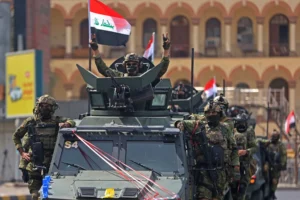
The popular genesis of the PMF, combined with the blessing of Grand Ayatollah Sistani in 2014 and their victory over the Islamic State in 2017 alongside American forces, has made them a lasting component of Iraq’s security, political, economic, and social landscape. Although they were dominated from the beginning by Shiite factions linked to Iran, they also include Sunni, Christian, Kurdish, Yazidi, and Turkmen factions. Before 2003, the Iraqi security sector was already fragmented: Saddam Hussein had established parallel forces and delegated sovereign prerogatives to tribes. The American invasion and the dismantling of the regular army deepened this dynamic, consolidating a militia-based order. As early as 2005–2007, groups such as the Mahdi Army or the Badr Organization were already operating within state institutions, supported by regular and foreign forces. This context laid the foundation for the emergence of the PMF and showed that the state/non-state distinction is insufficient to understand Iraqi security dynamics.
Institutionalization through Law No. 40 of 2016, which created the Popular Mobilization Commission as an official body directly attached to the Prime Minister rather than the Ministries of Defense or Interior, confirmed their anchoring within the state while formalizing their autonomy. The law established the PMF as an independent armed entity, legal but not absorbed, having its own budget, distinct administration, and autonomous command. This ambiguity allows them to retain parallel structures and close ideological ties with Iran. Several units operate according to internal or transnational political logics, preventing the establishment of a unified chain of command. In some areas, they issue their own administrative authorizations and are sometimes perceived as more effective than the local administration.
Having an internal organization similar to a state military apparatus (structured brigades, official uniforms, military justice and disciplinary system), they are now seeking specific legislation guaranteeing them the same statutory and financial benefits as the regular armed forces.
2024 Draft Law on the Authority of the PMF
A controversial draft law introduced in 2024 to amend Law No. 40 of 2016 was postponed in August 2025 to the next parliamentary session, under American pressure and due to internal divisions (Shiite blocs in favor, Kurdish and Sunni blocs opposed). In a tense regional and pre-electoral context, this postponement leaves it to the next Parliament and government to decide its fate. Comprising 17 articles, the text seeks to restructure the PMF hierarchy within the state apparatus, expand their legal and executive prerogatives, create new directorates and their own military academy, and grant competitive advantages to the Muhandis General Company[3], linked to the PMF. It would enshrine them as a permanent institution endowed with formalized structures, responsibilities, and privileges.
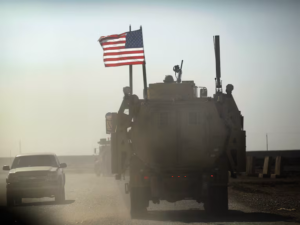
Its supporters, including Prime Minister al-Sudani, argue that dismantlement is unrealistic and that legal integration would enhance transparency and state oversight. Its opponents, mainly Washington, see instead the consolidation of a parallel army modeled on Iran’s Islamic Revolutionary Guard Corps (IRGC), ultimately impossible to reform. The U.S. has threatened financial sanctions, suspension of security cooperation, and an accelerated withdrawal of its remaining 2,500 troops before 2026 if the law is passed; these threats follow a series of warnings from American officials expressing concern over the strengthening of Iranian influence and an erosion of Iraqi sovereignty. The postponement thus reflects al-Sudani’s caution, as he seeks to balance internal political dynamics and external constraints as the elections approach.
Threat of Disqualification of PMF-Linked Electoral Formations
Washington’s current firm position against the influence of armed groups tied to Tehran and their political allies raises questions about the future of the Coordination Framework[4]: either a resurgence or the reconstitution of another bloc to maintain the dominance of Shiite parties and militias in power after the elections. Intensified U.S. pressure could even extend to the non-recognition of election results and a refusal to cooperate with any government that includes the PMF.
In this context, the Federal Supreme Court, the Independent High Electoral Commission (IHEC), and the Directorate of Political Parties and Organizations have received an unprecedented complaint filed by civil society organizations, aiming to exclude twelve electoral formations accused of being the political arms of armed factions, including the Badr Organization, Asaib Ahl al-Haq (AAH), the Babylon Movement (al-Haraka al-Babiliyya), the Imam Ali Brigades, and Kataib Sayyid al-Shuhada (KSS). The legal framework rests on several texts: the Constitution (art. 9.I.b), which prohibits the formation of militias outside the armed forces and can be invoked to argue that a political party cannot maintain an armed wing, the constitutional logic forbidding the militarization of the political sphere; Law No. 36 of 2015 on political parties, which prohibits any party from having or being affiliated with a military or paramilitary organization (art. 8.1), and from receiving material or organizational support from armed groups (art. 32); and Law No. 40 of 2016, which reaffirms that PMF members must renounce any political affiliation.
In practice, these provisions are easily circumvented through the creation of distinct political wings, allowing the main Shiite militias integrated into the PMF to participate in elections, sit in Parliament, and access government. Three pro-Iranian armed factions dominate: the Badr Organization (whose political wing bears the same name), Asaib Ahl al-Haq (AAH, represented by the Sadiqoun Bloc), and Kataib Hezbollah (KH, represented by the Hoquq Movement). Together they form the backbone of the Shiite Coordination Framework, led by Faleh al-Fayyadh and allied with Nouri al-Maliki. This parliamentary bloc, considered the unifying instrument of the parties affiliated with the main pro-Iranian militias, possesses significant institutional blocking power, mobilized to defend its interests and prevent any meaningful security sector reform. After the withdrawal of Moqtada al-Sadr in 2022, the Coordination Framework consolidated its control and supported the appointment of Mohammed Shia’ al-Sudani as Prime Minister, considered favorable to its interests. Since their participation in the 2018 elections through the Fatah Alliance, the PMF have established themselves as institutional political actors, integrated into the parliamentary and governmental arena, anchoring their strategy within a fragmented state apparatus dominated by clientelism.
Recent Designation on the Terrorist Organizations List
In mid-September 2025, the U.S. added four additional pro-Iranian groups to the list of Foreign Terrorist Organizations (FTO): Harakat al-Nujaba, Kataib Sayyid al-Shuhada, Harakat Ansar Allah al-Awfiya, and Kataib al-Imam Ali. This move forms part of Washington’s “maximum pressure” campaign against Iran and its allies, aimed at reducing the influence of its affiliated militias in Iraq. These factions had already been listed since 2018 as Specially Designated Global Terrorists (SDGT). Kataib Hezbollah was designated an FTO as early as 2009, and Asaib Ahl al-Haqin 2020. Until today, only the Badr Organization, the oldest Iraqi Shiite faction, born in the 1980s during the Iran-Iraq war and historically tied to the IRGC, has not yet been officially designated as an FTO by the U.S. In line with pressures to block the reform of Law No. 40 on the PMF, this measure seeks to limit the institutional expansion of the militias and sends a clear signal to Iraqi elites: U.S. cooperation will remain conditional on strict limits imposed on the political and security role of these groups.
Conclusion
The timeline of these events suggests that the coming elections could turn into a referendum on the future of non-state armed groups, particularly the PMF: on one side, those advocating for their complete disarmament in favor of a centralized state; on the other, those who view them as an integral part of Shiite identity and Iraq’s politico-security structure. The distinction between state and non-state actors, inherited from a Weberian and Westphalian reading that associates the state to the exclusive monopoly of violence, loses its relevance in the case of the PMF, where the boundaries between institutions, parties, and militias are structurally blurred. The hybridity they embody, rooted in state failures, cannot be reduced to anarchy: rather, it constitutes a functional mode of organization that provides security, regulation, and even public services. Recognized de jureby the state but operating de facto as part of the state apparatus, they command an administration, a budget, and structures similar to those of an official military body, while presenting themselves as defenders of the post-2003 political system against threats ranging from ISIS to popular uprisings. To categorize them merely as militias or hybrid actors obscures their real role in Iraqi governance.
In Western narratives on Iraq as a “fragile” or “failed” state, the PMF are too often seen solely as threats to be neutralized, rarely as governance actors capable of contributing to peace. While their power certainly needs to be regulated, it is essential to include them in political processes. They are neither external actors nor simple instruments of Iranian influence, but multidimensional networks, military, political, and economic, integrated into the state apparatus.
Their existence thus challenges the limits of the “hybrid actor” concept, which artificially separates the state from society. This framework, adopted by many researchers and Western policymakers, ratifies a binary logic between state and non-state that does not reflect the Iraqi reality, where official and informal spheres are deeply intertwined and interdependent within a state engaged in a process of structural hybridization. This context opens the way for a hedging[5] mechanism: externally, by balancing American pressures with Iranian expectations; internally, by maintaining balancing between official institutions, militias, and religious authorities.
Notes
[1] A Weberian conception of the state defines it as holding the legitimate monopoly on physical violence over a given territory, which constitutes the very condition of its sovereignty.
[2] A Westphalian conception associates the state with external sovereignty, encompassing the legal equality of states and the principle of non-interference in their internal affairs.
[3] The Muhandis General Company, created in 2023 primarily with public assets and attached to the PMF Commission, has a broad economic mandate covering construction, engineering, agriculture, industry, and mechanical contracts, while bypassing standard contracting procedures. Linked to the PMF, it reminds one of Khatam al-Anbia, the IRGC’s economic conglomerate.
[4] An alliance of Shiite parties formed in October 2021 after the disputed legislative elections, which plans to reunify after the elections scheduled for November 11, 2025.
[5] Hedging, as conceptualized by Cheng-Chwee Kuik, refers to a mechanism aimed at avoiding exclusive alignment by combining engagement and counterbalancing vis-à-vis rival powers, in order to preserve room for maneuver. In the Iraqi case, it refers to balancing U.S. pressures with Iranian expectations.