


[Lyna Ouandjeli] My first question is pretty broad: to what extent could Israel’s growing diplomatic isolation, particularly in Western Europe, influence the evolution of the Israeli-Palestinian conflict in the short and medium term? By diplomatic isolation, I mean in particular the recent recognition of the Palestinian state by several countries like Ireland and Spain, as well as growing criticism regarding acts of abuse committed by Israel in Gaza, often perceived as international humanitarian law and human rights violations.
[Rony Brauman] I would start by stating that the term “diplomatic isolation” seems inappropriate to me, although I understand what you mean by that. I would rather speak of Israel’s weakening on the international scene, as well as growing unease in a number of Western chancelleries. The latter are increasingly aware that they are supporting a country that is methodically and repeatedly violating international law and human rights, fundamental principles for Europe’s legitimacy, credibility, and political existence. You are right to ask this question. The recognition of the Palestinian state, or at least recognition projects, as some have recently announced, undoubtedly constitutes a positive signal. There is, nevertheless, a need for caution: nothing is guaranteed, and we will need to see what emerges from it in concrete terms, during the discussions set in June at the UN, for instance[1]. It is still hypothetical, but it remains an encouraging sign. That being said, it is clear that without constant international pressure, there will be no significant progress in Israel and in Palestine. For now, this pressure remains timid, but we can see the beginnings of it. The major issue, however, is that these diplomatic developments have been of no consequence for the Palestinians. They are being bombed, locked up, starved, persecuted, expelled, and killed. Today, what characterises the situation in Palestine is first and foremost the worsening rather than easing of the Israeli occupation. That being said, it is still important to highlight that we are witnessing the premise of an evolution, a fragile one, but one potentially carrying hope.
Lyna: Indeed. That can be seen with the announcement of an upcoming conference on the Israel-Palestine question, jointly organised by France and Saudi Arabia. During his visit to Egypt[2], President Macron also raised the possibility of France recognising the Palestinian state in June. We will obviously need to see how this will develop in concrete terms, but as you have highlighted, stability in the region is inconceivable without a sustainable resolution of this conflict, a resolution that will ultimately require the recognition of a Palestinian state. In a context where international humanitarian law violations are persistent, what role can the UN, the International Criminal Court (ICC) or other multilateral entities still play? And to go further: do you think international law as it is today needs to be adjusted to function more effectively and allow the sanctioning of political officials like the Israeli Prime Minister, Minister of Defence or Minister of Interior?
[Rony Brauman] I do not think a significant evolution of the International Criminal Court can be conceived today. The Rome Statute (1998)[3] was adopted at a time marked by multilateral optimism, a real willingness to establish international regulation, and a U.S. administration relatively open, led by Bill Clinton (presidential mandate from 1993 to 2001). Today, any attempt to question or reassess this statute, and more broadly, international law, could be interpreted as a regression. A simple example is the position of great powers like Russia, the United States, and, to a lesser extent, China: none would support a strengthening of multilateral mechanisms or the UN system. During an exchange I had with representatives from the International Committee of the Red Cross who speak out for international law by mandate, it was clearly stated that were we to reassess the Geneva Conventions today, this would inevitably lead to a setback: the obligations of states would be restrained, as would guarantees for humanitarian space. This also applies to the ICC. The Court has already broken with a form of practice expected of it, by targeting a country, in this case Israel, belonging to a geopolitical sphere that the permanent members of the Security Council had not anticipated as a potential target. This has led to hostile reactions, not in the name of law, but in the name of geopolitical power relations. Neither international humanitarian law nor international criminal law would gain today from a reassessment. There is instead a need to preserve the frameworks that already exist and concentrate on efforts to implement them. The signatory states of the Rome Statute must take their commitments seriously and implement the ICC’s decisions in practice.
For instance, regarding arrest warrants recently issued for leaders from Hamas and the Israeli government, some states like Germany or Hungary have already indicated that they would not implement them. France, meanwhile, has adopted an ambivalent position: on the one hand, it questions the validity of a warrant targeting a head of state still in office, relying on an immunity which normally does not exist in this case; on the other hand, it states that it supports the ICC. These fluctuations do not bode well. The United Kingdom has declared that it would strictly apply the Court’s demands, and other European states seem to be heading in a similar direction. Europe today is at a crossroads. Either it fully affirms the values it espoused in the aftermath of the Second World War – attachment to the rule of law, human rights and international justice – and applies them consistently, or it gradually abandons this foundation and begins a decline in credibility.
My dominant sentiment today is unfortunately that we are witnessing this second scenario. Relations with Israel are becoming clearly embarrassing for a number of European leaders. This embarrassment however remains rhetorical. It is rarely expressed publicly and, most importantly, does not translate into anything concrete: cooperation is ongoing, trade agreements unchanged, Israel continues to benefit from a quasi-European status, with exceptional privileges as part of its partnership with the European Union. In the eyes of the rest of the world, this is a disaster. All countries have a troubled past, full of violence. But in this case, in the wake of a genocidal colonial war with a global reach, Europe’s refusal to take concrete and coherent measures undermines the moral and political credibility it had left profoundly.
Lyna: Beyond diplomatic considerations, I would like to mark a short pause to address another fundamental aspect of this conflict: mental and physical health. I would like to hear your perspective on the subject. My first question is the following: what are, according to you, the direct and indirect impacts of such a prolonged conflict on the mental and physical health of civilian populations, Palestinian as well as Israeli?
[Rony Brauman] It is hard to answer this question precisely, due to the lack of global data on the matter. We nevertheless have access to partial elements that can allow us to guess these effects. The consequences are contrasted. First, one needs to be reminded that the war essentially takes place in Palestine, except for October 7, a violent and condemnable act of war. Israel therefore does not suffer consequences directly, although roughly 850 to 900 Israeli soldiers have been killed since the start of the Gaza offensive, and between 1,500 and 2,000 wounded. On an Israeli scale, that cannot be ignored. But the main consequences are of another, more diffuse order. There is a psychological backlash linked to the violence in Palestine. Israeli soldiers, often reservists, take part in daily atrocities: they humiliate, injure, kill or torture an entire population. This cannot be done without leaving a mark on their psyches.
And because this army of reservists functions on a rotation basis, with constant interpenetration between civil and military societies, two spheres that cannot be separated yet profoundly embedded, this brutality is imported into Israel. We are witnessing a brutalisation phenomenon within Israeli society, as it was the case in Europe after 1914. This brutality manifests itself through a rise in intrafamilial violence, road accidents, number of suicides, all indicators of increasing internal violence, directed against oneself or others. A form of suicidal pulsion can be discerned from this. Colonisation and violence in the Palestinian Territories are a slow poison that is contaminating large parts of Israeli society. The point here is not to over-pathologise, but it is clear that there are both psychopathological and health consequences. We should also mention the gradual impoverishment of Israeli society. In an ultraliberal system, the welfare state has been gradually dismantled. The war, which is very costly from a human, financial and psychological point of view, reinforces that trend. Access to healthcare could become more limited, a plausible hypothesis, though it remains speculative at this point.
On the Palestinian side, effects are multiplied. We are witnessing the growth of a generation filled with hate and/or thirst for revenge. For many, all Jewish Israelis are now perceived as powerful killers. Hardly any Palestinian family has been left untouched by the killings. A huge sadness and a dark passion gnaws at people’s spirits. Serious psychological disorders should be added to this: post-traumatic stress disorders, war neuroses, permanent states of fear. Chronic stress experienced by Palestinians on a daily basis holds measurable psychological consequences: weakening of the immune system, emergence of various epidemics (gastro-enteritis, dermatitis, etc.) linked to a lack of hygiene, reduced immunity, deteriorated general health, aspects that are rarely discussed.
We also need to take into account mutilations, heavy handicaps, injuries with lasting consequences (digestive, articulatory, neurologic, etc.) The Palestinian society will emerge from this conflict profoundly maimed and weakened. In a nutshell, the sanitary consequences of this conflict, both physical and mental, are huge for both societies, based on their respective scales.
Lyna: I would like to dive deeper into the Palestinian health system. We have seen several hospitals being bombed, destroyed, and even foetuses found dead in incubators. In this context of blockade, chronic shortages and repeated bombings, how are Palestinian health systems, both in the West Bank and Gaza, managing to function? What are their resilience capacities and what are the major obstacles they are facing on a daily basis?
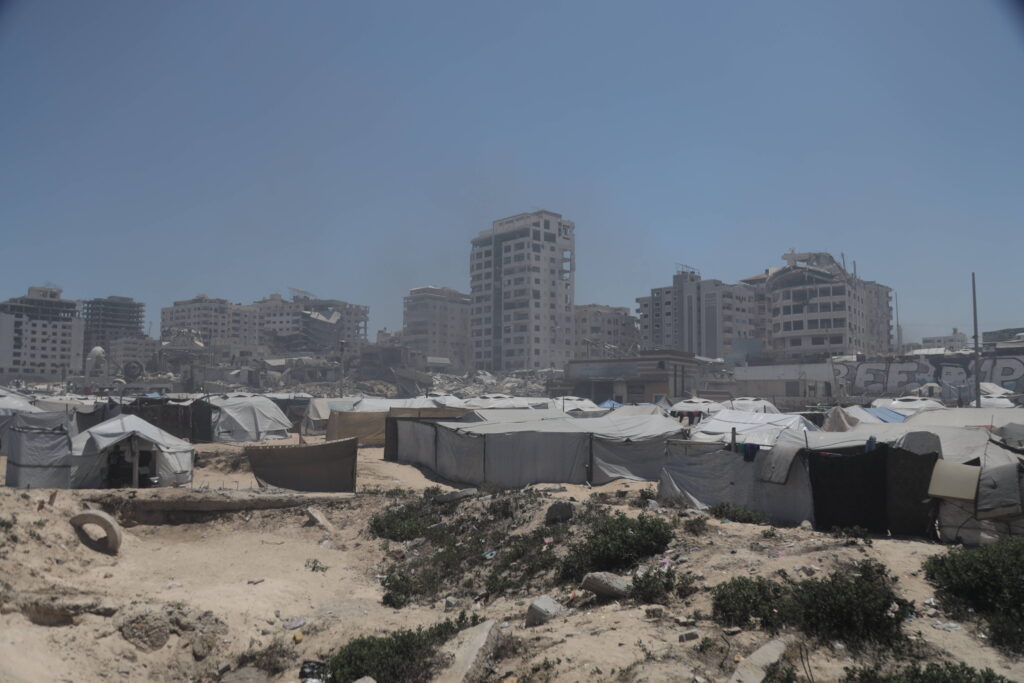
[Rony Brauman] The answer is unfortunately obvious. Before the war, there were about 36 working hospitals in Gaza which, despite an underdeveloped system due to the blockade and financial difficulties, demonstrated genuine commitment and efficiency. Today, only fragments of hospital infrastructures remain and are up and running. Eight weeks after the beginning of the humanitarian blockade (the interview took place in April 2025), stocks of medicine, basic medical equipment, bandages, anesthetics, antibiotics were already on the verge of exhaustion. The absence of fuel prevents generators from functioning, preventing sterilisation, operating room care or even lighting. This is not an accidental collapse: Israel has intentionally targeted and destroyed the foundations of the Palestinian health system. This takes place within a larger dynamic at play, where all elements necessary for social and physical life in Gaza are systematically dismantled. It is in this context that many are talking, rightfully in my opinion, of an ongoing genocide.
Lyna: In relation to this, we have seen several Palestinians being freed after many years spent in Israeli prisons. Some have even grown up there. According to you, how long can it take for a former detainee to start having a “normal” life, assuming that is possible, given the psychological and physical after-effects they can carry?
[Rony Brauman] A number of Palestinian prisoners recently released, some of them having spent up to 45 years in Israeli prisons, mainly in the West Bank, illustrate very well the extreme brutality of the Israeli prison system towards Palestinians. These individuals have often been detained in particularly harsh conditions: torture, prison overcrowding, healthcare privation, insufficient food supply, prolonged isolation. Of course, there is a feeling of relief, even joy sometimes, when being released. But none of them emerges unscathed, either physically or mentally. I cannot give a precise answer in terms of how long it would take to “return to normal life”, because situations vary enormously depending on the length of detention, the treatment they have undergone, and the family and political environment when they leave. But the after-effects are often profound and long-lasting: sleep disorders, chronic anxiety, post-traumatic syndromes, persistent physical pain, etc. We must also remember one essential aspect: a large proportion of Palestinian prisoners were not detained based on a fair trial or formal charges. Many were detained arbitrarily, sometimes without any file, without trial, basically political hostages, used as bargaining chips in asymmetrical negotiations. This adds to the violence of the prison experience: being locked up without a clear motive, or a judicial horizon, breaks the individual.
Lyna: I am asking you this question because I have heard a lot of conflicting views on the subject. On television, we often find that reality is simplified or biased, and the media are sometimes quick to take sides. This leads to fake news or information that goes from one extreme to the other. So if I may, I would like to ask you a final question about the media: what role do major Western media play today in the narrative of the Israeli-Palestinian conflict? And to what extent does their coverage, which often focuses on the Israeli perspective, contribute to making the Palestinian victims invisible, particularly during bombings or targeted attacks?
[Rony Brauman] Western media, and the media in general, have reacted very little to the mass killings of journalists, despite them being their colleagues. Gaza has become a real graveyard for journalists. No other conflict in the world has seen such deliberate, repeated and effective attacks on journalists: more than 200 have been killed, a third or more of them intentionally. This situation is unprecedented on a global scale. Added to this is the fact that Gaza is hermetically sealed off, preventing any foreign journalist from gaining access. Among major Western media, only a few, such as Le Monde, The Guardian and El País, have paid any real attention to what is happening on the ground in Palestine and Gaza. Overall, complacency has unfortunately prevailed. For the first time in April, there was a demonstration by journalists in solidarity with their colleagues who are victims of oppression, bombing and murder in Gaza. This demonstration took place mainly in France, and was led by the journalists themselves and their unions, although the management of the newsrooms did not really support it. There is no other conflict in which the media have been so tightly closed in.
That being said, in the interests of accuracy, it must be acknowledged that some newspapers and traditional media have made a serious effort to report on the situation in Gaza, often without sending special correspondents there. These media have managed to “de-invisibilise” the war, giving the public access to the essential information thanks in particular to Palestinian and Israeli-Palestinian sources online. But other media outlets, notably some print newspapers, have adopted an outrageously pro-Israeli stance, to an extent that defies comprehension. This country, which is waging a war that many describe as genocidal, has the support of normally moderate media, which is extremely problematic. Furthermore, in France, far-right media, such as CNews, have openly sided with Israel, justifying all its actions and quickly labelling demonstrations of solidarity with the Palestinians (and not with Hamas) as active complicity with what they call terrorism. Finally, there is a strong complicity between anti-Semitism and Zionism, particularly on the part of the United States, Hungary and other allies of Israel, who are stepping up their political and media support for Tel Aviv.
Lyna: And finally, here is my very last question. We are going to talk about the recent policy of the Trump administration, as well as that of certain American states, regarding foreign students who demonstrate in support of Palestine. How can we analyse the measures taken against them, such as threats to withdraw their visas or expel them? Do you think this is a sign that the right to academic mobility is being used for ideological ends?
[Rony Brauman] I do not think there is any real intention to wake up or take action. Trump is testing several things, he is backing down sometimes, like on tariffs, which are having unexpected economic consequences – he is adjusting, tempering and adapting. But within the United States, these measures are not really working for him, and he is losing some of his electorate, particularly those who did not support the demolition of public education or who are suffering from inflation. So this is a bad time for him. On the other hand, one point is clear: there is an open war on knowledge, science and universities, waged with great determination. The United States is in the process of cutting its academic institutions to the bone, with a programmed fight against freedom of expression and teaching. This is a very clear ideological line, a new McCarthyism[4]. But it’s not the same as in the 1950s: today, students are on file, listed on websites as “supporters of terrorists” or “anti-Semites”, to exclude them from employment with companies from the outset.
Being a pro-Palestinian student in many American universities now means hiding, concealing one’s opinions and even refraining from demonstrating, while monitoring one’s behaviour and even one’s clothing to remain within the expected norm. Dictatorial tendencies are emerging with surprising speed, which we had not anticipated. I think this is a war against knowledge and freedom of thought in the United States. The outcome is not certain: the country has the internal resources to resist and reverse this trend, but for the moment there is nothing to suggest this, and this offensive is progressing effectively.
Notes
[1] Editorial note: The international conference, placed under the co-presidency of France and Saudi Arabia, which will take place in New York from June 17 to 20, 2025, and will aim to make concrete announcements with regard to the peaceful resolution of the Palestinian question.
[2] Editorial note: President Emmanuel Macron went to Egypt from April 6 to 8, 2025, following Egyptian President Abdel Fattah el-Sisi’s invitation.
[3] Editorial note: The Rome Statute of the International Criminal Court (ICC) is the international treaty that led to the creation of the ICC. It was signed on July 17, 1998, in Rome and entered into force on July 1, 2002, after being ratified.
[4] Editorial note: McCarthyism is a period of U.S. history, taking place in the 1950s, marked by the “red scare”, a strong fear of communism. Named after Senator Joseph McCarthy who led a witchhunt against alleged communists that had infiltrated the government, the military, the media and Hollywood.