


For more than a decade, Libya has appeared to have become a state without a state, where violence and economic power lie in the hands of armed groups rather than the government. Since the fall of the Gaddafi regime in 2011, the collapse of military and security institutions has facilitated the emergence of local or religiously oriented militias that control territory, strategic resources, and political decision-making. Their autonomy, reinforced by the support of foreign actors, has transformed the country into a hybrid system in which the state struggles to exercise its authority. This situation raises a fundamental question: how has the proliferation of militias weakened the Libyan state and fueled the country’s persistent instability? To address this question, we will first examine the emergence and consolidation of militias in the context of state collapse (I), before analyzing internal rivalries and the influence of foreign actors that exacerbate tensions (II).
The Emergence and Proliferation of Militias in Post-2011 Libya
Context of Post-2011 State Collapse
Since the fall of the Libyan regime, Libya has been experiencing a major political, economic, social, and security crisis. NATO’s intervention, initially intended to protect civilians, failed to preserve a centralized state[1]. The National Transitional Council (NTC)[2], established in February 2011 as an interim body tasked with representing the Libyan people and preparing the transition toward a democratic government, attempted to restore political order and oversee institutional reconstruction. To this end, on 25 December 2012, the Political Isolation Law led to the complete dissolution of the army and security units of the Gaddafi regime. This legal framework was not unprecedented, as it was inspired by the de-Baathification law[3] adopted in Iraq in 2003 under U.S. impetus, which aimed to purge Saddam Hussein’s Baathists. This decision, intended to eliminate former Gaddafi-era elites, had the immediate consequence of depriving Libya of a significant portion of its essential military and administrative expertise. The armed formations of the former regime were replaced by civilian brigades composed of the “February 17 revolutionaries,” also known as “militias.” Initially perceived as guarantors of the revolution’s achievements, these militias rapidly gained autonomy, allowing for a complete reshaping of the country’s security landscape.
In 2011, militias numbered approximately 11,000 fighters nationwide[4]. This force expanded rapidly due to the weakness of the state and increased funding allocated to these groups, reaching nearly 260,000 fighters by the end of 2013[5]. The election of the General National Congress in July 2012 did not put an end to violence, which persisted in the form of multiple conflicts opposing militias to rival local armed groups. Libya thus became a state where the monopoly of violence is no longer held by the government, but by heterogeneous armed actors.
Proliferation of Non-State Armed Forces and Power Struggles in Western Libya
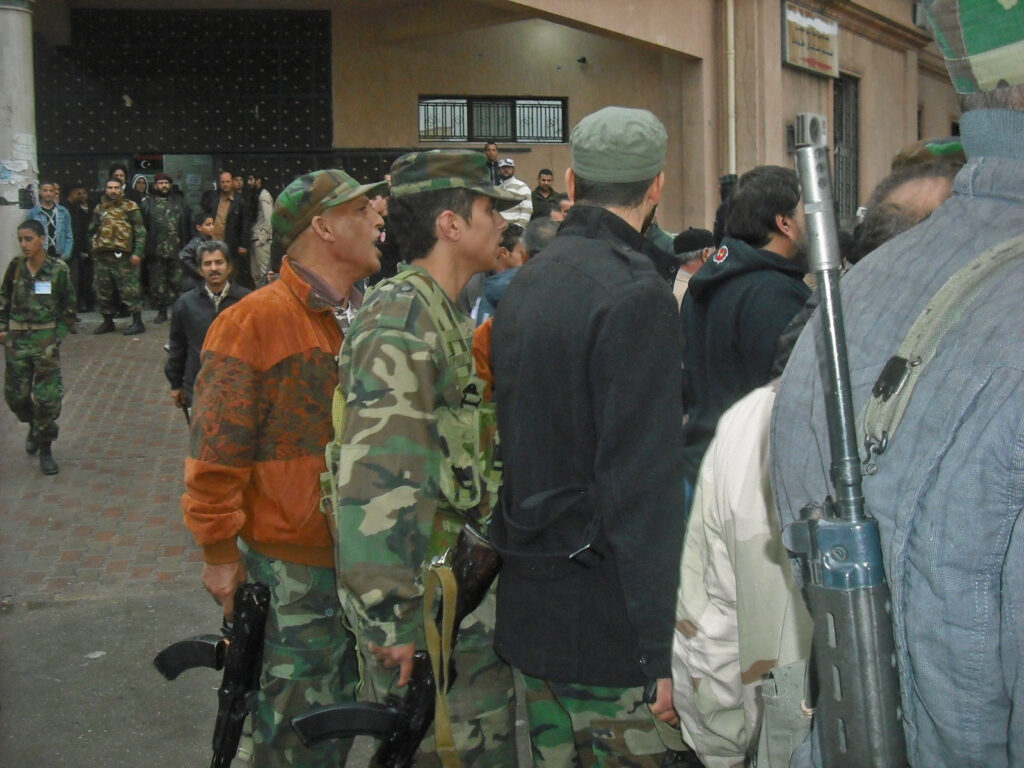
Post-2011 Libya has been characterized by the proliferation of “non-state armed forces,” whose role extends far beyond the military sphere to encompass political, economic, and security domains. These militias and armed groups seized weapons supplied by foreign powers as well as stockpiles from the former Libyan regime. Often grouped under the generic term “militias,” these armed actors vary widely in origin, organization, and scope of action.
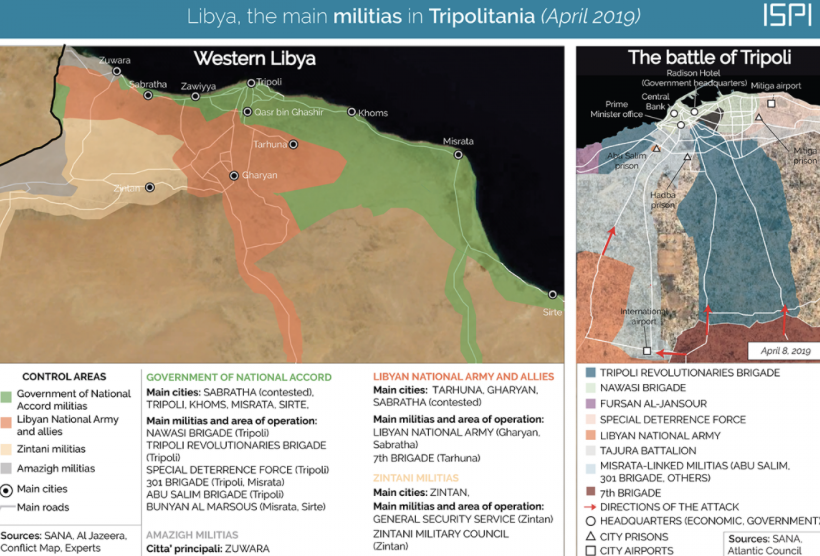
Kingdom of Militias: Libya’s Second War of Post-Qadhafi Succession ©Italian Institute for International Political Studies
Tripoli: Deployment and Strategic Role of the Misrata Brigades and Their Allies
First, the brigades originating from the port city of Misrata (located 200 km east of Tripoli) rank among the most organized and structured forces in Libya. Among the many Misrata brigades are:
- the Al-Mahjoub Brigade,
- the Al-Halbous Brigade,
- and the 166th Brigade.
These forces constitute powerful, well-equipped, and autonomous militias. They were recently deployed toward Tripoli in response to the May 2025 tensions. Previously, they played a key role in defending the capital against Khalifa Haftar’s offensives. Already involved in the capture of Tripoli in August 2011, they have retained control of strategic sites such as Misrata Airport and the commercial port. Some of these militias pursue political objectives that allow them to participate directly in governmental decision-making. They are present both within Parliament and the executive branch in key advisory positions, enabling them to act as armed extensions of the ruling power. This is notably the case of the “Cartel” of militias, which brings together:
- the Tarhouna militias,
- the Nawasi Revolutionary Brigade,
- and the Misrata brigades.
These militias play a decisive role in Libya’s political and security landscape. The government of interim Prime Minister Abdelhamid Dbeibah finances these militias in exchange for their political support and their role in maintaining order in Tripoli. During the conflict opposing him to Fathi Bashagha, the Prime Minister threatened to enter Tripoli with the support of the Misrata militias, illustrating the direct influence of armed forces on power relations and political decision-making in the country. Alongside them, allied brigades from Zawiya and Zintan were also mobilized toward Tripoli. Although traditionally allied with Misrata forces, these militias are riddled with deep internal rivalries, complicating their positioning in the current crisis.
Militias of the Jebel Nefoussa
Similarly, militias originating from the Jebel Nefoussa (a mountainous region in northwestern Libya) have been primarily involved in local security and the control of road networks linking western and central Libya. Their influence remains largely regional but significantly contributes to either local stability or instability depending on political alliances.
The Katayeb: Neighborhood Militias in Libya
The “Katayeb” ensure neighborhood surveillance and play a quasi-policing role, notably by controlling identities and issuing permits to visitors. Each district of Tripoli, as well as cities such as Benghazi and Sebha, has seen the emergence of these groups, often composed of veterans of the 2011 revolution. Thus, the Abu Salim Protection Battalion, or Abu Salim[6] Martyrs Brigade, led by Abdelghani al-Kikli, consolidated its influence in Tripoli’s Abu Salim district. His militia became an autonomous force capable of negotiating directly with the government.
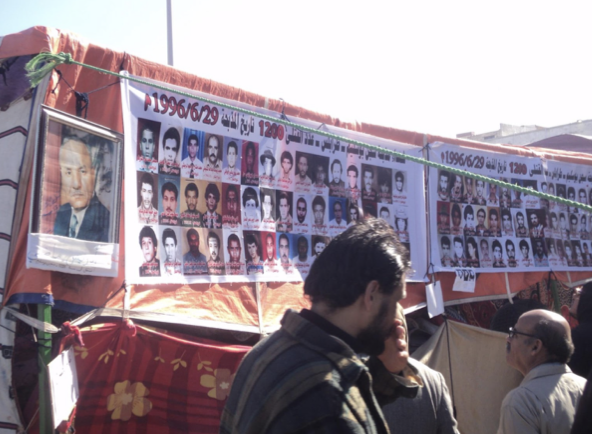
©Victims of Abu Sleem massacre – WikimediaCommons
Specialized Militias and Strategic Control: The Role of the RADA Force
Some militias have specialized in securing institutions and controlling strategic areas, establishing themselves as genuine “security” actors. In Tripoli, the RADA Force, led by Abdel Raouf Kara and affiliated with the Ministry of Interior, is responsible for securing Mitiga Airport and conducting operations against organized crime and trafficking in human beings, narcotics, and smuggling, while retaining broad autonomy and sometimes adopting a critical stance toward the government.
Brigade 444: Dbeibah’s Armed Arm in Tripoli
Conversely, Brigade 444, affiliated with the Ministry of Defense of the Government of National Unity, is clearly aligned with Abdelhamid Dbeibah, whom it has repeatedly supported in maintaining his authority in Tripoli[7].
Jihadist and Islamist Groups in Libya: Between Influence and Political Integration
Among Libya’s armed groups, jihadists stand out for their religious vocation and their attempt to impose an Islamist vision in a country that lived for 42 years under a secular, Marxist-Leninist ideology. Alongside them, Salafi “Islamists” pursue explicit political ambitions. While a historical distinction once existed between these actors, it has now largely blurred. Most members of these groups have integrated local militias or now hold positions within governmental institutions. This entanglement allows them to penetrate Libya’s political and social life. Their stated objective is to establish a centralized state structure inspired by the model of the ummah and to make Islam the foundation of the state.
These groups do not form political parties but engage in associative, religious, economic, and lobbying activities with governments in power. Some historical opponents of the Gaddafi regime, such as Abdelhakim Belhadj, were armed and financed by foreign powers, which continue to influence Libya’s politics and economy today.
Trafficking, Terrorism, and Influence: The Entrenchment of the Islamic State and Former Terrorist Groups
Over the years, these armed groups have strengthened their position through the arrival of new jihadist recruits from Tunisia, Morocco, Afghanistan, Syria, Egypt, and Somalia, contributing to the creation of the Islamic State (IS). This terrorist organization opposes the construction of a stable state and finances itself through drug trafficking (notably via “Highway 10”), human trafficking, and arms trafficking. A rival to Al-Qaeda in the Islamic Maghreb, IS absorbed Ansar al-Sharia and former members of the Derna Protection Force, turning Libya into a rear base for terrorism and destabilizing the entire Sahel-Saharan region. After the second civil war (July 2014–October 2020), some members of these armed groups integrated militias in Tripolitania or assumed positions within Libyan institutions, while others pursued strategies of political and military legitimacy.
Political and Security Instrumentalization of Militias and Armed Groups
Beyond their self-proclaimed role as “guarantors of the revolution and democracy,” militias and armed groups justify their interventions in political and public affairs. In the absence of a regular army and coherent security forces, the Libyan government has been forced to integrate certain militias into state structures to maintain an appearance of legitimacy and control. After his appointment as Prime Minister (2016–2021) following the Skhirat Agreement in December 2015, Fayez al-Sarraj attempted to subordinate the most influential militias to the Presidential Council and the Ministries of Defense and Interior. It was in this context that the RADA Force, led by Abdel Raouf Kara, was officially integrated into the executive apparatus to secure Mitiga Airport and government institutions.
Meanwhile, the 444th Combat Brigade, formed by Mahmoud Hamza, controlled southern Tripoli and several surrounding cities up to Tarhouna. The arrest of its leader in August 2023 by the Deterrence Service resulted in 55 deaths and 146 injuries, illustrating the capacity of these militias to impose their force even against the institutions they are supposed to support. Key ministries, such as Defense and Interior, rely in practice on armed brigades to secure their buildings and ensure the implementation of decisions. The Ministry of Defense relies on the 111th Brigade of Mujahfil, led by Abdel Salam Zoubi, to ensure its security and intervene directly in the allocation of military budgets[8]. The Libyan state has never regained exclusive control over legitimate violence, leaving it vulnerable to internal pressure and political manipulation.
Militia influence extends beyond security. They intervene directly in administrative and economic management. Some Libyan militias exert real political weight, participating in direct negotiations with the government or pressuring the population to advance their interests. Others use their influence to shape local or national elections by mobilizing or intimidating voters in their areas of control. This situation has transformed governance into a hybrid system combining official administration and armed groups. Military and ministerial officials emerging from these militias occupy strategic positions within key institutions such as the Central Bank, the Ministry of Telecommunications, and civil security services. This is the case for Tripoli’s Minister of Interior, Emad al-Trabelsi, and Deputy Minister of Defense Abdel Salam al-Zubi. Others, such as Central Bank Governor Farhat Bengdara and National Oil Corporation head Naji Issa, were appointed with militia support[9].
It should be noted that prior to his death in May 2025, Abdelghani al-Kikli controlled several ministerial posts and under-secretariats while leading a vast transcontinental financial network. While western Libya is marked by the presence of multiple militias, eastern Libya follows a different dynamic.
The Libyan National Army in the East: From Family Militia to Military and Economic Force
Many Libyan militias adopt numerical designations and military-inspired structures to present themselves as regular forces, such as Brigade 111. Marshal Khalifa Haftar amplified this logic by successively renaming his troops the Libyan National Army (LNA) and then the Libyan Arab Armed Forces (LAAF). The LNA presents itself as a centralized military structure under Haftar’s authority. Unlike western militias, it relies on a hierarchical chain of command, even though it integrates heterogeneous armed groups. This approach convinced some international actors to support it, despite its essentially militia-based nature. The LNA emerged in 2014 when Haftar assembled in Benghazi a heterogeneous coalition of civilians, former officers, Madkhali Salafist forces, criminal gangs, and regional militants to fight revolutionary and Islamist forces. Gradually, with foreign support, Haftar built his own forces under the command of his sons and close associates, separating his structure from former allies. The self-proclaimed eastern government thus functions as a family-run military enterprise, legitimized by the reconquest of the East and the fight against Islamist groups.
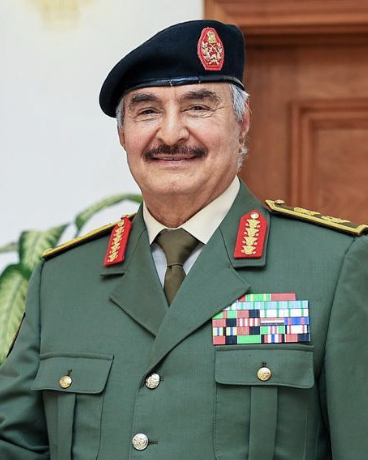
Khalifa Aftar ©WikimediaCommons
The LNA organized itself as a hierarchical and professional force[10]. Civilian fighters were trained as officers, wore uniforms, and were equipped with sophisticated command and communication systems. Its legitimacy rests on internal consolidation rather than classical state institutions. Simultaneously, the Haftar clan allied with local militias, notably Brigade 128 in Tripoli, to control lucrative economic activities such as drug trafficking, smuggling, and migrant transit, while sharing oil revenues. This strategy grants the LNA indirect control over key institutions such as the National Oil Corporation and the Central Bank, consolidating its influence in western Libya. In the historically autonomous south, the LNA exerts authority through local allies and foreign fighters, gradually centralizing control under Haftar’s sons, with some exceptions such as Brigade 128. The conflict has also taken on an international dimension, with military support from the United Arab Emirates and the presence of Wagner forces in Tripoli, prompting Turkish intervention in the west. Since Haftar’s defeat in Tripoli, Turkey has maintained a deterrent military presence, while the UAE and Egypt primarily exert political influence.
Today, the LNA exemplifies a militia transformed into a military and economic force, hierarchically structured and based on family power. By projecting its power on multiple fronts and indirectly controlling strategic resources, the Haftar clan consolidates its presence and influence in Cyrenaica and Fezzan.
Resource Control, Illicit Trafficking, and Militia Abuses in Libya
Libyan militias have established themselves as major economic and political actors, using military power to control strategic resources and exploit illicit trafficking. Oil and gas have long been the country’s main sources of revenue and are now widely instrumentalized. In the East, forces such as the eastern armed forces or members of the Haftar clan have been accused of diverting fuel and petroleum products intended for the state. Brigades affiliated with Haftar’s command, such as Brigade 128[11], control oil fields and impose taxes on production and transport, generating revenues estimated at over $100 million annually. Fuel and diesel are also used to exert local control, sustain parallel markets, and reinforce militia influence over the population. Customs taxes are imposed by eastern armed forces at border posts such as Wadi al-Ajal, Ghat, and Murzuq.
These groups also profit from arms, migrant, and drug trafficking to strengthen their financial and political autonomy. The Fezzan region has become a strategic transit zone for illicit activities. In addition to contraband goods, human trafficking has surged[12]. Militias levy transit fees on migrant flows and participate in drug distribution through international networks[13]. In Tripolitania, militias exploit migrants, often detaining them in informal camps where they are subjected to violence and sexual abuse. Some are ransomed for up to $3,000 per person. An estimated 700,000 to one million migrants transit Libya annually, generating millions of dollars for militias[14].
Militia entrenchment is accompanied by coercive and abusive practices that partially replace state authority. Militias exert direct control through extortion and violence, imposing “protection taxes” on businesses, transport, and markets, as practiced by the RADA Force in Tripoli, which reportedly earns several million dollars annually. Others operate arbitrary detention centers where citizens are held without trial or forced to collaborate. Libyans are kidnapped from workplaces, universities, or streets and released only after ransom payments[15]. In regions such as Tarhouna, militias linked to Mahmoud Hamza’s 444th Brigade have seized private property, often tied to political conflicts or economic interests.
This complex relationship between the nascent state and militias has produced a hybrid system in which armed and civilian forces simultaneously perform security and local governance functions. Rivalries between militias are frequent, resulting in sporadic clashes and temporary alliances driven by economic and political interests.
State–Militia Dynamics in Libya: Political and Armed Rivalries
Since 2011, a defining feature of Libya has been the state’s inability to exercise an effective monopoly over legitimate violence. The army and police are heavily dependent on or influenced by militias that are often more powerful and better organized, creating persistent tensions between the state and militias, as well as among militias themselves.
Rivalries Between the State (or State-Affiliated Forces) and Militias
In May 2025, violent clashes erupted in Tripoli following the death of Stability Support Apparatus (SSA) militia leader Abdelghani al-Kikli, alias “Gheniwa,” during an operation by Brigade 444, affiliated with the Ministry of Defense[16]. Pro-government units clashed with rival militias across several neighborhoods, resulting in deaths, injuries, and the temporary suspension of flights at Mitiga Airport. These events highlighted the state’s inability to impose authority even in the capital. The United Nations called for calm, warning that the clashes posed “a threat to civilian security and that the absence of fully operational state forces fueled the escalation of violence.” In September 2025, under international mediation—particularly Turkish—the Libyan government and certain militias signed security agreements for Tripoli. These aimed to withdraw some militias from sensitive urban areas, transfer control of Mitiga Airport and several prisons to state institutions such as the Ministry of Justice, and reorganize militia zones of influence. While these measures reflected attempts to reassert minimal state control, authority remains largely dependent on militia cooperation or neutralization.
In eastern and Fezzan regions, clashes occurred between Haftar’s forces and Hassan Maatuq al-Zadma’s al-Zadma Brigade, which threatens the Haftar clan[17] through recurring confrontations with forces affiliated with Haftar’s sons, Saddam and Khaled. These conflicts are driven by competition over strategic resources, including gold deposits near Ubari estimated at over two tons annually, potentially generating tens of millions of dollars[18]. Al-Zadma reportedly secured foreign alliances[19] providing military and financial support, weakening Haftar’s grip as rival factions gain strength.
Rivalries Among Militias
In other areas of western Libya, clashes have erupted over control of strategic routes, economic infrastructure, and border zones. In Al Zawiya, for example, rivalries between local militias escalated into fights over control of roads, migrant trafficking, and illegal activities, heightening insecurity in the region. In 2023, the city of Tarhuna, a strategic hub for several militias, became the scene of violent clashes following the arrest of Mahmoud Hamza, the militia’s leader. This event triggered conflicts between his supporters and other rival groups, including the Kaniat militia, formerly allied with the Government of National Accord (GNA) Coalition during the second civil war. Hamza’s capture intensified tensions between these factions, which compete for control of resource-rich areas and strategic infrastructure. These clashes resulted in over 55 deaths and 146 injuries.
Furthermore, bomb attacks on the 444th Brigade near Bani Walid in 2025 caused numerous casualties. These events and rivalries demonstrate a struggle for power, territorial control, and the country’s resources. This internal competition has attracted the interest of many foreign actors, some of whom exploit or support these divisions[20].
Foreign Influence and Militias in Libya: Strategic, Economic, and Military Stakes
Since the fall of Gaddafi, Libya has become a strategic arena for foreign powers exploiting state weakness and militia proliferation. In the East, the self-proclaimed government and Haftar’s LNA function as a quasi-private, family-based structure supported by Russia, the United Arab Emirates, and Egypt. Russia supplies heavy equipment and Afrika Corps mercenaries, enabling control of strategic areas. The UAE finances militias to secure oil, while Egypt provides security support to counter Islamist groups and limit Turkish influence. Recent rapprochement with Turkey and the death of Libyan Chief of Staff al-Haddad could further strengthen the Haftar clan. In the West, Turkey supports Abdelhamid Dbeibah’s government and Tripoli militias, providing drones and armored vehicles. In December 2025, the Turkish parliament extended its military mandate in Libya by two years, officially to support the Government of National Unity and consolidate the 2020 ceasefire. This extension may strengthen Turkey’s presence and reinforce pro-government militias.
Foreign interference has reinforced militia autonomy, fragmented political power, captured economic resources, and imposed ideological and strategic influences. According to the UN Support Mission in Libya (UNSMIL), between 2021 and 2024 approximately 70% of oil revenues were directly or indirectly controlled by militias backed by foreign actors. Libya risks remaining a proxy battlefield, where external support for militias continues to strengthen their positions, undermining any prospect of reconciliation and long-term stability.
Notes
[1] The resolution that served as the legal basis for the military intervention in Libya in 2011 is United Nations Security Council Resolution 1973 (2011), adopted on 17 March 2011. It was approved by a large majority (10 votes in favour, 5 abstentions, and no votes against) and authorized Member States “to take all necessary measures” to protect civilians, including the establishment of a no-fly zone, while explicitly excluding any foreign occupying force.
[2] The National Transitional Council (NTC), led by Mustafa Abdel Jalil, governed Libya during the 2011 civil war, coordinating the rebel forces. It managed the interim administration and was responsible for preparing the democratic transition leading up to the 2012 elections.
[3] De-Baathification in Iraq refers to the process implemented after the fall of Saddam Hussein in 2003 by the U.S. administration and the Iraqi interim government to eliminate the influence of the Baath Party from the Iraqi state and society.
[4] In 2012, there were 75,000 militiamen. Their numbers increased due to various financial support from the government at the time.
[5] According to estimates by the UN and researchers specializing in Libyan security
[6] The “Abou Salim Protection Battalion,” for example, used weapons from Gaddafi’s stockpiles to extend its control over Tripoli.
[7] Abdel Ghani al‑Kikli, nicknamed Gheniwa, was one of Tripoli’s most influential militia leaders and headed the “Stability Support Apparatus (SSA),” a de facto armed force integrated into the state security apparatus under Abdel Hamid Dbeiba’s Government of National Unity (GNU). He was assassinated on 12 May 2025 in Tripoli during a mediation meeting at the Tekbali military camp. His death triggered a series of clashes between rival militias, who recently gained attention by attacking the offices of the Stability Support Authority (SSA) following the assassination of its leader, Abdel Ghani al‑Kikli.
[8] Militias have also been instrumentalized by various governments to control strategic institutions such as ministries, banks, ports, and airports. For example, in the pharmaceutical sector, militias close to members of the current government established companies to purchase medicines.
[9] Farhat Bengdara was appointed Governor of the Central Bank of Libya in 2021. In the same year, Naji Issa was elected by Abdelhamid Dbeibah as Chairman of the Board of the National Oil Corporation (NOC), Libya’s state oil company. The Stability Support Agency, led by al‑Kikli, enabled the control of ministerial positions and bank credits, consolidating the militia’s political power over Tripoli and western Libya.
[10] « En Libye, les milices sont l’État, Wolfram Lacher », entretien accordé au Moyen-Orient 65 • Janvier – Mars 2025
[11] The 128th Reinforced Brigade is a military unit within the Libyan Arab Armed Forces (FAAL), led by Khalifa Haftar. As an integral part of the LNA, it helps strengthen the Haftar camp’s territorial control, notably by securing strategic areas and providing support operations to other allied Libyan forces.
[12] Fezzan serves as a hub for illicit arms trafficking. More than 20,000 tonnes of weapons were stored in warehouses of the Libyan Ministry of Defense in 2017. It is now estimated that 70% of the weapons circulating in the Sahel originate from Libya. Added to this are weapons sold by international actors, including missiles, assault rifles, RPG‑7 rocket launchers, drones, and explosives.
[13] According to the UN, around 70,000 migrants pass through southern Libya each year, often under extremely precarious conditions.
[14] Rapports de l’ONU sur la migration (HCR -Haut-Commissariat des Nations Unies pour les réfugiés et l’OIM- Organisation Internationale pour les Migrations).
[15] Libyans were forced to pay more than €10,000, equivalent to 53,900 Libyan dinars (LYD), according to the testimony of a resident of a Tripoli neighborhood.
[16] The clashes take place within a broader context of struggle for political and security power, marked by persistent rivalries between pro- and anti-government militias, some of which aim to weaken or overthrow Prime Minister Abdel Hamid Dbeibah.
[17] Because the militia based in Fezzan is armed and has financial resources (from trafficking), it poses a threat on two fronts: 1. Non-integration into the army – it functions as a hybrid element that obeys only its leader, not Haftar. 2. Risk of proliferation – it could lead to the creation of other scattered militias, thereby undermining the authority of the LNA.
[18] In 2025, reports indicated that conflicts over control of these gold-rich areas erupted in regions such as Fezzan.
[19] Including Egypt, the United Arab Emirates, mercenaries from Sudan, and, unofficially, Chadians.
[20] Rivalries between militias have significant impacts on civilians. Urban fighting and troop movements in residential areas lead to disruptions in public services, forced displacements, and heightened insecurity. These clashes also cause temporary school closures, mass migrations, and a loss of trust in public institutions.