

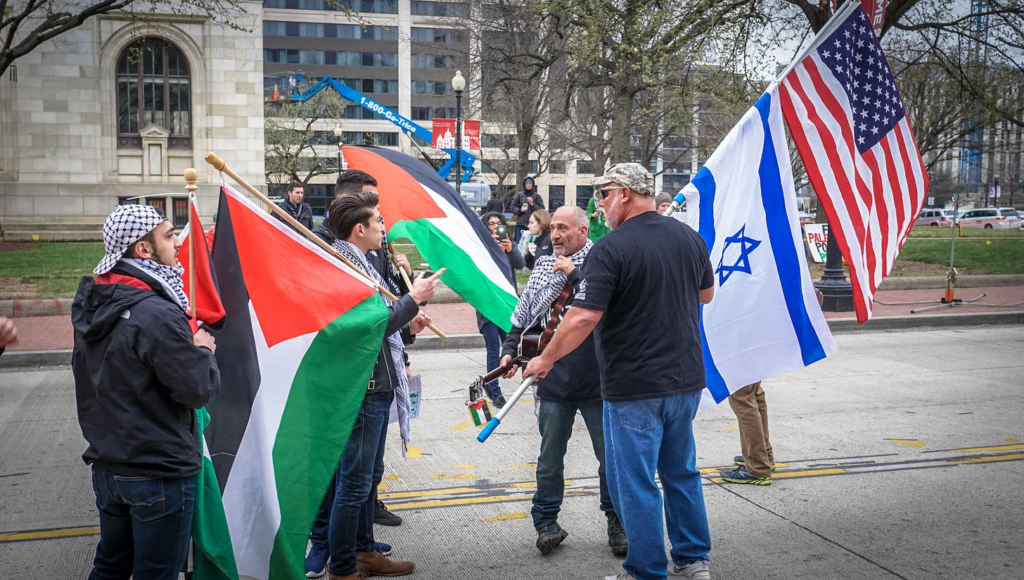

[Haoues Seniguer] First of all, thank you, Lyna, and thank you to EISMENA for granting me this interview. My name is Haoues Seniguer. I worked for ten years as a senior lecturer at Sciences Po Lyon, where I directed the diploma program on the contemporary Arab world. My field of specialization concerns the relationship between politics and religion; more specifically, between politics and Islam.
In recent years, I have done extensive work on the question of Islamism. I consider myself, with due humility, an expert in the Justice and Development Party in Morocco, an Islamist party, but also an observer of the dynamics between Islam and politics in France. Since September 1st, 2025, I have been a professor of contemporary history of international relations, opening a new chapter in my research focused on the long-term ties between the United States and the Maghreb.
I write and speak in the media, because I believe that it is critical for researchers to make their knowledge accessible and to step beyond the academic sphere. In my view, scholars must go out into the city and share, based on their expertise, the knowledge they have built up over time.
[Lyna Ouandjeli] You have collaborated with the former CFRI, now EISMENA, on articles about the perception of Islam in France, which are available on our website. You also took part in a trip to Iraq, primarily in Erbil, where you were able to showcase your political science expertise. Therefore, I thought it would be important to reconnect with you and ask you a few questions about your recent book, published by Le Bord de l’eau: “God Is with Us: October 7 and Its Consequences — How Jewish and Islamic Religions Justify Violence.” You highlight the following quote:
How a certain form of Judaism and a certain politicized Islam create conditions for the legitimization, escalation, and sacralization of violence in God’s name, through words, or conversely, through the silences that accompany them.
Why did you choose this quotation to present in your book?
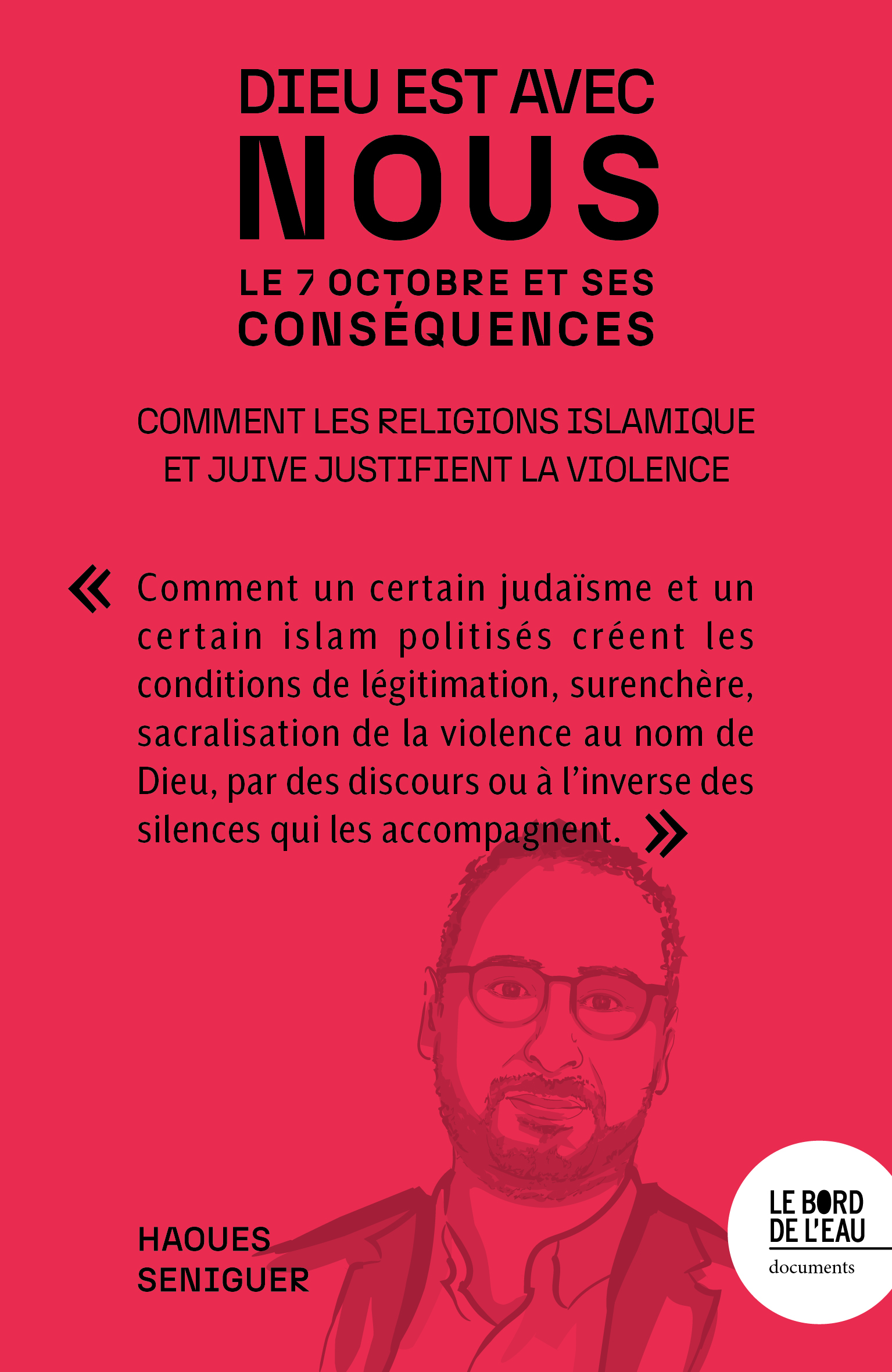
Front page of his book.
[Haoues Seniguer] Thank you again, Lyna, for your kind words. I am very happy to collaborate with EISMENA, a remarkable institute that takes the time to work in the field, often in regions without access to the same resources as in the West. So, why this phrase? It is linked to a scientific as well as ethical approach. In my teaching and research, I have always been careful to avoid essentialism or culturalism. When I say “a certain Islam” or “a certain Judaism,” it is precisely to avoid generalization or stigmatization. I reject both positive essentialism — the idea that Islam or Judaism is peace — and negative essentialism — the idea that Islam or Judaism is violent. This phrase captures the spirit of my work: to remain nuanced, factual, and contextualizing each claim in specific documents and quotations.
[Lyna Ouandjeli] For a long time, Islam has been negatively portrayed in the media and in political discourse. Since around October 7, 2023, however, Judaism too has faced heightened negative perceptions. Two opposing narratives now compete for legitimacy. Today, September 5, 2025, marks two years since the war between Israel and Palestine began, a war that can be qualified as a genocide against the Palestinians (legal classification adopted by the United Nations on September 16, 2025). We find ourselves with two camps: some blame Judaism for the ideology of Eretz Israel; others blame radical Islam through Hamas, now weakened and almost nonexistent. Could you explain your motivation for writing this book, and why you chose October 7, 2023, as a starting point, when Islam had already faced negative perception with Al-Qaeda and the Islamic State?
[Haoues Seniguer] Thank you for that question, Lyna, and for raising several key points. I hesitated for a long time before writing this book, because I do not consider myself a specialist of the Israeli–Palestinian conflict. That hesitation was not false modesty but intellectual rigor and ethics. I wanted to approach the conflict from the perspective of my expertise : the relationship between religion and politics. In my view, religion has often been either overestimated or underestimated in this context. My aim was to reconsider the place of the religious frame of reference (which is therefore not the religion as a whole) through real actors and given contexts.
I chose October 7, 2023, because of widespread misreadings in the media. I explicitly describe those attacks as terrorist acts, yet many have interpreted them solely as antisemitic. Certainly, there is an antisemitic dimension to Hamas, but the primary motivations behind this attack, from the actors’own point of view, are rooted in anti-colonial resistance: resistance to Israeli domination, the blockade of Gaza, ongoing colonization of the West Bank, and the treatment of Palestinians, whether imprisoned or living under occupation. In the discourse surrounding October 7, religious references abound : the Prophet’s Night Journey, Qur’anic passages, notably Surah 9, used to justify the struggle against Israel. It was therefore crucial to analyze these elements carefully and contextually. I did the same on the other side : examining how Benjamin Netanyahu, though personally not very observant, draws on biblical references to reassure the messianic far right and appeal to certain American Zionists (a topic I do not address in the book). This sacralization of the conflict has contributed to making the massacre of Palestinians, now widely seen as genocidal, acceptable in the eyes of some.
[Lyna Ouandjeli] Indeed, the instrumentalization of religion is nothing new. We have seen it in various governments, both Eastern and Western, such as Saudi Arabia and Iran, which have used religion to justify their positions vis-à-vis each other. We have also seen the emergence of militias in the wake of conflicts: Hamas in 1987, of course, but also Hezbollah in 1982, created during the Israeli invasion of southern Lebanon. The Shiite community was then largely slaughtered, and Israel used this situation, along with the presence of the PLO, to extend its control to Beirut. Religion thus becomes a tool for legitimizing military actions. For example, each side refers to sacred texts: Hamas to suras or hadiths, Israel to passages from the Torah or prophecies such as those of Isaiah[1]. Thus, you write that religion serves as a tool of legitimization for both Hamas and Israel. What, in your opinion, are the main similarities and differences in this instrumentalization?
[Haoues Seniguer] That is a delicate question, and I am not sure I can answer it exhaustively. The main similarity, if there is any symmetry at all, lies in the fact that religion can serve as a tool of emotional mobilization. It plays this role on both sides, while remaining deeply tied to the territorial dimension of the conflict. We must avoid falling into the trap of believing this is a “clash of civilizations”, even though some actors, admittedly, do think in those terms. Benjamin Netanyahu, for example, has long adopted a Huntingtonian worldview, which is evident in his writings since 1995. Religion mobilizes people who feel attached to the land. The lands of Palestine and Israel possess a sacred dimension; otherwise, Palestinians would accept living elsewhere, and Israelis would have renounced Jerusalem or agreed to the division proposed by international law. Religion therefore functions as an instrument, on the Israeli side as much as on the Palestinian side.
Among Palestinians, including within certain segments of the Arab far left, religion also serves as a cultural ferment. This was evident, for example, in the thought of the nationalist theorist Michel Aflaq (1910–1989)[2], who emphasized the importance of the Islamic frame of reference as a cultural dimension. On the Israeli side, Netanyahu understands that the sacred dimension of the land can legitimize his actions, even if he is not personally very observant, because symbols and gestures are what matters in politics. The asymmetry, however, is twofold. First, there is no mechanical link between symbolic violence and material violence: some extremely violent discourses remain rhetorical, while others can lead to concrete acts. Second, Israel holds a considerable advantage: it is a sovereign state recognized by the international community, and its religious references have substantial effects. The Palestinians, by contrast, lack the means to give material force to their words. Even when they seek to mobilize Muslims worldwide by invoking the Qur’an or the Hadith, this does not translate into real outcomes on the ground. Gaza remains isolated, and there are no external fighters able to support Hamas or Islamic Jihad brigades.
Conversely, some rabbis have encouraged Netanyahu to pursue the total destruction of Gaza. An article published in Quds al-Arabi, a widely followed Arabic daily, reports on a letter from rabbis to the Prime Minister justifying violence in the name of a fantasized and murderous conception of religion. A clear asymmetry is therefore apparent. What I regret, as a researcher and citizen, is the lack of interest shown by some colleagues in religion: not to overestimate it, but to avoid underestimating it when analyzing a conflict that remains fundamentally political and territorial in nature.
[Lyna Ouandjeli] Religion does indeed provide additional legitimacy and allows bringing people together around a shared cause. This explains its effectiveness in various conflicts. Religious manipulation also ensures the support of the faithful and reinforces the legitimacy of those in power. Benjamin Netanyahu understands this very well. Since 2022, he has allied himself with the far right, which takes a radical stance on Gaza, advocating its “recovery” and total control. You make an interesting point: the distinction between the original political Zionism of Theodor Herzl and religious Zionism. You mention Rabbi Cooke, who illustrates this shift. While Herzl advocated a national and secular project, some rabbis gradually sanctified the Zionist project. With the adoption of a law affirming that Israel and the Jewish land are intended exclusively for Jews, in 2022, this religious dimension has become central to the logic of “recovery” of Palestine. Can you explain this shift and this cleavage?
[Haoues Seniguer] Thank you, that is a very rich and interesting question. It allows me to be more precise. I defend the following hypothesis, which runs through all of my work: the more a conflict is sacralized, the fewer the conditions for peace. A politicized religion exposes populations to great risks and profound instability. The absence of a viable and sustainable political solution increases the chances of seeing the emergence or reemergence of a religion that has become savaged in a religion steeped in religiosity.
With regard to Zionism, I have sought to remain nuanced, so as not to essentialize the term or its adherents. In the spirit of Maxime Rodinson, who offered a critical reading of political Zionism, and of Denis Charbit’s analyses, we can distinguish three main forms:
- Political Zionism, associated with Theodor Herzl, who distrusted theologians wishing to control political power.
- Cultural Zionism, which sought to revive Jewish tradition and the Hebrew language, embodied by figures such as Martin Buber (1878–1965).
- Religious Zionism, which has gained increasing strength and today holds dominant political influence, particularly through the messianic far right.
I also argue that religion tends to fill the void where democratic and deliberative conditions are lacking: the less democratic debate there is, the more religion steps in to occupy that space. It is important to stress that this nuance does not mean that all anti-Zionism is antisemitic. There exist forms of anti-Zionism not rooted in antisemitism, even if some can lead to antisemitic attitudes.
Today, religious Zionism has largely overtaken both cultural and political Zionism. Thus, Benjamin Netanyahu, though not personally religious, draws on these religious resources for political purposes. The Likud party, founded in 1973, has aligned itself with messianic extremists around an identitarian conception of the Jewish nation. The key difference lies in religious maximalism, more pronounced among figures like Itamar Ben Gvir or Bezalel Smotrich than among the relatively more moderate supporters of Likud or Netanyahu himself.
[Lyna Ouandjeli] Returning to Theodor Herzl, his book The Jewish State, published in 1896, is fundamental. In German, it is titled Der Judenstaat. Herzl develops the idea of a Jewish state, but a secular one, and he reinforces this notion in 1902 in Altneuland, where he evokes the Promised Land and insists on a non-religious state, not based solely on religious self-determination.
[Haoues Seniguer] If I may add a brief comment: what you have just said perfectly illustrates the position of secular Zionists. A frequently quoted saying captures this logic: “We do not believe in God, but we believe that God gave us this land.” This expresses a specific form of secularism, even among Israelis who do not genuinely believe in the existence of God.
[Lyna Ouandjeli] One could even extend this distinction to explain the divide between Orthodox and “modern” Jews. There is an important dichotomy here: some defend a state not founded exclusively on the Jewish religion, while others adhere to a more traditional vision, inherited from the post-1945 period. These divergences partly account for the divisions within Israeli society and within the Jewish community more broadly.
I would now like to address Hamas. In your book, on page 73, you write:
Even when adopting a belligerent tone or invoking calls to violence, religious references do not automatically translate into concrete actions or direct political consequences. The absence of material means or institutional support can limit their scope, confining them to rhetoric without immediate impact. As a result, the relationship between religion and politics in such a context proves to be far more complex than it appears, often marked by discontinuities, blind spots, and ambiguities that make any linear or reductive analysis inoperative.
This passage refers to Hamas, created in the 1980s. Its original charter was widely condemned as antisemitic and racist, calling for the extermination of the Jewish community. However, you note that Hamas lacks the material means to act thoroughly: its headquarters are limited to Qatar, and its funding comes from certain Gulf countries. Today, Hamas has undergone an ideological shift: it no longer seeks to expel Israelis or Jews from Palestinian territory. Its discourse still grants an important place to religion, but now prioritizes a historical and political framing of the conflict. Could you explain why you chose to emphasize this material component, and how it has contributed to the transition from an extremely radical ideology to a more political and historical approach?
[Haoues Seniguer] This is a very sensitive topic, and I thank you for drawing my attention to this passage. I should point out that my style can sometimes be quite dense: I often put forward an idea only to immediately qualify or nuance it; a dialectical approach that may make reading more complex. The 1988 Hamas Charter has generated much debate. I refer here to the work of Jean-François Legrain, who translated this charter into French and analyzed the new Hamas document released in 2017. To substantiate my argument, I rely on three main sources: the 1988 Charter, the 2017 document, and the public speeches of Hamas leaders, often delivered in Arabic, where there is, in principle, no intention to conceal their actual stance. Between 2005, and perhaps even earlier, and 2010, one can observe that some Hamas leaders began to secularize their discourse. Why? For pragmatic reasons: religious language reaches only part of the population. To advance the Palestinian cause, one must use secular, or secularized, language, capable of mobilizing Western partners and interlocutors, or non-religious audiences sensitive to the Palestinian issue.
This process of secularization can be understood through what Pierre Bourdieu would call an “effect of field” (effet de champ): to exist politically, an actor must adopt the logics of the political field, which cannot be satisfied with purely religious slogans. This manifests in the professionalization of Hamas leadership, and in the adoption of a legal or humanitarian discourse, which is by nature more universalist and inclusive. The material factor is also central: Hamas simply lacks the concrete means to implement its religious or radical discourse. The 1988 charter contains antisemitic and conspiratorial elements, but certain leaders, such as Khaled Meshal, have articulated a struggle against Zionism and Israeli colonial domination, without sliding into antisemitism. As I noted, this internal debate is not new and intensified during the 2000s.
Others, like Mahmoud al-Zahar, defended the continuity of the original charter, even after Hamas’s brief period in government (2006–2007) and despite the blockade imposed on Gaza. My goal is to highlight these internal debates, while also showing the pragmatic evolution of Hamas. I also draw on the research of Jeroen Gunning, who argues that Hamas, like any political party, adapts its ideology to circumstances in order to maintain legitimacy. It is therefore natural to observe a party’s movement toward professionalization, and a moderation of racist or antisemitic rhetoric, so as not to undermine its quest for legitimacy on the international stage.
[Lyna Ouandjeli] It is important to highlight this capacity for renewal. Hamas emerged during the First Intifada, went through the Second Intifada (2000–2005), participated in the 2006 elections alongside Fatah, and later experienced civil war. At each stage, its strategy and discourse had to evolve. We have also seen the various blockades and sieges of Gaza up to 2005, the partial Israeli military withdrawal, the construction of the separation wall between East and West Jerusalem, and the progressive expansion of Israeli settlements. Gaza has remained under Hamas control, while the West Bank has been largely governed by Fatah since 2006. You emphasize both the nationalist and power-driven logic of Hamas, but also that of Israel. In your view, today, is religion truly placed at the forefront, or is it rather used as a rhetorical cover to mask underlying power, nationalist, and colonial dynamics already at play?
[Haoues Seniguer]
I would like to return to the question of those who consider religion merely a façade. From the very first lines of my introduction, I refer to an older work by Bassam El Hachem, a relatively unknown Lebanese scholar, published in 1984. He argues that religion can possess a certain autonomy: while it is not isolated from other dynamics, it can, at times, act independently, depending on the actors and the context. It is therefore not a social isolate, but it can nonetheless exert its own driving force. As I often repeat, the role of religion varies according to actors and moments. For the religious authorities of the International Union of Muslim Scholars or for Palestinian ulema, religion is central. Among certain Hamas figures, however, it remains present but less decisive than political discourse.
Thus, religion can serve as a façade, an instrument, or conversely as a determining cause. This is why I cite Raymond Boudon: there are reasons to believe what one believes. Those who invoke religion genuinely believe in it and grant it a certain authority. Without denying its instrumental dimension, one must not underestimate the affective bond some actors maintain with their faith. Throughout the book, I sought to show how this religious sensibility enables certain actors to “stand upright”, even in the absence of material means. For example, the death of Abu Obaida, spokesperson for the Izz al-Din al-Qassam Brigades, deeply affected the Al Jazeera audience and much of the Arab world. His discourse, simultaneously strategic, military, political, and religious, managed to mobilize and to reassure those anguished by the destruction of Gaza and the immense military power of the Israeli army.
The key, therefore, is always to rely on specific examples in order to assess the weight of religion according to context and actor. Language plays a crucial role here, one that can be traced in public speeches and social media narratives.
[Lyna Ouandjeli] Indeed, religion may dominate in some videos, while in others, its influence is more subdued. It is essential to conduct case-by-case analyses: is it religion being emphasized, or rather a nationalist or other political logic? We can now turn to the question of historical and theological instrumentalization, so-called “Arab terrorism”, and the rhetoric of jihad against the Jews. Since October 7, 2023, radical statements by Yoav Gallant, former secretary of Defense, and Benjamin Netanyahu, current Prime Minister, have invoked numerous religious references, such as Isaiah, Joshua to Eretz Israel, to justify military action.
To synthesize this first question: What is the influence of this messianic rhetoric in contemporary Israeli politics, particularly since 2022, with the rise of the far right? Netanyahu systematically equates Islam with Islamism, without distinction, even though he acknowledges the richness of Islam and the Arab world. Yet, he simultaneously seeks to distort this richness, as seen in Israeli schoolbooks that depict Islam as the source of all evils, and Arabs as a historical threat to the West. In your opinion, what are the consequences of this international perception of the conflict? It seems to partly explain Western support for Israel, portrayed as fighting radical Islam. You also show that Netanyahu draws on the origins of Islam to justify contemporary terrorism. Can we, in this sense, speak of a comparable instrumentalization of religion and history to that of Hamas? Finally, how might one deconstruct the simplistic reading of October 7, 2023, presented by some as a “jihad against the Jews”?
[Haoues Seniguer] First, it is important to underline that Netanyahu, in a work I found dating back to 1995, is very explicit about his position. The Likud has never recognized the Palestinians nor seriously considered a Palestinian state. There was a tentative outline on his part, but it was so minimal that it was obviously rejected by the Palestinians: he spoke of a “confetti state” or even a half-state, in his own words. Netanyahu adopts a civilizational and civilizing reading of Islam and the Arab world: the Arab world is portrayed as the breeding ground of terrorism, and Islam, even if granted minimal credit, is perceived as dangerous. Today, this discourse resonates even more strongly because of recurring controversies around Islam.
I think that my dual perspective — rooted in France and in my interest in the Arab world — convinces me that this negative perception of Islam serves Netanyahu’s interests. For instance, it allows him to tell CNews that there is a “clash of civilizations”, where Israel would be the vanguard of an enlightened West against an Islamist darkness. Islam is systematically equated with Islamism, granting Netanyahu credibility in public debate.
This credibility rests on several factors:
- An objective reality: despite the ups and downs of Israeli democracy, many believe it is better for Israel to maintain stability than to rely on authoritarian Arab states.
- Guilt linked to the genocide of the Jews: in Germany and France, historical persecution of Jews creates a sense of responsibility that leads some to minimize the negative effects of Netanyahu’s messianic discourse.
- Cultural and social proximity: in the eyes of many Europeans, Israelis resemble Westerners more than Arabs or Muslims involved in recurring conflicts in the Middle East and Maghreb. This perception is reinforced by terrorist attacks carried out by actors claiming Islam, such as September 11, 2001, or the 2015 attacks in France.
In this context, the idea emerges that “Israel will do a better job” than an Arab regime, including in dealing with radical Islam. Unfortunately, this pejorative view of Arabs and Muslims contributes to the suffering of Palestinians, who find themselves trapped by this globalized negative perception.
[Lyna Ouandjeli] This is an important point. When examining Western discourse, I have tried to analyze it as thoroughly as possible because I aim to understand this inescapable support, which I would even call indestructible. We see that the West is beginning to acknowledge certain realities in Israel. When we read the founding speeches of the State of Israel in 1948, as you highlighted, Israel resembles us. There is this historical guilt linked to 1945 and the genocide that claimed over six million lives, which is essential not to forget. This guilt is regularly emphasized. Furthermore, there is the idea that Israel represents the perfect democracy in the Middle East, which, according to Western perceptions, Arabs and Muslims are perceived as incapable of embodying. This vision comes with a negative image of Islam, amplified by terrorist attacks and the rise of violent groups in the Middle East and North Africa.
It is important to note that this discourse is largely borrowed from certain Westerners, notably in France. Since the day after October 7, 2023, the initial French stance was very radical and opposed to the Palestinians, presenting the conflict as an Israel–Hamas confrontation and neglecting the harms caused by Israel in this asymmetric war, where the means between Hamas and Israel are incomparable. Subsequently, French engagement evolved, but Israel continued its expansionist policy, including actions against Lebanon, Iran, and Syria. The idea of a “Great Israel” then emerged, encompassing a large part of the Middle Eastand the Sinai in Egypt, historically contested, notably during the Six-Day War.
So I ask you: has the French stance, since that is what you analyze in your work, had consequences on the events of October 7? Recently, Emmanuel Macron seems to adopt a more favorable position toward Palestine, attempting to renew historical peace ties. Does this indicate a certain detachment of France from support for Israeli policy? Finally, did the events of October 7 contribute to a normalized racism toward Muslims and, conversely, a “liberated” anti-Semitism, where some portray Judaism as violent, while media such as Cnews promote a Judaism defending Western values against radical Islam?
[Haoues Seniguer] I would first say that Netanyahu shamelessly exploits the memory of the Shoah, a living memory marked by enormous trauma. He leverages it to such an extent that I am incredulous at the lack of reaction in the French public sphere. In 2015, he even claimed, according to an article in Libération, that it was not Hitler but the Mufti of Jerusalem, al-Husseini, who allegedly inspired the Final Solution – an assertion that is at least revisionist. This exploitation of the tragic memory of the Shoah is therefore a central element. Regarding the French reaction, it is linked to the shockwave of October 7. France has had some of the largest Jewish and Muslim minorities in the past century. The violence and massacres against unarmed civilians in southern Israel were analyzed within this context, explaining certain political haste in official statements, such as the presidential idea, quickly abandoned, of sending a coalition against Hamas.
However, some comparisons need correction: Hamas has nothing to do with ISIS. Certainly, some methods used on October 7 may recall images disseminated by ISIS, but their agendas are profoundly different. Hamas acted in a nationalist and violent perspective, but not in an expansionist one: its objective is territorial and national, not international with the aim of conquering the world to establish a caliphate. There were also variations in French diplomacy regarding Gaza. Gazans were victims of Hamas operations, without Palestinians being associated with these decisions – a point debated in the Arab world. Some, like Abu Marzouk, acknowledge that if the consequences of October 7 had been fully anticipated, the operation would never have occurred.
Thus, even within Hamas and among Palestinian cultural actors, there is debate and evolution. French diplomacy has been variable, but the symbolic recognition of Palestine constitutes a step forward. The question remains: which Palestine? The West Bank is heavily colonized, Gaza has been almost entirely destroyed, and the creation of a viable state remains hypothetical. Borders, public institutions – all of this remains uncertain. I doubt that a concrete Palestinian state will emerge in the immediate future. At present, my response, though unsatisfactory, reflects this reality.
[Lyna Ouandjeli] Finally, the current situation in Gaza indeed raises the question of reconstruction. As you said, Gaza is destroyed: almost nothing remains. There are no medical systems, no hospitals, no schools. Many exiled Palestinians do not know how to return to their territory; some cannot return for reasons beyond their control. Even Haifa, once Palestinian, is no longer so, making population identification even more complex.
There is therefore a real challenge in rebuilding this Palestinian state, destroyed and assimilated to the colonial and imperialist idea of Israel. There is also growing awareness, even within Israeli society, that a purely Jewish messianic ideology is no longer applicable to Gaza, which is now materially nonexistent. Some contest the use of religion as justification, noting that Netanyahu continued the bombings to avoid prosecution related to corruption and an international arrest warrant. Many questions remain open: How will Saudi Arabia and Iran behave? How might some states recognize Israel, while many other Arab states do not? How can a cordial relationship be established with a state that has violated the sovereignty of neighboring countries? Finally, some journalists, no longer taking an Islamist perspective, attempt to focus on the human aspect and pacify the pro-Israel/pro-Palestine debate, which remains very complicated given the current situation in Gaza and the Palestinian history since 1948, or even 1917.
Regarding your book, do you have a final word? What message would you like your readers to take away?
[Haoues Seniguer] Listen, I hope they will read the book from beginning to end, particularly the discourse analysis, despite some technical or complex aspects. What I have tried to do is examine the role of religion with nuance. I do not want to give a superficial equivalence between Israelis and Palestinians. Palestinians certainly need to make efforts, particularly their leaders, but the efforts must be far greater on the side of the dominant actor, namely the State of Israel. This state, recognized by global powers and present in international conferences, must do more. Without pressure from Western powers, there is no objective reason for Netanyahu to make concessions.
What we encounter are classic themes in international relations, like the realism of Raymond Aron in Peace and War Among Nations (1962). There is no tribunal or force to prevent Netanyahu and his allies from acting in Gaza. Furthermore, Netanyahu and his allies do not fully recognize the reality of Palestine. It would be appropriate for the media and Western powers to examine the founding texts and evaluate the homophobic, racist, supremacist, and human-rights-denying content promoted by some of his government allies, like Ben Gvir and Smotrich. Even though Netanyahu is not messianic, he has never publicly challenged these expansionist views. In fact, he finds himself more aligned with them than ever.
[Lyna Ouandjeli] I will also conclude on this point. I would recommend reading Edward Said, The Question of Palestine (1979), which highlights many aspects of the current situation. Denying the existence of Palestinians is tantamount to legitimizing Israeli policy toward Palestine. It is essential to recognize their existence, culture, and territory to break the vicious cycle of violence. Effective justice should condemn the actions of the Israeli army and government, as well as those of Hamas, while also considering the destruction inflicted on Israeli society by Hamas since its creation.
It is also important to recall Palestine’s economic dependence on Israel, particularly through the shekel. According to international law since 1907 (Hague Convention), the colonial power has an obligation to respond to the needs of the colonized state. Your book highlights this necessity well. Finally, understanding religion and religious language allows us to dissect the discourses of the different parties, whether Hamas or Israel. And we must remember that this conflict has been ongoing since 1948, or even since the Balfour Declaration of 1917, not since 2023. Accepting this collective memory is essential for a complete analysis.
Notes
[1] Isaiah was a Hebrew prophet who lived in Jerusalem in the 8th century BC. His work, the Book of Isaiah, is one of the longest and most influential prophetic books in the Bible. The Prime Minister refers to it, slightly distorting the words, when he quotes: “There will be no more thieves within your borders, and your gates will be glorious,” an allusion to verse 18 of chapter 60. In the Hebrew Bible, this verse reads as follows: “No more shall violence be heard in your land, nor ruin or destruction within your borders; but you shall call your walls ‘Salvation’ and your gates ‘Glory.’” The Book of Isaiah occupies a central place in the Old Testament and addresses major themes such as the deportation of the Jewish people to Babylon and their return, the reconstruction of the Temple in Jerusalem, and events related to the end of time.
[2] In 1940, Michel Aflak and Salah Eddine Bitar founded the Arab Ihya Movement, which was later renamed the Arab Baath Movement, adopting the name of a group created by Zaki al-Arsouzi. The movement quickly gained popularity and, in 1947, merged with al-Arsouzi’s Arab Ba’ath organization to form the Socialist Party of Arab Resurrection (Hizb al-Ishtiraki al-Ba’ath al-Arabi), commonly known as the Ba’ath Party. This Arab nationalist party advocated pan-Arabism and, under the leadership of Aflak and Bitar, established the ideological foundations of Arab nationalism and socialism. Zaki al-Arsouzi remained a major source of inspiration, without playing an active role.