


The unstable situation in the Middle East, aggravated by the multifaceted war waged by Israel, raises many questions[1]. The Israeli-American bombings targeting Iranian nuclear sites in Isfahan, Fordo, and Natanz last June have only increased the climate of uncertainty in the region. In this context, the central question remains: what role can Israel play in the future of the region? Alongside others, we consider the current period as an “Israeli moment,” without it constituting an irreversible dynamic that would permanently establish Israel’s hegemony over all neighboring countries. This is the preamble upon which the following reflections are based. The equation is well known: how to achieve a true and lasting peace in the face of two peoples claiming the same land? The solution remains to be built. Several possible responses exist, each depending on the crisis factors (economic, geopolitical, social, institutional, or territorial) considered in the analysis. It is therefore crucial first to clearly identify and name them precisely.
The first type of response, widely used in recent years, relies on a geopolitical reading focused on the evolution of international relations among Middle Eastern countries. While these dynamics obviously influence the situation, they often produce scenarios disrupted by constantly changing events and struggle to reach a genuine consensus. A second type of response stems from an eschatological interpretation, as promoted by the current Israeli government under Benjamin Netanyahu. It draws on the very real suffering experienced by the Jewish people throughout History[2] to justify the denial of Palestinian rights—rights that are equally ancient as those claimed by Jews over this land. This exclusive conception of Zionism, which leads to the denial of the existence of a Palestinian people, is far from consensual, even within Israeli society[3]. Finally, other, more pragmatic responses adopt a circumstantial reading, viewing October 7, 2023, as the starting point of a new cycle that Netanyahu exploits to reinforce a drift toward autocracy and illiberalism. While this approach is not without relevance, it tends to focus on immediate consequences rather than the deep-rooted causes of the ongoing crisis[4].
The second type of response can only lead to a deadlock and an endless war, while the first and third share a common limitation: neglecting the Israeli people as a central actor in any potential resolution. Historical experience shows that peace is built primarily between peoples, rather than solely between states. Another type of response is based on the conviction that Israeli hegemony is essentially circumstantial and therefore reversible. Israel’s current position of strength stems primarily from three external factors:
- The unconditional political, military, and financial support of the United States;
- The tacit complacency of other North American countries and most Western European countries, including the United Kingdom, Germany, France, and Italy;
- The hypocritical passivity of many Arab governments, including those of the UAE, Saudi Arabia, Egypt, and Jordan.
Israel’s position is also reinforced by the absolute and highly irrational support provided by the international evangelical movement, present in many countries, notably in Africa, which, for example, led a Ugandan judge at the International Court of Justice[5] to publicly defend Israel “in the name of God,” as reported by Courrier International.
However, this alignment, favorable to Israel, is far from permanent in the international order. It is already beginning to crack, as shown by the current diplomatic tension between the Israeli government and the authorities of countries considering recognizing the State of Palestine at the UN in September 2025, as well as internal tensions within Israeli society highlighted by French-Israeli political scientist Denis Charbit[6]. From this observation, a different approach to the future can be envisioned. From this perspective, the blockade and destruction of Gaza must be lifted, and bombardments, occupations, and indiscriminate violence in neighboring countries must cease. It seems unrealistic that a state of ten million inhabitants (20% of whom are Arabs[7]), with a territory smaller than Brittany, can sustainably and alone maintain hegemony over a space such as Egypt, Iraq, Saudi Arabia, Syria, Jordan, Lebanon, and the Gulf—one hundred times larger, twenty times more populous, and far wealthier.
The current hegemonic ambition is also explained by internal disorder within Israeli society, generating a crisis that seems to stem as much from collective psychological factors as from the international context. The people of Israel remain forever marked by the Holocaust, the ultimate and indelible collective trauma. The seventy-five years since the creation of the State of Israel had somewhat mitigated this wound, but the October 7, 2023, Hamas attack on Israeli soil brutally reopened these scars. It revived the memory of the Final Solution and, at the same time, was perceived as legitimizing Israel’s right to retaliate. Yet, as Israeli writer David Grossman reminds us, revenge cannot constitute a policy[8]. This is not merely a primal desire for retaliation. A large number of Israeli Jews, as well as a significant portion of the Jewish diaspora, seem caught in a well-known psychological transfer process: the syndrome of reproducing the violence or mistreatment they suffered. Like a child who was abused and becomes a violent adult, Israeli society may reproduce destructive behaviors. This leads to a widespread form of the banality of evil, a psychological blockage potentially affecting many individuals, which Hannah Arendt[9] described as an inability to think fully.
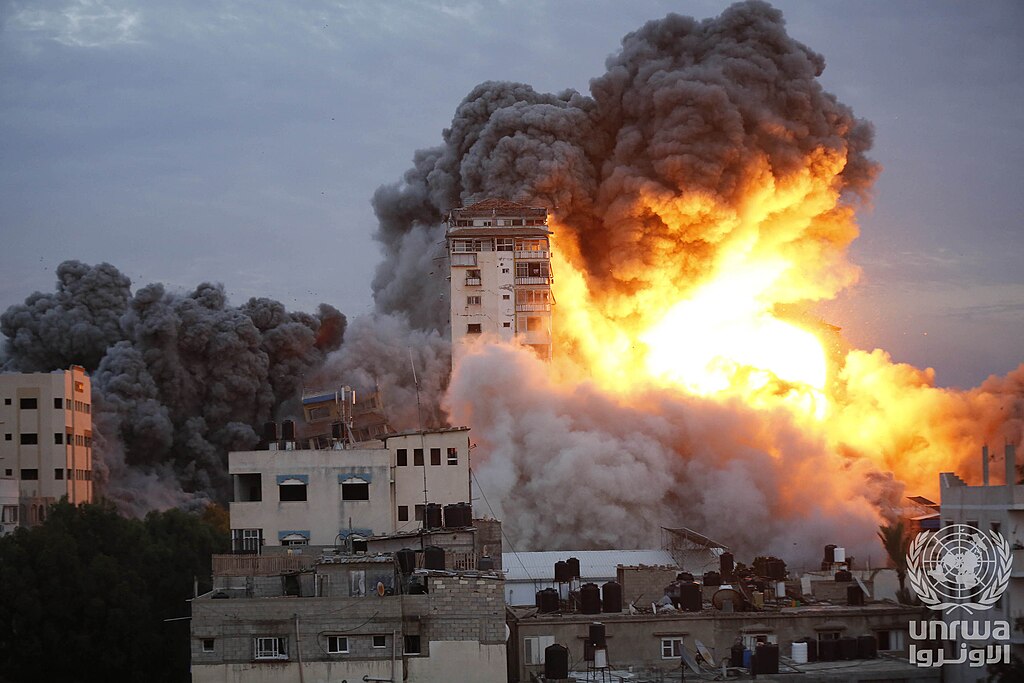
In Gaza, however, it is precisely a genocidal logic and a search for a final solution that appear to be at work[10]. The facts speak for themselves: more than 55,000 deaths according to the Palestinian Ministry of Health—cited by Le Monde on June 27, 2025—three times as many severe injuries, hundreds of thousands of permanently displaced persons, and unbearable living conditions. Added to this, for several months, are the blockade and severe malnutrition, which starve the population, cause the death of thousands of children and vulnerable people, place 500,000 people in catastrophic famine conditions according to the UN (IPCInfo 22/08/25), and leave survivors with irreversible consequences[11].
The Israeli government itself is not exempt from deep psychological distortions. Artificially propelled by unconditional U.S. support, Netanyahu’s personal calculations, and the biased biblical interpretations of some far-right ministers, its relentless policies of incessant military actions and not always targeted assassinations reveal, in our view, another well-known problem: a disease of power. This pathology takes the form of excess, paranoia, and overconfidence, fueled by pride, contempt, and lack of empathy. This is the drift known since antiquity as the syndrome of hubris, perfectly illustrated by current ministerial arrogance and outbursts.
Only the Israeli people can put an end to the authority of leaders afflicted by hubris, provided they overcome their own traumas and fully grasp the stakes. There is no guarantee that this stage of collective awareness has already been reached[12]. Yet it concerns both Israel’s security and the justice due to the Palestinian people. A war without end produces only losers: as long as Israel remains a threat to its neighbors, it will itself be exposed, through reciprocity, to the risk of another October 7—or worse. Peace agreements signed with Egypt and later with Jordan demonstrate that an alternative path is possible. This will also be a condition for achieving Hamas disarmament. It is from this social catharsis that hope for peace can be reborn.
There are also signs that positive developments may be on the horizon. In a recent interview, American artist Nan Goldin, a photographer and filmmaker from the Ashkenazi Jewish[13] community, emphatically stated: “The blockade of Gaza must be broken… we are passively watching the final solution take place before our eyes.” Her voice deserves to be heard, as does that of writer David Grossman, who calls on Israel to acknowledge its mistakes. These statements, along with many others[14], open perspectives and constitute steps forward[15].
Notes
[1] Lire le témoignage saisissant de Jean Pierre Filiù publié avant le blocus israélien, Un historien à Gaza, Édition Les Arènes 2025
[2] Editor’s Note: The authors are referencing the Holocaust.
[3] Wladimir Z. Jabotinsky Le Mur de Fer : les Arabes et Nous E.book 2022
[4] Rob Geist Pinfeld, de l’université hébraïque de Jérusalem, pour L’Express, 16/08/25
[5] courrierinternational.com du 22 août 2025
[6] Nouvel Obs N° 3178 août 2025 p. 23
[7] Editor’s Note: The authors are referencing data that are accessible on the World Bank or any economic reviews.
[8] Le Monde, 15/08/25, p.18/19
[9] À propos du procès Eichmann à Jérusalem en 1961/62
[10] Gaza Une guerre coloniale, dir. Véronique Bontemps et Stéphanie Latte, Abdallah Sindbad, Acte Sud, 2025
[11] Voir la vidéo, Famine à Gaza, diffusée par Libération, 24/07/25
[12] Propos d’Alain Diechkoff, Libération, 19/08/25, p.13
[13] Nouvel Obs, N°3177, 07/08/25, p.56/57
[14] Lihi Ben Shitrit, Réveil, Courrier International, 22/08/25
[15] L’Arab Center de Washington D.C. vient de constituer un groupe d’experts pour réexaminer l’ensemble de la situation au Moyen-Orient, dépêche publiée le 18 août 2025