


“Difficult” but also “useful.” That is how Iran’s Foreign Ministry Spokesman Esmaeil Baqaei described the fourth round of negotiations that have taken place in Muscat, Oman, between his country and the United States. In his view, the two sides are still trying to “understand each other’s positions” and “find reasonable and realistic ways to address their differences”. As Tehran and Washington agreed to hold a fifth round of negotiations, their respective and rather different worldviews are becoming apparent.
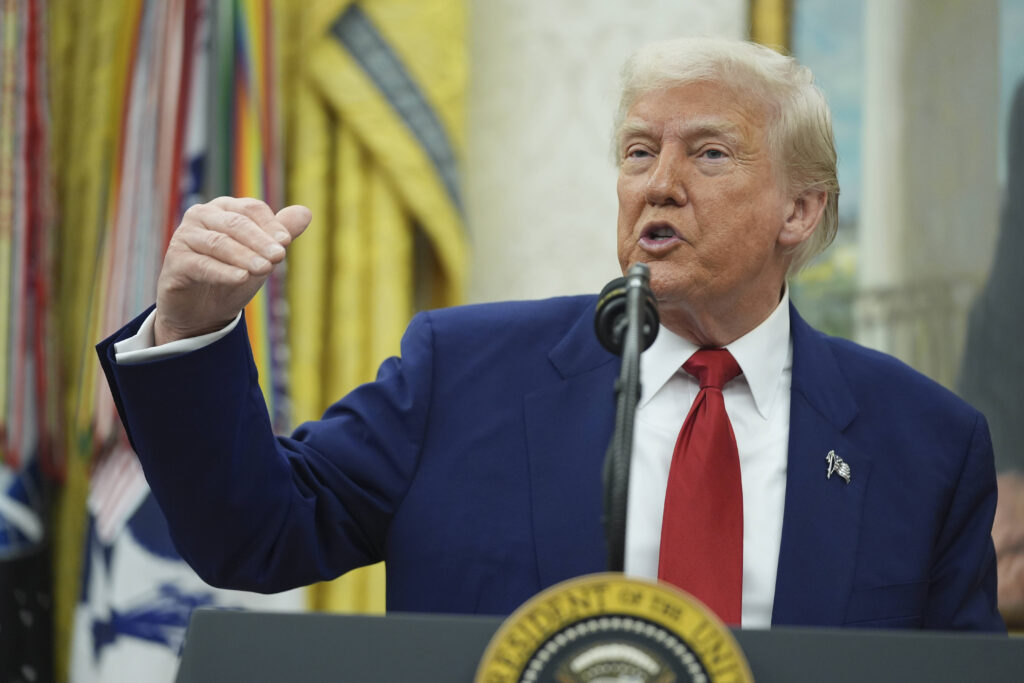
The first notable aspect of the negotiations is that it is not the U.S. government as a whole, but rather Trump himself who is leading the discussions. This feature is significant, as the U.S. government’s foreign policy establishments, derided as “the Blob” by former Deputy National Security Advisor for Strategic Communications and Speechwriting Ben Rhodes, might differ with the president when it comes to Iran. Trump’s world is quite a contrast to the Iranian carpet-making worldview. The former is characterised by speed, flexibility, and foxlike style. The Iranians, on the contrary, are patient and focused, resembling in many ways the hedgehog rather than the fox, as the metaphor goes.
Another aspect of Trump’s approach is that unlike his supporters, he does not align with neoconservatism, one of the most ambiguous and debated terms in American politics. As Jacob Heilbrunn, Senior Fellow at the Atlantic Council, explains, “No one, however, has ever really succeeded in precisely defining neoconservatism”[1]. We refer to neoconservatives as those who believe that American power can transform the world through military intervention. Hence, not being a neocon means not believing in war as a U.S. foreign policy tool. As U.S. Special Envoy to the Middle East Steve Witkoff argues, Trump is not a “neocon” who believes “that war is the only way to solve things.” According to him, “The president believes that his force of personality, the way he is going to respond to certain situations, can bend people to do things in a better way in the interests of the United States government”. Trump pursues negotiation because he believes he is capable of making a deal and achieving peace. In this view, his personality is more effective than war.
This is quite a contrast to the previous Trump administration who was rather hawkish in his first presidential term and even during the last campaign when it came to Iran. That is no longer the case. The idea of Trump not being a neocon is shared by Middle East expert Ghassan Salamé. “My deep feeling,” the Lebanese academic stated while presenting his new book in Beirut, “ is that Trumpism is not neoconservatism. … I’m saying that in order to say that I don’t think that Trump is looking for a war with Iran”.
Trump might not be a neocon. Nevertheless, it is not clear what he is, making it tricky for the Iranians to develop a coherent strategy. Trump’s game of uncertainty may be one of his strong suits, making his opponents struggle to guess, but playing tricks might not necessarily contribute to making a deal. While the Iranians are trying to uncover Trump’s real aim, they are equally masters at concealing their true intentions. It is a practice known as taqiya. The current negotiation is an arena where deception and uncertainty are met accordingly.
Several dilemmas arise in this context. The Iranians might be willing to give up the goal of acquiring a nuclear weapon, but they are not willing to give up the right to enrichment. This reflects a rejection of the model of Libya which had to give up on all its nuclear capabilities, both military and civilian, to put an end to the sanctions targeting its regime. It is therefore not surprising that the Iranians are swinging between pessimism and optimism. For the Iranian losing the right to enrich is interpreted as a commencement of a domino theory that will eventually result in the regime change, especially when the Libyan model is mentioned. Currently they are willing to freeze the enrichment but acquire the right to enrich in future.
A quick glance at the Iranian, and one feels a sense of optimism, maybe out of desperation, but optimism nonetheless. As former senior Iranian diplomat Seyed Rasoul Mousavi puts it in an interview with the Islamic Republic News Agency (IRNA), before the negotiations began, contradictory statements were being made by American officials. At the negotiating table, “the issue was clearer, and the atmosphere that existed before the talks fundamentally differed from that after the negotiations.” However, he emphasises that “predicting the future is not possible” and particularly believes that Israel may act to undermine the diplomatic path between Tehran and Washington. This optimism is also shared by Erwin van Veen, a Senior Research Fellow at the Clingendael Institute, especially as Trump would like to reach the “deal of the century.” The survival of the regime is at stake this time. Therefore, Iranians are showing willingness to negotiate as a form of mitigating a real threat to their future.
War with Iran, or any war in fact, is an ideological stand for some in D.C. As conservative political commentator Tucker Carlson puts it, “Now is the worst possible time for the United States to participate in a military strike on Iran. We can’t afford it. Thousands of Americans would die. We’d lose the war that follows. Nothing would be more destructive to our country. And yet we’re closer than ever, thanks to unrelenting pressure from neocons. This is suicidal. Anyone advocating for conflict with Iran is not an ally of the United States but an enemy”. This comes in sharp contrast to the position of the Netanyahu camp which sees war as the only option against the perceived threat Iran represents. In fact, what Tucker Carlson expresses coincides with the Iranian grand strategy.
In 2015, a senior Iranian official met with former U.S. Secretary of State Henry Kissinger. As Iranian-American political scientist Vali Nasr recalls in his forthcoming book Iran’s Grand Strategy: A Political History, Kissinger probed his Iranian guest on when it might be that Iran would abandon its revolutionary ideology and embrace pragmatism. In response, the Iranian interlocutor wondered when the U.S. would exhaust itself, see reason and change course in the Middle East. Not being a neocon can be seen as a form of exhaustion. This is apparent in the current U.S. domestic polity. Nevertheless, an exhausted, visionless U.S. is not easily predictable and rational, especially as everything depends on the mood of a person. The negotiating process may be prolonged and grow stressful because enrichment and the tactical procedure around it may be difficult, particularly for Israel and less so for the Gulf nations this time.
What might happen? Iran wants to buy time and calm the situation down as it has reached one of the weakest points in its modern history. It has done the same in the past, when neocon U.S. invaded Iraq. Iran might show willingness to abandon building nuclear weapons. However, looking at Iranian history and culture, this will represent a temporary pause rather than a change in strategy, especially as nuclear power is becoming the norm again. If in the past Iran has tried to build a nuclear weapon to balance power in the region, it is now more about deterring its own population and ensuring regime survival .
When it comes to the Trump administration, there are two aims: stopping Iran from becoming a nuclear power and fixing the level of enrichment. Iran is willing to freeze the development of a weapon, which would satisfy the U.S. When it comes to stopping enrichment, Iran tries to escape the Libyan model. Again, not only for external issues, but for domestic as well. “The West’s focus on the risk of an atomic bomb has caused the reality to be overlooked,” according to international security expert Fatima Moussaoui. Iran has significant resources and a highly educated youth. The Iranian research and development capacity despite the blockade is permanent evidence of this. This youth, while proud of its national history, is open to the world and wants to evolve. Therefore, if the Iranians manage to avoid a military attack and ease the sanctions, it will have a huge impact on the wider region. The survival of the Iranian regime will halt the changing nature of the post-October 7 world.
In the current world condition, Iran has the potential to revive faster, especially with the support of China. As such, Iran would maintain its hegemony over Iraq and possibly beyond, which would be bad news for Iraqi democracy and development. If the talks fail, the alternative would not just be more economic pressure on Iran but possible military attacks by Israel and the United States. The combination of a hawkish U.S. administration, even more hawkish Israelis, and a considerably weakened Iran makes the possibility of military attacks imminent and more devastating than ever before.
Notes
[1] Jacob Heilbrunn, They Knew They Were Right: The Rise of the Neocons, 2008