

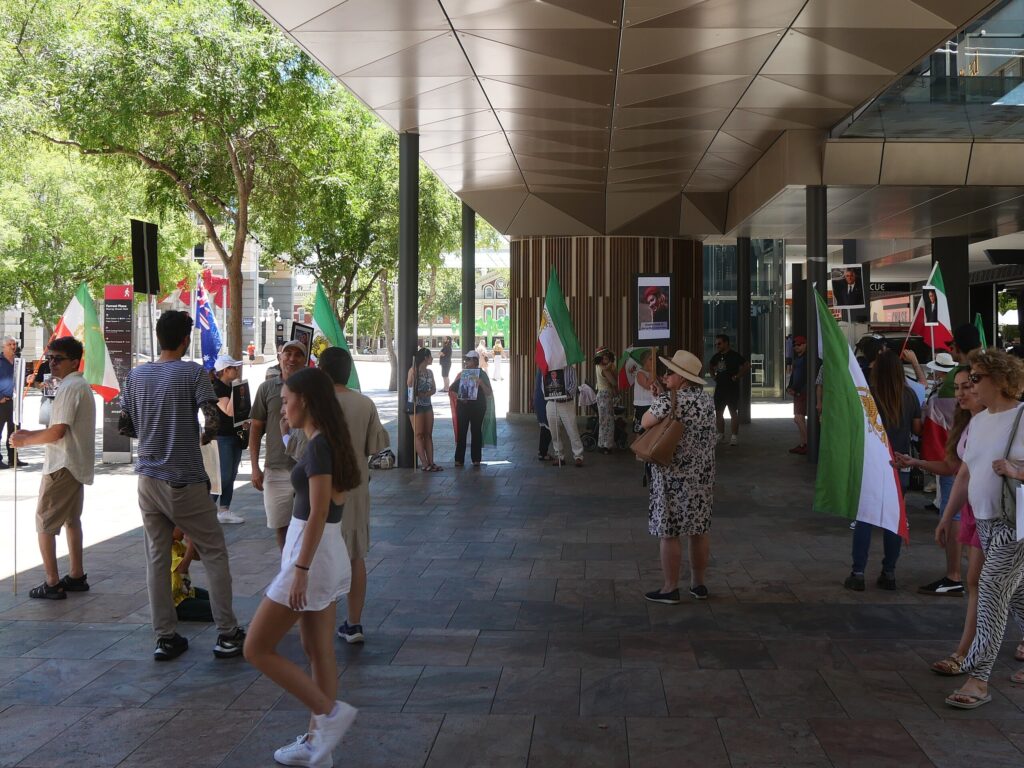

A new cycle of public demonstrations has emerged in Iran, contributing to an important pattern of recurrent protest waves that have marked and are shaping the country’s recent history. While such social mobilisations tend to appear episodically, each of them is shaped by distinct structural triggers, social configurations and, or, political meanings. The present protest cycle can be analysed as a moment in which the relationship between state power and society reveal underlying tensions that are partially obscured in periods of relative quiescence. So, in several respects, the current wave of demonstrations differ from earlier episodes of contention. What sparked the current protest is the government’s planned budget for the next fiscal year, which begins with Nowruz, on 21 March. What is known is that this budget formalises an already deteriorating economic outlook, notably through the anticipation of inflation rates that are expected to significantly outpace wage growth. The concepts of budget, hyperinflation, and wages are not typically associated with revolutionary mobilisation. However, as historians suggest, extreme inflation pressures can function as powerful destabilizing forces under certain conditions. Studies of the French Revolution, for instance, emphasise the role of extreme inflation between 1794 and 1796 as a key factor in the erosion of social trust and political legitimacy. During that time, revolutionary governments relied on a paper currency, called the assignat, whose over-issuance contributed to price increases exceeding 50% per month.
The fear surrounding the forthcoming budget is, more fundamentally, a fear about the future. At the same time, the Iranian currency is experiencing a free fall, it is expected to get worse. Those familiar with Iran and the Persian language often associate the country with the expression “زندگی سخت است,” i.e., “life is hard.” Yet particularly for the poorest segments of society. The government appears to lack viable solutions to the current economic crisis, apart from austerity and frugality. This is reflected in official discourse such as: “If you save 10% on your electricity, gas, and water usage, we can save 900,000 barrels of oil and gas every day. This is our country’s wealth, and we’re wasting it. We consume electricity unnecessarily and use too much heat.” Framed as a matter of national wealth and collective responsibility, such statements nonetheless indicate that the draft budget intends to transfer its chronic fiscal deficits directly onto society. Although the protests have economic origins, they are unlikely to stay confined to the economic sphere. In a totalitarian state like Iran, all activities inevitably acquire a political dimension.
It started in a Bazaar
The fact that the current demonstrations started in the Grand Bazaar is significant. The bazaar is seen as a conservative power base and “one of the many pillars of the Iranian state.” Yet, as in protests of 2018, economic grievances appear to be the primary driver of bazaar mobilisation. Historically, bazaaris opposed the Shah’s modernization project, which they perceived as a threat to traditional economic and social structures[1]; in this sense, bazaars have long been understood as emblematic of tradition, in contrast to the modern shopping malls. Together with the mosque, the bazaar has constituted one of the two central apparatus underpinning the Islamic Republic. However, the mosque has progressively lost much of its social and symbolic authority, particularly among younger generations. Should the bazaar similarly withdraw its support, the regime would lose a critical component of its material and economic base. While the mosque has functioned primarily as a spiritual and ideological apparatus, the bazaar has provided the regime with an economic one. The erosion of both would leave the state increasingly reliant on coercive power for its survival. This new reality might force the current Iranian elites to shift from a totalitarian form of governing to an authoritarian model. In doing that, they change the regime’s face and narrative and might allow more social freedom. Steps they have already started, through relaxing the headscarf rules. Nevertheless, for a variety of reasons, this will be a risky and uncertain step.
This paradigm shift hinted at by Mohammad Javad Zarif in his essay neatly titled “The Time for a Paradigm Shift Is Now.” He stated that “Iran has the capacity to make this critical transition from an approach centered on confronting perpetual threats to one focused on exploiting opportunities. It is not only feasible but also profoundly in the interest of Iran, the region, and the global community. Achieving it necessitates unwavering domestic resolve and external noninterference, driven not necessarily by morality or international law, but simply by self-interest.” Despite the reasonable call, Zarf remains an unheard voice within the current elites. This shift is the prime for what is called Bonapartist, i.e., a scenario when a possible strong figure emerges from within the system.
Non-Farsi people are not taking part at large
As the numbers of the cities and towns are rising, still the focus of the demonstrations is primarily in the Persian-speaking regions. One might expect that, given the economic origins of the protests, their impact and mobilisation would be more uniformly distributed across Iran’s ethnically and linguistically diverse population. However, that is not the case. So far, the protests concentrated in the Farsi-speaking areas; including Kurdish, Azeri, Arab, and Baluchi, have been limited. This pattern underscores the fragmentation of the Iranian socio-political landscape and cautions against treating Iran as a monolithic entity.
Recurrent events suggest that divisions among Iranian’s constituent communities are widening, especially as Farsi-speaking populations are becoming increasingly more ethno-nationalistic. This trend is exacerbated by the regime’s growing recourse to nationalist rhetoric, which serves to fill the ideological vacuum created by the weakening of religious discourse. As Ali Ansari demonstrates, the symbols and narratives of Iranian nationalism are neither shared nor embraced by non-Farsi-speaking communities; consequently, nationalism fails to function as a genuinely unifying ideology. The inability of Iranians to imagine a plural and democratic Iran shows that what is happening is no more than a repetition of what is already there. This is a poverty of thinking rooted in an imperial view among the Iranian elites.
The return of the ‘prince’
Among opposition figures, Reza Pahlavi’s name has been mentioned with the current wave of protests. It is not clear whether mentioning his name is ‘organizational or inspirational.’ He is a complex figure. Pahlavi is a complex figure: his supporters are largely young Iranians who never experienced his father’s authoritarian rule and, in many cases, have never met him. They refer to him as “Prince Reza”. He left Iran as a teenager and has never been back. Whether the Iranian youth want the restoration of the monarchy or their support is nothing but a reaction to all the anti-Shah slogans and stories they’ve been fed over the years is not clear. Nevertheless, the emergence of Reza Pahlavi is a sign of the crisis of leadership within Iranian oppositions. He is not a unifying figure, especially among the minorities and religious communities. He resembles those exile politicians that are strong outside and weak inside. To paraphrase Marx in The Eighteenth Brumaire of Louis Bonaparte: if Reza’s father was a tragedy, the son Reza is a farce.
As I have mentioned, another interesting feature of the Prince is Bonapartism. While the current regime might like to change into Bonapartism, as there are sectors within Iranian ruling elites longing for Bonapartism. Expectedly, Reza Pahlavi also desires it. Despite this, the perspective of the regime turning Bonapartism or the Reza prince becoming Louis Bonaparte is slim. Nevertheless, the situation might only be saved by a Bonaparte-like figure, as “the Islamic Republic has reached a dead end,” as a former Rouhani advisor stated. It is rather sad when a great society like Iran is swinging between totalitarian and authoritarian modes of governing. What is gloomier is that for Reza Pahlavi, the issue of inequality, as the most serious issue in Iran, is not even worth mentioning.
Can the anger be absorbed?
Unlike the past, the current government tries to absorb the public anger. It began with the resignation of the central bank governor, Mohammad-Reza Farzin. The resignation was an attempt to paint the crisis as financial rather than political and to take the blame. Two days later they appointed Abdolnasser Hemmati, who had served as the country’s economic minister from August 2024 to March 2025, to lead the Central Bank. The government also tries to negotiate with the Bazaaris through taxation relief. However, so far it has proved futile in stopping the protests. Nevertheless, it shows the government realizes the new reality and tries to acclimate.
Tehran’s options appear increasingly limited. Iran’s challenges are deep-rooted and structural, and any durable improvement would require political and ideological transformations beyond what the Pezeshkian administration is likely able to deliver. Can the Iranian system still go through a change without collapsing? Is Iran resembling the Soviet Union or China? Questions cannot be answered yet. As it appears, the Iranian government cannot solve the problems. If the protesters are pressurizing the regime from outside the system, the establishment itself is failing to contain its structural crises. The combination of both makes it challenging for the government to control the protesters. If the inside and outside manage to meet at some point, then the tipping point will occur. As the protests uncovered the hidden structures and divisions within Iranian societies, among other things, it showed that Iranian society is deeply a class-based society. The current protesters are underclass people who are primarily living in small and medium-sized towns and cities. This is in addition to ethnic and sectarian differences. Accordingly, the longer the current regime survives, the more fragmented the Iranians become. A prospect makes any future governing more challenging.
What might come?
Some are considering that Iran has reached a point in which a political change is unavoidable (considering Iran’s polycrisis and geopolitical shift), as Iranian observer Rojîn Mûkrîyan put it to me. As Iran desperately needs change, what is clear is that it is too late for any change. Iran in this way resembles the former Soviet Union more than China. The previous wave of protest, when Jina Amini, a Kurdish woman, died in 2022, and the subsequent protests in 2022–23, revealed deep-seated issues of ethnic, economic, gender, and political discrimination, according to Barzoo Eliassi, from Linnaeus University[2]. The current protests reveal deep poverty and a strong class divide.
Against this background neither nationalism nor religiosity will offer any remedy to Iran’s poly-crisis. Therefore, the Iranian protests are not only against the regime but also against the dominant idea of Iran itself. Iran might now long for freedom and bread. But soon the issues of inequality, environment, and scarcity of basic needs such as water will shape Iranian societies at large.
Notes
[1] Keshavarzian, Arang. Bazaar and State in Iran: The Politics of the Tehran Marketplace. Cambridge 2009
[2] Eliassi, B. Minoritized Communities in Iran: The Struggle for Unconditional Equality. Iranian Studies. 57 (2). 2024.