

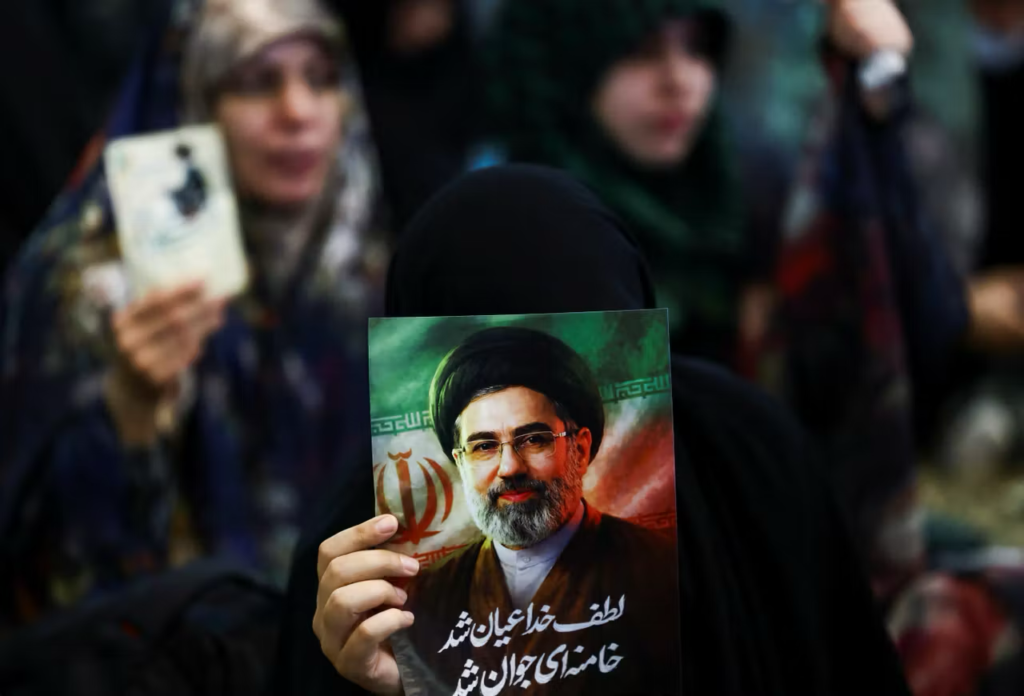

Appointing Mojtaba Khamenei as the new Supreme Leader of Iran signifies both continuity and rupture. The aspect of continuity is primarily represented by the military (IRGC) and the Bayt, which are strong forces within the regime. Conversely, the rupture lies in the fact that Iran no longer adheres to its anti-dynastic and republican claims. Moreover, Mojtaba continues the fusion of many different institutions: the army and economy within the Iranian governing system and society. Some are formal and others are informal. While this illustrates the importance of the post of the Supreme Leader within the system, it also shows how this complex system relies on money, blood, and charity, in addition to the official central and local governments institutions. This analysis is based on an actual conversation between a Kurdish student and an Azeri taxi driver who is also a member of Basij. The student documented the encounter in a travelogue that he later posted on social media, supplemented by an interview with him.
The taxi driver and the Supreme Leader
After spending several months at Tabriz University working on his PhD thesis, Miqdad Shakali decided to return home to Iraqi Kurdistan, according to his travelogue, which he plans to publish as a book in the future. To reach the border, he took a taxi. The driver was a 65-year-old Azerbaijani Turk who spoke broken Farsi. Although it was an ordinary taxi ride in Iran, the journey was long, so they filled the time by listening to music and chatting about various topics. After all, he was an amiable companion, as he writes.
He was suffering from diabetes, but what troubled him even more was his family’s story, Miqdad writes. “Until recently, we lived in a small rented house in the Abbasi neighborhood of Tabriz,” the taxi driver said. The city is the capital of East Azerbaijan Province and considered one of the most important metropolises in the country. Predominantly Shiite Azeris or the Turkish speakers, have historically been considered the country’s most loyal ethno-linguistic minority. They are located in the provinces of West Azerbaijan, East Azerbaijan, Ardabil, Zanjan, Qazvin, Tehran, and Hamadan.
He continued, “Our only source of livelihood was this Peugeot Pars,” he said. Referring to the brand of his taxi. The car brand is a hybridization of the French brand Peugeot and the Iranian Pars. The car itself has a complicated history, as it’s seen to be part of the Iranian Revolutionary Guard Corps (IRGC) industry complex. For this reason, the company that makes the car, Iran Development and Renovation Organization (IDRO), is blacklisted by the US.
“Life became more challenging after my wife stopped working, which happened after our only son, who was a member of the IRGC, was killed in Syria.”
Iran effectively intervened in Syria in March 2013, according to the memoirs of the senior Iranian Revolutionary Guards Commander General Ahmad al-Hamadani. The latter was killed near Aleppo in 2015. The memoir The Fish Letters, borrows its title from a poem by the Iranian poet Sohrab-Sepehri, an attempt to highlight the mysticism and religiosity of the mission. The old taxi driver himself was a member of Basij. The latter is a volunteer paramilitary function as a supplementary part of the IRGC.
“One day, I received an invitation to visit the Bayti Rahbar in Tehran.” The Bayt has representatives in every province through a fusion of mosque-state assemblages. The Bayt-i Rahbar is translated as “house of the Leader” referring to the Supreme Leader of Iran and its complex apparatuses. However, these two concepts require further examination to understand their complex meaning and symbolism. Usually, “Bayt” is translated as “office,” which refers to the office of the Supreme Leader. However, the concept of a bayt is much more nuanced than just a bureaucratic office. In Islamic heritage, the term Ahl al-Bayt (Arabic: أهل البیت) specifically denotes the family of the Islamic prophet Muhammad. This term carries particular significance in the context of Shia Islam. Accordingly, the Ahl al-Bayt have been thoroughly purified from vices, sins, and flaws. Consequently, they are infallible and superior in knowledge, piety, virtues, and character, making them perfect role models to follow, thereby God placing them at the level of leadership and authority for the guidance of mankind. Originating from this ecosystem, the Bayt combines holiness, knowledge, purity, and economic wealth. Therefore, it is considered the Iranian regime’s nerve center. When it comes to institutional trajectory, the Bayt has its own history, which dates back to the early days of the Revolution, especially after the emergence of various multilayered networks that linked revolutionary-religious foundations known as bonyads.
The taxi driver from Tabriz took a bus to Tehran to visit the house of the supreme leader. “Upon arrival, we entered a large hall,” he said. After a while, he [Ali Khamenei] came in, and we all stood up and chanted slogans. After his speech, I raised my hand several times until he noticed me. When he called me to come forward and, in the moment, when I realized nobody was listening, I told him Haji Agha, my only son, was martyred in the fight against ISIS in Syria; his name was Murtaza. I am financially devastated, and Murtaza’s mother has lost both legs in her son’s separation and cannot speak easily. After I left him, the team took my details. Ten days after the meeting, I received a phone call from the leader’s office [Bayt] in Tabriz, and they visited me. After a period of time, they bought me a bigger and newer house and provided me with a salary.
The poor, the master, and the system
As the conversation above shows, the Iranian political and economic system is neither modern as such nor traditional as such. There is a duality of power that runs through nearly all political spheres of the Islamic Republic of Iran. This duality makes the failure a form of governing and a failed modern state to emerge. The individual who manages this failure and governs it is a trusted insider within the system, specifically the son of the former supreme leader. He is not only inheriting the title but also the mode of capturing and controlling the wealth in the country. He takes and distributes it as a form of gaining power and allegiances. Therefore, the Kurdish student’s travelogue encompasses many aspects of the Iranian governing system’s complexity. The impoverished taxi driver of Azari descent, similar to many others in Iran, is integrated into the system via martyrdom and financial assistance. This integration happens through a particular parallel of state apparatuses that operate alongside the state without adhering to its regulations. We see the taxi driver’s family as poor, religious, militarized, and above all connected to the system through martyrdom and blood. These forms of tribal bonding are beyond individual rational secular calculation.
Mojtaba Khamenei grew up within this ecosystem. It knows all its minor details, and no one else is capable of running that mega-institution like him. He was destined to replace his father. He could not have been otherwise. The Supreme Leader is not running the affairs from behind. In the Middle East, historically, when the father plans to prepare the son to inherit the power, they first make him visible in the palace, involve him in meetings, and make him familiar to others. That is what Ali Khamenei did to Mojtaba. He started to treat and consult Mojtaba as he would an eventual successor to his responsibilities, rather than purely as an advisor.”
In his first statement, Mojtaba signed his name as Mojtaba Hosseini Khamenei, rather than the traditional way of name-calling in Iran, which is first name followed by family name. Mentioning Hossein is not without symbols and significance. Hussain was the youngest son of Ali, the Prophet Mohammed’s cousin. When Yazid, son of Muawiyah, became caliph, he demanded allegiance from Hussain. The latter refused. Imam Hussian ultimately had to confront Yazid.
This refusal and consequence of tragic death are at the core of the Shia belief. This is what Mojtaba also alludes to. The replacement of his father was surprising news, but at the same time it was expected. Mojtaba is becoming the Supreme Leader representing Wali al-Asr, the absent Imam Mohammed al-Mahdi, according to the constitution, and, at the same time, he represents his father, Ali Khamenei. The two might be different in many ways; however, they share many features also, among them, their absence. Representing the absent is a particular source of power in the Shia tradition, as the last Imam has gone missing.
Mojtaba can refer to and relate to them in order to deal with his opponents, especially within the system. Iranian elites are notorious for their elites’ infighting. The two absent figures provide a type of legitimacy different from any form of republic-style legitimacy. Representing the Imam during the Occultation is a religious and constitutional duty, while representing the father is a family, social, and cultural duty in addition to institutional and elite cohesion.
Whether Mojtaba survives or not, his inheritance of the father’s seat might be against most of the Iranian revolution principles; the 1979 uprising that toppled the Shah was, above all else, a revolt against hereditary rule, says Iranian theologian Reza Aslan. There are claims that Ali Khamenei had reservations about his son taking over his position. As he was perceived as not very bright and was viewed as unqualified to be a leader, according to sources.
This goes against other information that has been around for a long time, claiming that the Supreme Leader’s son Mojtaba holds extremist views and wields significant influence in the Supreme Leader’s office. However, this makes the Iranian regime depart from its traditional narrative and worldview and embrace its true reality. A power in the hands of a conglomeration of different power centers functions as an arbitration system. Mojtaba might have inherited many elements of power, but for a variety of reasons, it might be hard for him to concentrate all the power in his hands. First, he is injured, not knowing how severe. Second, Iran he inherits is weak and isolated. Third, it is easier for Iran’s enemies to penetrate into the country. Fourth, after the current war, no country considers itself allied with Iran. In addition to all these, he is a wanted president. For all these reasons, Mojtaba has to compromise internally and externally.
Surviving in a weakened Iran with an injured sense of pride will likely lead to harsh consequences for its own people, as well as for neighboring countries, particularly Iraqis and Kurds, and possibly the Gulf states. This dynamic is pushed by further insecurity and revenge-taking. Mojtaba fought against Iraq as a teenager. He has strong connections to Iraqi militias. Currently, the Iraqi elites are expressing concern about the potential outcomes of the ongoing war.