

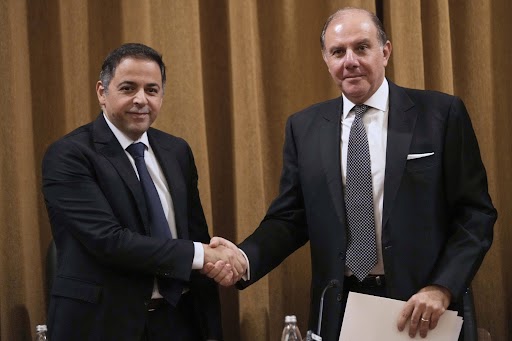

Is a breath of fresh air blowing through the land of the cedars? This is the impression conveyed by the current wave of appointments to the highest echelons of the Lebanese state. Following the election of a President of the Republic and, shortly thereafter, the formation of an executive committed to reforming the country, it is now the Central Bank’s turn to welcome new leadership, with the nomination of Karim Souaid. A lawyer by training, who was elected on March 27 by the Council of Ministers with 17 votes out of 24, succeeding the highly controversial Riad Salameh, who was arrested in September 2024 on charges of financial misconduct.
However, given the background of the new governor of the Banque du Liban (BDL) and the political support behind him, his willingness to implement the financial reforms deemed essential by Prime Minister Nawaf Salam and the International Monetary Fund (IMF) – currently negotiating an aid program with the country – remains uncertain. Since 2019, Lebanon has been grappling with an unprecedented economic crisis, marked by soaring inflation and an external debt exceeding 400% of its GDP. The BDL has played a central role in this crisis, pursuing a monetary policy characterised by artificially stabilised exchange rates and an opaque management of foreign reserves, which contributed to the collapse of the banking sector and the freezing of depositors’ accounts, estimated at US$82 billion.
The appointment of the new head of the BDL is therefore crucial for the future of Lebanon’s economy and its people. In coordination with the executive branch, Karim Souaid will be responsible for outlining the country’s reform roadmap and will serve as the primary interlocutor with the IMF. This highly political election has exposed an initial rift within the new Lebanese executive between the reformist wing, embodied by Nawaf Salam, and, transcending sectarian divides, the entrenched elites of Lebanon’s consociational regime. Finally, this appointment cements the new international balance of power weighing on Lebanon.
Karim Souaid: A Profile Shaped by the Banking Sector
After transitioning to fund management, Karim Souaid developed an extensive network stretching from New York, where he had begun his career as a lawyer, to the Gulf capitals, where he advised players involved in privatization deals. He can also count on multiple supporters within the Lebanese political arena. On the board of directors of the investment fund he founded in 2006, Growthgate Capital, sits Maher Mikati, the son of a former Prime Minister, as well as Varouj Nerguizian, the special advisor on finance and monetary policy to the current President.
His positioning also places him as a close ally of the banking sector, which has long opposed reforms to the country’s financial sector. According to the Financial Times, his appointment was reportedly pushed by Antoun Sehnaoui, the head of one of Lebanon’s major private banks – Société Générale de Banque au Liban (SGBL) – and a prominent member of the Association of Banks in Lebanon (ABL). This proximity raises questions about the stance he will adopt in the context of the reforms sought by the new head of government.
Karim Souaid will have to position himself on two key issues at the heart of negotiations with the IMF, which aim to stabilize Lebanon’s financial sector. The lifting of banking secrecy – a right initially granted and then fiercely maintained by the ABL in exchange for the creation of a central bank in 1964 – is a prerequisite for conducting a serious audit of the BDL and the banking sector. The second major issue is the restitution of deposits, which have been locked in Lebanese banks since 2019, following the collapse of the banking system, as well as the restructuring of the sector.
A Position Contrary to That of the Prime Minister?
On this issue, two opposing views are at play. The first, championed by the banking sector, seeks to place the majority of the losses on the Lebanese state and relies on a rhetoric that holds the state primarily responsible for a system that led to the crisis, while overlooking the fact that private banks greatly benefited from this same system. The other approach advocates that the losses should first be absorbed by the shareholders of the banks and the large depositors. This vision was central to the economic and financial recovery plan negotiated in 2020 between the Lebanese government and the IMF. Potentially leading to the liquidation or merger of insolvent banks, it had faced strong opposition from the banking sector at the time.
While Karim Souaid has openly declared his support for lifting banking secrecy, with a draft law to that effect even being approved by the Council of Ministers on the day of his appointment, the fate of depositors remains much more uncertain. Some observers point to the financing by his fund, Growthgate, of a Harvard study that emphasises an approach placing a significant portion of the losses on the Lebanese state. While this view, which aligns with the banking lobby, contrasts with the one advocated by the new head of government, it nevertheless seems to have considerable resonance within the Presidency. According to L’Orient-Le Jour, a draft law aligned with the ABL’s approach is reportedly being prepared at the Baabda Palace. This would involve the creation of a deposit restitution fund financed by a portion of state assets.
Unlike the draft law proposed in the Council of Ministers at the end of 2023, which was ultimately rejected, the new government has opted to prioritize the restructuring of the banking sector, separating it from the sensitive issue of depositors. Adopted by the Council of Ministers on April 12, the text provides for the creation of a banking authority to oversee the process, which will be chaired by Mr. Souaid. A reflection of the tensions between Prime Minister Nawaf Salam and the governor of the BDL, the composition of this authority has sparked numerous debates. By introducing two external members from regulatory bodies, appointed by the Council of Ministers – the president of the Control Commission and the head of the Deposit Guarantee Corporation – it is expected to reduce the governance influence of the central bank.
Similar to the draft law on the lifting of banking secrecy, the text still requires approval from the deputies, a step that could prove challenging given the weakness of the reformist wing within Parliament.
A Nomination with Strong Political Implications
Beyond its impact on the future of the Lebanese economy, Karim Souaid’s appointment as head of the BDL could mark the beginning of a crisis between the two leaders of the new Lebanese executive. The vote in the Council of Ministers has indeed deepened the divide between ministers close to Nawaf Salam, who come from civil society, and those appointed as concessions to the traditional political parties, such as Finance Minister Yassine Jaber, who is close to Nabih Berry. The Prime Minister has also made no secret of his opposition to the profile of the new head of the country’s monetary policy. Following the voting session, he stated that the governor would need to “adhere to the government’s reformist financial policy.”
More surprising was the support Karim Souaid received from Joseph Aoun, who is generally reluctant to make concessions to the power brokers of Lebanese politics and the financial sector. This positioning seems more a matter of prioritising current issues on his agenda. The former commander-in-chief of the army has chosen to prioritise security matters as the southern suburbs of Beirut were bombed by Israel for the first time since the ceasefire was signed, and as sporadic incidents at the Syrian-Lebanese border continue to multiply.
As evidenced by the visit of U.S. envoy Morgan Ortagus on April 6, the implementation of economic reforms and the disarmament of the Hezbollah politico-military group are strongly correlated for the United States. Ortagus met with various Lebanese leaders, including Mr. Souaid and the Finance Minister, emphasizing that the revival of the Lebanese economy depends on the implementation of reforms and the expansion of state authority.
Washington’s Influence in the Selection Process
Just as was the case with the election of Joseph Aoun, Washington has been heavily involved in the process of selecting the governor of the BDL. The new U.S. administration prioritises the fight against Hezbollah’s financing, as seen with the closure of its al-Qard al-Hassan foundation. Following Donald Trump’s election, Karim Souaid expressed strong support for the new U.S. administration, notably stating that countries in the region “must align their political and financial compass with that of America.”The intervention of the U.S., whose priorities are at odds with those of the new Lebanese executive, suggests an attempt by the Lebanese President to gain leverage on the implementation of the ceasefire in the south in exchange for economic concessions.
Nevertheless, following the bombings in Beirut, the U.S. renewed its unconditional support for Israeli policy in Lebanon. On the economic front, they may even come to pressure the IMF. As the largest contributor, Washington has significant blocking power within the institution. Furthermore, Karim Souaid’s appointment completes the marginalisation of French diplomacy on the Lebanese issue. Unlike the new U.S. administration, France remains sensitive to adhering to IMF conditions. During his visit to Beirut on March 26, French envoy Jean-Yves Le Drian was met with a firm rejection when he proposed a compromise solution to appoint a different governor.
At the crossroads of economic and diplomatic issues shaping Lebanese political life, the election of the new central bank governor reveals the new international power dynamics in Beirut. Pushed by Washington with the support of actors deeply embedded in the politico-economic system that has devastated the country, he embodies the inertia that prevents Lebanon from opening up to new horizons.