


[Lyna Ouandjeli] To set the context for our discussion, we will look at Iran’s position in response to the evolving situation in the Middle East after October 7, 2023. This date marked a major shift in the region, especially with the Israel-Hamas conflict[1]. These changes have led regional players, including Iran, to adjust their strategies. Tehran seems to be refocusing on its regional interests, relying on its proxies. We will explore whether Iran is heading towards instability or managing to stay in control.
[Lyna Ouandjeli] So the first question is: how has Iran adjusted its regional strategy after the events of October 7, particularly regarding its proxies and its relations with the Gulf States?
[Bernard Hourcade] I believe that October 7 marked the unexpected onset of major upheavals across the region, affecting Israel, Syria, Iran, and Saudi Arabia. The Palestinian issue, long sidelined, suddenly resurfaced with force. Iran was not directly involved in Hamas’s initiative, which did not appear to be planned by Tehran. However, this event set in motion a dynamic with an uncertain outcome. In this process, Iran plays a central role, particularly through Hezbollah[2], one of the key successes of its regional strategy. However, this influence has been severely tested: militarily weakened by the “beeper affair,” which decimated its leadership, Hezbollah also suffered the loss of Hassan Nasrallah (September 27, 2024). Additionally, the rapid collapse of the Syrian regime—Iran’s main ally since the Iran-Iraq War (1980-1988)—marks a decisive turning point. What is unfolding today could be seen as the end of an era: that of the Iran-Iraq War and Iran’s proxy strategy. At the time, Iran, under attack by Iraq and diplomatically isolated, sought regional allies, particularly among the Shiites of southern Lebanon, leading to the creation of Hezbollah. Today, the rapidly evolving situation is challenging this policy, forcing Tehran to redefine its strategic priorities.
This dates back 45 years. Today, we have entered a new phase. Iran had understood that it needed to distance itself from its proxies, which, although valuable instruments of influence and significant military forces, had become a burden. Tehran’s priority was no longer to expand its regional influence but to preserve the Iranian state itself, weakened by a severe economic crisis, U.S. sanctions, and years of internal mismanagement. With this in mind, Iran was considering a gradual disengagement from Hezbollah, the Houthis[3], and affiliated militias. However, this withdrawal had to be methodical and controlled. But the events of October 7 disrupted these plans, abruptly accelerating the process. Iran now finds itself in a delicate position, giving the impression of having been defeated, though this is not entirely the case. Nevertheless, it has suffered a major strategic setback. The Revolutionary Guards, once the spearhead of the Islamic Republic, have been humiliated, forced to abandon Lebanon and Syria without even engaging in battle. And an army that withdraws without fighting is perceived as defeated. Yet, Iran still has other levers of action, which we will discuss further.
[Lyna Ouandjeli] My colleague, who is an intern, Ishaan, will ask you the second question.
[Ishaan Louarn] Hello, Sir. The second question is as follows: To what extent has the war in Gaza forced Iran to reconsider its support for armed groups such as Hamas and Hezbollah?
[Bernard Hourcade] The war in Gaza is an exceptionally large-scale conflict. Never before has a United Nations (UN) member state, like Israel, attacked an external territory to such an extent, systematically devastating it. Beyond the number of casualties, what stands out is the total annihilation of infrastructure: water and electricity networks, sanitation systems, cemeteries, homes […] it is the destruction of a territory. This conflict has taken on a new dimension, but it has also put Iran in a difficult position. Tehran has always supported the Palestinian cause within the framework of the “axis of resistance,” but it now finds itself weakened by the simultaneous collapse of Hezbollah and Syria. Iran is therefore in a tough spot: if it continues to support Hamas, it must also confront a strategic defeat it had not anticipated. This war is accelerating regional dynamics, particularly by strengthening Israel’s military and political power, as it benefits from unwavering support from the United States. For Iran, this confrontation with Tel Aviv comes at a particularly unfavorable moment. Tehran had hoped to revive dialogue with Washington and European countries, especially within the framework of nuclear negotiations. However, this war seriously jeopardizes that strategy, placing Iran in an even more precarious situation.
[Lyna Ouandjeli] Considering both Iran’s central role and its vulnerabilities in the conflict between Israel and, to some extent, Iran itself as it tries to support the Palestinian cause, do you think its growing involvement in this Israeli-Palestinian conflict has ultimately strengthened or weakened its position on the regional stage?
[Bernard Hourcade] What is essential to note is that, starting with the election of Ebrahim Raisi in 2021-2024, Iran decided to distance itself from some of its proxies, which had become obstacles to a possible international opening and the lifting of sanctions. However, this withdrawal was accelerated by recent events. Iran made the strategic choice to defend itself alone and refocus its priorities on its national territory, marking a break with the revolutionary Iran that once sought to export unrest in the region. Today, the Islamic Republic is threatened in its very existence and is retreating to its tried-and-true values. The Iranian attack on April 13 and 14, 2024[4], illustrates this strategic turning point. On that night, nearly 400 projectiles – drones, cruise missiles, and ballistic missiles – were launched from Iran toward Israel, 1,200 kilometers away. A large portion of these projectiles was intercepted by a coalition including the U.S., British, French, Israeli, and Jordanian armies. This episode highlighted an international mobilization in response to Iran’s actions.
Far from seeking to inflict major damage, Iran wanted to send a clear message: it will no longer rely on its proxies, such as Hezbollah, to target Israel. From now on, it favors its own military capabilities to defend its territory. The issue of Hezbollah and Palestine is not solely Iran’s concern, but rather that of all the countries in the region. Iran refuses to bear alone the cost of the conflict that Israel is waging against the Palestinians. Thus, it distances itself from the Palestinian cause, as its priority is primarily the defense of its own national territory. This repositioning marks a major strategic shift. In this context, a direct consequence is emerging: the Palestinians could be the main losers. Iran has clearly stated that the protection of its territory and the preservation of the Islamic Republic now take precedence over everything else. While Hezbollah and the Palestinians remain part of the resistance axis against Israel, they are no longer an absolute priority. Therefore, it is feared that this loss of priority will lead to a weakening of Iranian support for the Palestinians.
[Ishaan Louarn] Given these new regional dynamics, do you think Iran still has control over the evolution of the Shiite crescent, or is it being surpassed?
[Bernard Hourcade] It is surpassed. When we spoke about the Shiite crescent[5], I was against this analysis, which relied on religious explanations. Since 1979[6], the entire Middle East has been analyzed through the lens of Shiism versus Sunnism, with everything explained by religion, including the martyrdom of Imam Hossein[7]. Religion is, of course, important, but reducing everything to religion is a mistake. It’s not a Shiite axis, although it exists; it is primarily the Iranian axis, a political project that stretches from Tehran to the Mediterranean, opposing Saudi Arabia and Israel. In reality, it’s not an axis, but an Iranian network. Iran has a network; it’s not a physical highway from Tehran to Beirut. It’s much more complex than that. The Shiite crescent never existed as such. What existed was an Iranian policy of regional influence through proxies. This tactical, military, and political logic disappeared with the fall of Hezbollah and Syria. Today, Iran is retreating to its own territory and seeking to defend its regime and national territory from within Iran. There is a complete refocusing. Iranian nationalism has taken precedence over the Iranian revolution. It’s a true turning point.
[Lyna Ouandjeli] We are focusing here on the relationship between Iran and Saudi Arabia. Since the fall of Bashar al-Assad’s regime, Saudi Arabia has taken a more prominent role in the region, notably organizing conferences. One such conference is scheduled for February 27, primarily focused on the situation in Syria, with another potentially taking place in June in cooperation with France. In this context, do you think the rapprochement between Iran and Saudi Arabia, similar to what was observed in the 1970s before the Iranian revolution, remains viable after the events of October 7 and the fall of the Syrian regime? Could this rapprochement be compromised by the regional tensions that have resulted?
[Bernard Hourcade] Absolutely. I believe that in recent developments, the rapprochement between Iran and Saudi Arabia represents a key step. As I mentioned earlier, Iran is refocusing on its own territory. For Iran, what matters most are its neighboring countries. Iran shares borders with 15 countries[8], the Caspian Sea being a lake and the Persian Gulf also a shared space. In other words, Iran’s priority is security with its neighbors. Of course, Palestine, Israel, and other issues are important, but the priority remains there. Among these neighbors, it is not Afghanistan, Iraq, or Azerbaijan, but Saudi Arabia, the other major country in the region. Although it is very different from Iran for a thousand reasons, as you mentioned earlier, in 1973[9], when Richard Nixon visited the region, he told the Shah of Iran and the kings of Arabia, “You are the policemen of the Gulf.” At that time, it was to protect American oil, but today it is no longer American oil, and yet they are once again the policemen of the Gulf. These are the two major countries still capable of playing a role, with Iraq devastated by war, Syria too, Egypt somewhat sidelined, and Afghanistan having taken another path. These two countries, with their different strengths and weaknesses, may be complementary. For Iran, having a strategy of cooperation with Saudi Arabia, not necessarily friendship, but at least good neighborly relations, becomes crucial for regional stability. Iran and Saudi Arabia have distinct visions and means of action, with Iran close to China and Russia, and Saudi Arabia with the United States. It is possible to find common ground. The Gaza war accelerated the events, just as Trump’s election also had an impact. But for Iran, today, the strategic priority is no longer the axis of resistance against Israel, but rather building something sustainable with Saudi Arabia. This cooperation could help rebuild the Middle East, not under the auspices of Israel as with the Abraham Accords, but rather with a Middle East led and energized by the two major powers of the region, Iran and Saudi Arabia, who could bring their specific dynamics to pull the region out of the current crisis.
[Ishaan Louarn] You started to mention the issue of Trump. What impact did Donald Trump’s arrival in power have on the Iranian nuclear issue?
[Bernard Hourcade] The war and the axis of resistance have profoundly changed. Far from disappearing, it is now Saudi Arabia that seems to be taking up the torch, as evidenced by recent conferences[10] on the issue. Resistance to Israel is now embodied in Arab countries, while Turkey and Iran no longer play a central role in this axis. It is these Arab states that openly reject Trump’s proposals on Palestine[11], thus adopting the position that Iran had historically held. Paradoxically, the heir to the axis of resistance is no longer Iran, but Saudi Arabia, even though it had never desired this role. The Palestinian issue remains an unmanageable crisis, over fifty (seventy) years old, which brings nothing but difficulties to those who get involved, with no real political or strategic gain. Yet, it remains unavoidable. Both Iran and Saudi Arabia recognize that, without a lasting resolution to this conflict, the region will never know stability. So far, every attempt at resolution, since the Oslo Accords[12], has only lasted a few years before collapsing. If a lasting solution is to emerge, it must be more solid and comprehensive. Iran faces a dilemma: it cannot completely abandon the Palestinian cause, as that would give Saudi Arabia a leverage of power, making it an unavoidable actor in the region. Iran has long cultivated its image as the defender of Jerusalem, and losing this strategic asset would significantly weaken it. This rivalry between the two powers is very real. It is in this context that Trump implemented his own method, notably through the Abraham Accords[13], which redefined regional alliances.
In 2020, the Abraham Accords allowed Israel, which had been distant from the Gulf, to establish official relations with the United Arab Emirates and Bahrain, while Saudi Arabia began moving toward rapprochement. Iran, on the other hand, found itself surrounded, which increased its hostility toward Saudi Arabia and intensified conflicts, especially in Yemen. This gradual integration of Israel into the dynamics of the Persian Gulf contributed to the explosion of the October 7 conflict. The recognition of Israel by Arab states had become a political reality, and Hamas violently opposed it. It categorically rejects any normalization between Saudi Arabia and Israel, as well as the possibility of an agreement between Iran and the Jewish state. It was in this context that the October 7 attack occurred, a tragic consequence of the Abraham Accords. By trying to impose a new order in the Middle East, Trump actually triggered this war. Today, he is back on the scene with new proposals, notably in Ukraine, where he favors surprising financial solutions. Iran, meanwhile, is undergoing a major economic and political crisis. Protest movements, particularly those by women after the killing of Mahsa Amini, reflect deep unrest within Iranian society. The economic situation is disastrous, and the reformist government of Pezeshkian, although supported by the Supreme Leader, is struggling to stabilize the country. The nuclear issue remains unresolved, but negotiations with Europe are ongoing. Trump seeks to establish himself as the man of the situation by playing the mediator. He negotiates with Saudi Arabia, which has become the key intermediary between Iran and the United States. This is a difficult reality for Tehran to accept, but one that is gradually taking hold. By upsetting regional balances, Trump forces Saudi Arabia to assume a central role in managing Middle Eastern crises. He imposes on it the responsibility to financially invest in the reconstruction of Gaza and to adopt a constructive regional policy. Meanwhile, he pressures Iran: either it accepts a nuclear agreement and limits its missile arsenal, or Washington strengthens its support for Riyadh. This balancing act relies on the rivalry between the two powers, with neither wanting to see the other triumph or collapse entirely. But a question arises: Is Trump truly capable of conducting such a sophisticated strategy? He has already started a war and exacerbated tensions between Iran and Saudi Arabia. A confrontation between these two states seems unlikely, but the evolution of regional power dynamics remains uncertain. The growing concern is the current escalation, particularly in the West Bank, where the destruction of Palestinian camps continues under inhumane conditions.
Moreover, some sources, including the Washington Post, mention a potential Israeli attack on Iranian nuclear sites in the coming months. This possibility has sparked many speculations about the exact timing, but the key issue is not there: Israel aims to strike Iran as it did with Syria, weakening its national army in the process. Such an attack would be a gift from Trump to Israel, giving it a dominant position in the region. However, if this occurs, Iran will inevitably respond, leading to the rise of the most radical factions within the regime. In a country of 92 million people, many of whom aspire to a normal life, such a confrontation would only prolong the internal crisis and strengthen the extremists. The destruction of Iranian nuclear sites would plunge the Middle East into open warfare with incalculable consequences, with hundreds of thousands of deaths, the Iranians being the primary victims. In the face of this explosive situation, the real question is whether Trump will have the courage and clarity to adopt a diplomatic approach. Will he be willing to encourage Israel and Saudi Arabia to negotiate, while offering Iran sanctions relief in exchange for a compromise? This scenario, though complex, would be the only way to avoid a new regional escalation. But Trump’s personality, swinging between boldness and unpredictability, hardly suggests a positive outcome. His return raises many concerns, and the future of the Middle East remains more uncertain than ever.
This would be complicated. Can Donald Trump, in his great wisdom and madness, actually do something? I wonder, but I am very worried.
[Lyna Ouandjeli] How do you perceive the impact of recent events on the geopolitics of the Middle East, particularly after the early February speech between Donald Trump and Benjamin Netanyahu in Washington, where the potential displacement of Palestinian populations to Jordan and Egypt was discussed? In this context, how do you analyze the position of these countries, caught between their alliances with the United States and the internal dynamics linked to their public opinion? Moreover, as Iran seems to be strengthening its military cooperation with Moscow and considering nuclear negotiations with Washington, do you think these developments will influence its relations with the United States? Would Donald Trump be inclined to engage in such negotiations or adopt a more rigid stance? What is your analysis of this issue?
[Bernard Hourcade] Donald Trump, by making such extreme statements about the “French Riviera,” Gaza, and so on, paradoxically forced Arab countries to realize the gravity of the situation and acknowledge that their traditional stance was no longer sustainable. The King of Jordan recently emphasized this: if Israel carries out its plan in Gaza, Jordan and Egypt, despite being allies of the West, could face internal revolts they may not survive. This would be a major blow to regional stability, and Trump understands this. The same applies to Russia. Iran is cleverly using its relations with Russia and China to send a clear message to the United States: if its interests are not taken into account, other powers are ready to fill the void. However, historically, Russia has always been seen as a central adversary by Iran. Since the 18th century, the Russian Empire conquered the Caucasus provinces at Iran’s expense, and the Soviet Union invaded the country during World War II. These events fostered a deep mistrust of Moscow, a mistrust that persists to this day. However, geopolitics demands pragmatism: Russia is an indispensable neighboring power, and it is rational for Iran to maintain relations with it. A 20-year strategic agreement was signed between the two countries, but in practice, such agreements are essentially tactical. They do not reflect a deep alliance but rather serve to demonstrate that an alternative to American influence exists. Iran’s main objective is regional stability: it seeks to maintain peaceful relations with its neighbors and to develop as a stable regional power, after 45 years under an Islamic regime. Iran is also the only country in the Middle East to have experienced an Islamist regime for such a long time. This experience allows it to draw both benefits and limits from it. Socially, Iranian society is one of the most advanced in the region. The role of women is a striking example: whether they wear the veil or not, they are among the most active and socialized in the Middle East. Furthermore, the general education level in Iran is one of the highest in the region, thanks to a dense university network and notable technological advancements.
Iran is one of the few nations capable of placing satellites into orbit, a technological feat mastered by only five countries in the world. This demonstrates that Iranian society has considerable potential to build a better future. However, the country finds itself in a precarious situation, oscillating between positive prospects and risks of destabilization, particularly after the geopolitical earthquake triggered by October 7. The uncertainty is heightened by Donald Trump, whose decisions remain unpredictable. Today, Sergei Lavrov, the Russian Foreign Minister, is in Tehran to negotiate with the Iranians and try to find solutions in a context where both Ukraine and Iran are playing their cards in a high-stakes game. The Middle East is undergoing a major transformation: alliances and power dynamics are being redefined, and it is difficult to determine who truly holds the advantage. Iran, for its part, seems to be opting for a strategic retreat. The April 13-14 missile attack confirmed its status as a regional power, but without an exacerbated expansionist ambition. This evolution is part of a larger context in which the Middle East’s geopolitical map is being reshuffled. Saudi Arabia, once marginal on the international stage, is now a key player, with a clear political vision and a society undergoing transformation. In contrast, other countries remain deeply wounded. Iraq is a martyred nation, as is Syria, not to mention Afghanistan. What can be hoped for is that Iran does not suffer the tragic fate of these nations. However, this hypothesis seems unlikely, as Iran benefits from a strong tradition of national unity and a well-established state structure. Unlike Syria or Iraq, it is not mired in civil war, which allows it to maintain relative stability despite regional tensions.
It is therefore imperative to rethink the situation. We are at a moment similar to that of 1960, when the Algerian War was coming to an end, and colonial independence marked the collapse of an old order. After that, the Islamic Revolution in Iran allowed political Islam to manifest itself, providing the Muslim world with a unique means of expression. However, that phase is now over. Political Islam, although still an important geopolitical factor, is no longer the central dynamic, whether it concerns the Shiite arc, the Sunni arc, etc. Today, we are witnessing an Iran that, for example, has clearly expressed its desire to stay away from major international alliances, preferring a certain autonomy. At the same time, the BRICS countries, which were once colonized or underdeveloped, are striving to assert themselves on the global stage, although China and Russia have distinct ambitions. We are thus entering a new geopolitical phase, and the Middle East mustn’t become a dramatic and military battleground for this global reshaping. The Palestinian crisis is its symbolic heart. Unfortunately for the Palestinians, their situation goes far beyond their own people. Although they are a small people, with only 5 to 7 million inhabitants, and their territory is modest, the resolution of the Palestinian issue remains key to stability throughout the Middle East. The Palestinian issue is therefore of paramount importance for the future of the region. Thanks to the Palestinians for their resilience, but they will need a lot of courage to face the challenges that lie ahead.
[Lyna Ouandjeli] My last question would likely touch on two points you raised. The fall of Bashar al-Assad’s regime on December 8, 2024, truly shocked the international community, especially the European Union, the United States, and even Syria’s neighbors. Many have doubts about the transitional government led by Ahmed al-Charaa (HTC). Previously, it had been observed that Syria and Iran had experienced tensions, particularly on the political front. Iran had demanded that Bashar al-Assad protect the Golan region, a task he could not fulfill due to the weakened Syrian army. The Syrian economy has suffered significantly, and it has become evident that Syria heavily relies on resources like captagon to sustain itself and pay both military personnel and government employees. Iran has tried to support Syria repeatedly, but Syria remains heavily indebted to Iran. In this context of Middle Eastern reconfiguration and Iran’s strategic renewal, which now seeks long-term solutions instead of relying solely on nationalism, it is crucial to consider the need for renegotiating relations with neighboring countries. Iran will not completely isolate itself and will continue to play a key role in the region.
Following Ahmed al-Charaa’s current approach, which seeks to include all minorities – including Kurdish and southern armed groups – within the Syrian army, do you think there could be a rapprochement between Syria and Iran if we set aside the religious issue, despite the tensions between Sunni and Shia? Could Syria once again become a solid ally for Iran in this speculative context? Additionally, Lebanon is also seeking a new government, and Joseph Aoun has proposed a new ministerial team. It remains to be seen how this will evolve, particularly due to the need to deal with Hezbollah, which cannot be ignored in Lebanese politics. The question is whether Syria, Lebanon, and Iraq, with elections scheduled for the end of 2025, could become strategic allies for Iran. Do you think Iran could successfully establish new, solid ties with these regimes as they consolidate?
[Bernard Hourcade] As I mentioned earlier, the Iran-Iraq war is now over. Iran, which sought to ally with Syria to confront Iraq and with Hezbollah to oppose the French, Americans, and Israelis who supported Saddam Hussein, has closed that chapter. Iran’s Mediterranean ambition and its alliance with Syria remain, of course, but the Lebanese state, just like the Syrian state, as well as the Lebanese (Shia and non-Shia) and Syrian populations, still carry a negative memory of that period. Iran appeared as a colonizer in Syria, initially as a protector, but it also profited from the situation while spending money. That era is now over. I believe that the government in Damascus, whether led by al-Charaa or another actor, will not want the Iranians to return as “good allies” or “close friends”; that relationship belongs to the past. Even during the last years of Bashar al-Assad’s rule, Iran and he disagreed on many issues. As a result, Iran is now looking to withdraw from Syria. Inside Iran, some political groups wanted to maintain a presence, citing the need to fight against Israel, but internal political divisions are very deep.
In conclusion, Iran is now turning towards the Persian Gulf, Saudi Arabia, Kuwait, Iraq, and opening up relations with China. Iran sees itself as a South-West Asian country, not a Middle Eastern one, asserting that the Near East belongs to a different dynamic. The 40-year Iranian adventure, marked by its support for Hezbollah and Syria, is, in my opinion, over. There will certainly be consequences and continuities, but priorities have radically changed. What needs to be understood today is that Iran, within this new strategy, is primarily focused on protecting itself and developing. But we should not expect a lasting friendship between Iran, Lebanon, and Syria. At best, Iran will have good neighborly relations and will try to recover its money. I believe Iran has abandoned the idea of recovering the 30 or 40 billion dollars it lent or spent in Syria and Lebanon. This is a closed chapter, part of the past. Just as Trump did not claim the money lost in the June 6, 1944, landings in France, Iran will not seek to recover that lost money in Syria. This page has definitely been turned, and it was difficult to turn.
[Lyna Ouandjeli] Thank you very much. We will closely follow the evolution of the situation in Iran and observe how it unfolds, particularly regarding its withdrawal from the international stage. It will be interesting to see if Iran manages to overcome some of its economic and social challenges, especially after the numerous protests and the human rights violations against certain communities, notably women. However, it seems that Iran has a certain potential for the future. It appears to have become more aware of its strengths and significance. Iran may become more open, which could represent a positive aspect in this reshaping of the Middle East, where dynamics have truly changed.
[Bernard Hourcade] Certainly, I think there are positive aspects that may emerge. However, it is important to consider the internal political consequences in Iran following recent events. Iran is deeply divided, with political forces that have shaped the Islamic Republic. The Supreme Leader has managed to keep everyone under control for now, but it is a “basket of crabs” that is gradually fracturing.
The question is whether, in this dramatic situation, Iran will implode or explode—it is uncertain. The regional and internal issues are important, and I don’t have an answer yet.
[Lyna Ouandjeli] Thank you very much for your time.
Notes
[1] Editor’s note: Hamas, officially known as the Islamic Resistance Movement, originated from the Muslim Brotherhood and was founded during the First Intifada in 1987 as the group’s political branch. As a Palestinian nationalist and Islamist movement, Hamas does not recognize the State of Israel and has always aimed to reclaim militarily occupied Palestinian territories and establish a theocratic Palestinian state. Hamas is designated as a terrorist organization by several countries, including the United States, Canada, the European Union, and the United Kingdom, among others.
[2] Editor’s Note: Hezbollah (“Party of God”) is a Shiite Islamist political party supported by Iran and a paramilitary group in Lebanon. The movement was founded in June 1982 in response to the “Peace for Galilee” operation, during which Israel invaded Lebanon in an attempt to eradicate militants of the Palestine Liberation Organization (PLO) who had taken refuge there since the 1960s. Its emblematic leader, Hassan Nasrallah, led the militia from 1992 until his assassination in September 2024.
[3] Editor’s note: The creation of the Houthi movement, a group primarily composed of Zaydis (a minority associated with Shiism), dates back to the 1990s when religious leader Hussein al-Houthi led a rebellion against President Ali Abdullah Saleh, whom he accused of corruption. After several internal splits within the movement, the Houthi faction adopted the name of their leader and became radicalized in the early 2000s. The turning point was the U.S. invasion of Iraq. They are also known as “Ansar Allah.”
[4] Editor’s note : For more information on this topic, you can refer to the article from Le Monde., « L’Iran lance une « vaste attaque » de drones et de missiles contre Israël », Le Monde, 13 April 2024.
[5] Editor’s Note: The concept of the Shiite Crescent is based on the broad observation of a geographical continuity of Shiite presence (Northern India, Pakistan, Afghanistan, Iran, Iraq, Syria, Lebanon, Yemen, and Bahrain). It emerged in 2004 following a statement made by King Abdullah II of Jordan.
[6] Editor’s Note: The year 1979 refers to the Iranian Revolution, which took a religious turn under the leadership of Ayatollah Khomeini.
[7] Editor’s Note: Hossein was the son of Ali ibn Abi Talib, the fourth caliph of Islam and the first Shiite Imam. He was also the grandson of the Prophet Mohammed. He became the third Imam of Twelver Shiism. In 680, during the Battle of Karbala, he was killed by the forces of Umayyad Caliph Yazid I. Hossein refused to pledge allegiance to the caliph, whom he considered a tyrant. His martyrdom is commemorated each year during the month of Muharram, particularly on the day of Ashura.
[8] Editor’s note: Iran shares its borders with Armenia, Azerbaijan, Turkmenistan, Turkey, Iraq, Kuwait, Oman, Saudi Arabia, Bahrain, the United Arab Emirates, Qatar, Yemen, Syria, Afghanistan, and Pakistan. Here, Bernard Hourcade refers to both land and maritime borders, as well as mixed borders (such as using an allied country like Iraq for Syria, or Yemen with the Houthis).
[9] Editor’s Note: In 1973, under the presidency of Richard Nixon, relations between Iran and Saudi Arabia were characterized by strengthened strategic cooperation in the context of the Yom Kippur War and the oil crisis.
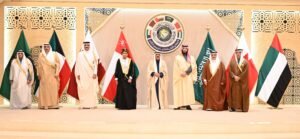
[10] Editor’s Note: On February 21, 2025, the Kingdom of Saudi Arabia convened Arab leaders to discuss their joint efforts to support the Palestinian cause and the situation in the Gaza Strip. Saudi Arabia hosted Russia and the United States in Riyadh on February 22, 2025, to formalize both the thaw in relations between the two countries and pave the way for dialogue on ending the war in Ukraine. The discussions also addressed the issue of Israel and Palestine.
[11] Editor’s Note: This refers to the speech given by U.S. President Donald Trump on February 4, 2025, regarding the construction of a “Middle East Riviera” in Gaza, the potential takeover of the area by Washington, and the forced displacement of Gazans to Jordan or Egypt.
[12] Editor’s Note: The Oslo Accords (September 13, 1993) began with secret discussions in Norway. By late summer 1993, initial drafts of an agreement leaked to the press. Israel agreed to a self-governing arrangement in the Gaza Strip and Jericho. On September 10, Israel recognized the Palestine Liberation Organization (PLO) as the “representative of the Palestinian people,” though without mentioning the establishment of a “Palestinian state.” The accords were signed on September 13 based on these terms. However, history shows that the agreements did not last long due to events in 1994, including the Cave of the Patriarchs massacre in Hebron, carried out by an Israeli Jew against Palestinians, Hamas’s retaliatory attacks targeting Israeli civilians, and the major turning point: the assassination of Yitzhak Rabin on November 4, 1995, by a far-right religious Israeli.
[13] Editor’s Note: The Abraham Accords (September 15, 2020) established the normalization of diplomatic relations between Israel and the United Arab Emirates, as well as Bahrain. Morocco and Sudan followed shortly after. Behind these agreements, the Trump administration aimed for Saudi Arabia to join these states and normalize its relations with Tel Aviv. However, this did not materialize, as the events of October 7, 2023, put the project on hold.