


Terrorism: Daesh, a ticking time bomb
The terrorism in all its forms and manifestations (Ansar al-Islam, Ansar Al-Sunna, Al-Qaida, Daesh) poses a serious threat to Iraq. While it is true that the origin of movements embracing terrorism as a weapon of war can be traced back to periods predating Saddam Hussein’s regime fall, it must also be acknowledged that United States-led invasion of Iraq has significantly contributed to the transformation of terrorist movements into a substantial threat not only for contemporary Iraq but also for its future, as we will explain in the following pages.
The birth of terrorism in Iraq
In the beginning was the Muslim Brotherhood (MB)! Back in the 1950’s, the MB established itself in Iraq, opening a first cell in Baghdad, a second one in Mosul and a third one in Halabja, in Iraqi Kurdistan, 15 km from the Iranian border. In the 1980s, the Kurdish MB decided to engage in jihad against Saddam Hussein’s regime by joining the Kurdish national struggle alongside the Kurdistan Democratic Party (KDP) and the Patriotic Union of Kurdistan (PUK).
After the liberation of Iraqi Kurdistan from Saddam Hussein’s regime in 1991, the militant base of Bzotnawa came back to the country and set up in towns near the Iranian border, within the Halabja region. Between 1990 and 2000, a significant portion of the new generation within Bzotnawa became radicalized. They started to follow the model of Osama bin Laden’s jihad and abandoned the model of their ulemas, cultivated within Bztonawa since the 1980s—a model centered around jihad as a struggle for the national emancipation of the Kurdish people. Thus, in the early 2000s, in the mountains of Iraqi Kurdistan, specifically in the village of Biara, the first terrorist movement was born. Separating from Bzotnawa, the internationalist jihadists established a new organisation named Jund Al-Islam (Soldiers of Islam), which would rapidly transform into Ansar Al-Islam (Partisans of Islam).
From its inception, the organisation declared a holy and total war, not only against the Kurdistan Regional Government but also against the entire Kurdish society, labeled as unbeliever (kafir). As a result, and for the first time in the history of the Islamist movement in Kurdistan, the slaughtering of Kurds, including activists from political parties or even those with no political affiliation, was carried out in front of the terrorists’ cameras. This was a profoundly shocking event for the entire Kurdish society.
Ansar Al-Islam would practice all forms of terrorism (kidnapping, torture, beheading, car bombings, assassination, etc.) until March 20, 2003. From that day onwards, American Tomahawk cruise missiles rained down on Ansar al-Islam, destroying their military bases. Hundreds of jihadists were killed. As for the thousands of survivors, they disappeared across the Iranian border.
From Afghanistan to Iraq: The Migration of Internationalist Jihadists
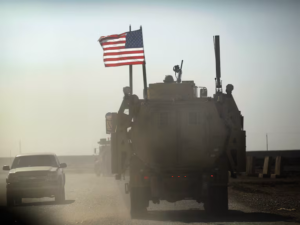
On April 9, 2003, the first American tanks entered Baghdad. Saddam Hussein’s regime fell, and thousands of U.S. troops occupied the country. Alongside them, internationalist jihadists scattered not only in Iran but all over the world, and made their way to the Arab part of Iraq. Thus, the two sides—the American camp on one side and the jihadist camp on the other—turned Iraq into the arena for their confrontation.
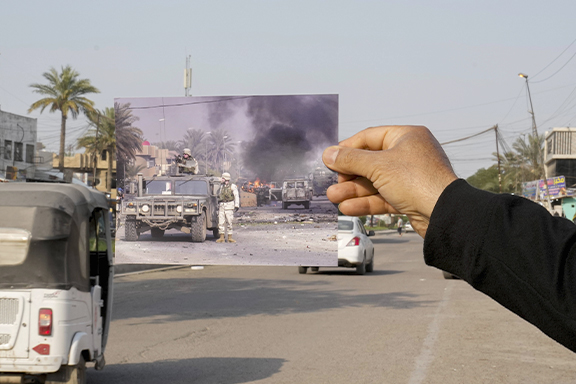
Photo of the same street in Iraq under the occupation of the US army in 2003
In this context, Ahmed Fadil Nazzal al-Khalayla, known as Abu Musab al-Zarqawi, emerged on the new Iraqi scene as the reference point for international jihadism in Mesopotamia. He would quickly unite and lead all the Islamist groups—local, national, and international—engaged in the war against the Americans and their Shiite-Kurdish allies. Born on October 20, 1966, into a poor and large family of three sons and seven daughters, young Ahmed, in order to contribute to his family’s survival, dropped out of elementary school and began “taking on odd jobs for short periods.”
During his teenage years, the young Ahmed, accustomed to minor delinquency, was quickly taken under the wing of a Salafist imam from a small mosque in his neighbourhood. As a result, a rapid, simplified religious resocialization tailored to his profile—Salafist version—prepared him to embark on the path of jihad in Afghanistan. In 1989, at the age of 23, young Ahmed arrived in Hayatabad, on the outskirts of Peshawar, where he would be housed and fed by the Services Office, founded by Abdullah Azzam and Osama bin Laden. It was during this time that Ahmed became Abu Musab Al-Zarqawi, received military training, and participated in several battles alongside Afghan jihadists, including the liberation of the city of Khost, in Eastern Afghanistan.
From 1989 to 1993, Abu Musab remained active between two countries, Pakistan and Afghanistan. Through his dynamism and connections with high-ranking Arab and Afghan leaders such as bin Laden, Zawahiri, Hekmatyar, and Sayyaf, he quickly made a name for himself. In 1993, at the age of 27, highly experienced, Ahmed returned to Jordan and immediately devoted himself to the jihadist ideals. However, he soon realised that Jordan was not Afghanistan and that he could not benefit from the same level of manoeuvrability. In 1994, he was arrested by Jordanian authorities for possession of weapons and falsification of passports and sentenced to fifteen years of imprisonment. However, the ascension to the throne of the new king, Abdullah II, in 1999, led to his amnesty. He immediately left for Pakistan again.
A year before the events of September 11, 2001, he set up in Afghanistan to lead a training camp near the city of Herat. Internationalist jihadists saw in him an orderly, organized, and disciplined leader. When the Americans bombed Afghanistan in December 2000, before invading, Zarkawi took this time the path to Iraqi Kurdistan, along with hundreds of internationalist jihadists, where they were welcomed as heroes. In the mountains of Kurdistan, Zarkawi discreetly observed the differences existing between the Afghan and Kurdish fields. In Afghanistan, Islamist parties completely dominate the landscape; anyway, there are only Islamist parties. However, in Kurdistan, the two secular Kurdish parties, the Kurdistan Democratic Party and the Patriotic Union of Kurdistan, dominate the region, with Islamists existing only at the margins. Consequently, a massive occupation of the field by internationalist jihadism is not very likely. This brief period ended with the destruction of Ansar Al-Islam’s military bases by the Americans and the special forces of the Kurdish Peshmergas in March 2003. Accompanied by his internationalist jihadists, as well as by Kurdish jihadists who definitively lost their ground, Zarkawi left Kurdistan to settle in Iraq, now under American occupation. Between 2003 and 2006, Zarkawi, at the helm of the Iraqi branch of Al-Qaeda known as Al-Qaeda in Mesopotamia, turned Iraq into an absolute hell, both for Americans and Iraqis. Car bombings, beheaded hostages, and bomb attacks—Zarkawi led a bloody war in the country. On July 1, 2004, facing great difficulty against terrorist operations, the Americans offered a reward of 25 million dollars to anyone who would provide information leading to his capture.
From 2004 to 2006, the entire American power in Iraq was focused on his capture, yet the child of Zarqa always managed to escape and escalate the degree of radicality of his violence. Until June 8, 2006, when he was ultimately killed by the Americans. The announcement was made by the commander of American forces, George Casey, and the Iraqi Prime Minister, Nouri Al-Maliki. Thus, with the passing of Ahmed Fadil Nazzal al-Khalayla, terrorism entered a declining phase, until the eruption of a major protest movement on both sides of the Iraq-Syria border. The harsh repression of this movement is one of the major factors behind the resurgence of terrorism and the establishment, for the first time, of a terrorist state entity in the name of the Caliphate.
The establishment of the Caliphate
The history of ISIS’s Caliphate began with the formation of a platform, established four months after Zarkawi’s assassination: on October 13, 2006, various groups engaged in resistance against the American occupation and the new Shiite-led Iraq, including Al-Qaeda in Mesopotamia, founded the Islamic State in Iraq. However, it must be acknowledged that this new organization did not halt the downward trajectory of the jihadist movement between 2006 and 2010. The figures clearly illustrate this process: between 2003 and 2006, the estimated number of casualties in Iraq stood at 69,969. These numbers significantly dropped between 2007 and 2010, with casualties numbering at 45,895. This indicates a decrease of 24,074 deaths.
Another indicator of this weakening is the assassination in 2010 of Al-Zarqawi’s successors, namely Abu Omar Al-Baghdadi and Abu Hamza Al-Mouhajer, by the U.S. military in Iraq. It is precisely in this context of decline that Abu Bakr al-Baghdadi emerged and assumed leadership of the Islamic State in Iraq. The new leader, instead of public appearances, focused on organizational strengthening, operational functionality, and the development of strategies for the movement. However, four events will rapidly alter the entirety of his program. The first is the onset of the Arab Spring, which toppled dictators like Ben Ali in Tunisia, Hosni Mubarak in Egypt, Gaddafi in Libya, Ali Abdullah Saleh in Yemen, and led to a civil war in Syria, just on the other side of the Iraqi border.
The second event is, of course, the withdrawal of the U.S. military. On December 15, 2011, President Barack Obama announced the withdrawal of remaining troops from Iraq. This left a substantial security as well as political vacuum, as Iraq remained fragile and far from the “extraordinary success” that President Barack Obama had mentioned. The third event is at the crossroads of the previous two—the emergence of a significant Sunni protest movement against the power of Nouri Al-Maliki, the Prime Minister, who adopted an extremely anti-Sunni policy. The movement spread across the entirety of Sunni territory in Iraq, and Al-Maliki responded with the use of extreme force.
The final event is arguably the support of Gulf countries and Turkey for the armed Sunni insurgency in Iraq, embodied by ISIS. In intense conflict with the Islamic Republic of Iran, the Gulf countries and Turkey indirectly support and in various ways, the protest against Bashar al-Assad in Syria and Nouri al-Maliki in Iraq, both considered staunchly pro-Iranian, served as determining events that halted the downward spiral of the terrorist movement. These events presented an exceptional opportunity for it to resurge not only on the Iraqi scene but also regionally and internationally. Thus, on March 6, 2013, ISIS achieved its first major conquest just across the border, in Syria, by taking control of the entire city of Raqqa.
A month later, the leader of the organisation, Islamic State in Iraq, Abu Bakr al-Baghdadi, announced that the Islamic State in Iraq was now the Islamic State in Iraq and the Levant (ISIS). This announcement aimed to establish itself on the Iraq-Syria stage as the sole actor with the legitimacy to embody Jihad. This was categorically rejected by the Al-Nusra Front, representing Al-Qaeda in Syria, which subsequently entered into a fratricidal war with ISIS. On the Iraqi stage, as early as January 2014, ISIS shifted the balance of power on the ground by seizing Fallujah and Ramadi, the two largest cities in the Al-Anbar province. These two cities are very close to the Iraqi capital, Baghdad. Ramadi is only 110 km away, while Fallujah is merely 70 km away.
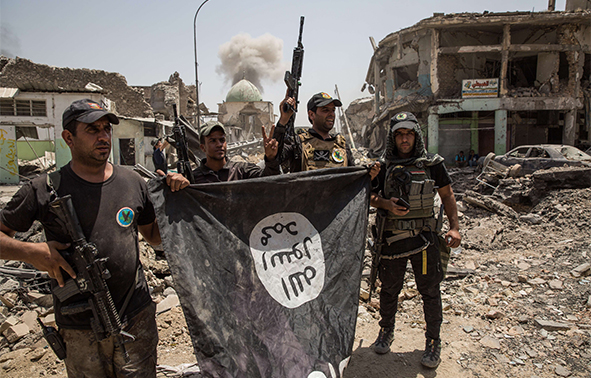
With little credible resistance from the Iraqi army, ISIS advanced rapidly, occupying cities and villages along its path. On June 10, 2014, Mosul, the second-largest city in Iraq and the largest city of the Sunni population, the province of minorities, fell into the hands of ISIS. It was in this city that Abu Bakr al-Baghdadi proclaimed the establishment of the Caliphate on June 29, 2014. For three long years, the world witnessed a state experiment deemed as “absolute barbarism” by the international community. War crimes, crimes against humanity, genocide—the savagery of ISIS compelled the international community to form a coalition and act as swiftly as possible.
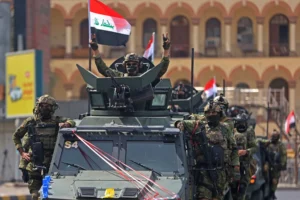
Three years later, the Iraqi Prime Minister, Haider al-Abadi, officially announced victory over ISIS and the destruction of its caliphate. Indeed, Iraqi forces reclaimed cities and controlled the Iraq-Syria border. However, in 2023, ISIS remains present and continues to strike regularly in different regions of Iraq. Iraqis continue to be victims of ISIS operations consistently. Hence, in the current situation, the nature and extent of the terrorism threat warrant a fresh perspective.
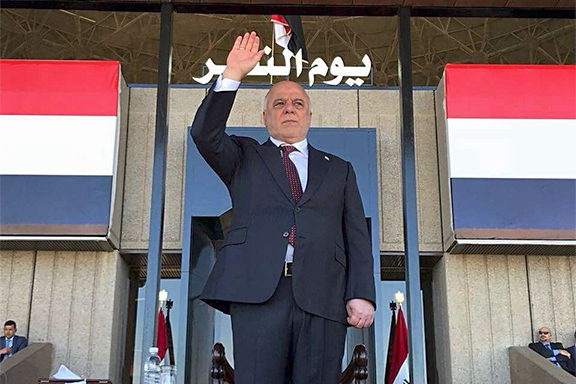
Iraqi Prime Minister Haider al-Abadi salutes security forces during an Iraqi military parade in Baghdad, in front of a notice which has for meaning “Day of the Victory” in Arabic.
An Army of the Islamic State in detention
While there have been indeed advancements in eliminating jihadist leaders on both sides of the Iraq-Syria border since the territorial defeat of ISIS, it must be acknowledged that “the underlying conditions that led to the group’s expansion in 2013 and 2014 remain,” notes Michael Kurilla, who has been leading U.S. operations in the Middle East since January 7, 2022. The place of the Sunni community within the new post-Saddam Hussein Iraq, the stagnation in the country’s reconstruction, the widespread poverty and unemployment, the militarization of society, the systemic corruption, and the presence of a thriving market for radical ideology—combined with the Syrian civil war and the absence of prospects for a peaceful solution—have thrown millions of individuals between Iraq and Syria into the unknown, uncertainty, and complete doubt about their existence in these two countries.
In this context, with 30,000 fighters in prisons—20,000 in Iraq and 10,000 in Syria—along with 60,000 supporters incarcerated in the two countries, ISIS remains an extraordinarily serious threat not only to this region but to the whole world as well. Based on these factual data, General Michael Kurilla developed the concept of a “true army of the Islamic State in detention,” which he explained in his testimony before the U.S. Senate Armed Services Committee on March 16, 2023.
However, the issue isn’t solely about managing this detained army, but also about ISIS’s ability to incorporate angry social categories into its militant base, to lead armed resistance against identified enemies, and to carry out attacks worldwide, especially in Iraq and Syria. While we may have the impression that ISIS’s capabilities to act, fight, and expand are greatly declining, this is just an impression, an illusion that would be dangerous to rely on: the organisation’s reserves of fighters, anger, and violence are far from exhausted. On the contrary, today more than ever, ISIS is a ticking time bomb. In his speech on August 9, 2022, before the United Nations Security Council, Vladimir Ivanovich Voronkov, the Assistant Secretary-General of the newly established United Nations Office of Counter-Terrorism, stated: “The border between Iraq and Syria remains highly vulnerable, with up to 10,000 ISIS fighters active in the region.”
Faced with this exceedingly serious threat, the strategy developed and applied thus far is undoubtedly security-oriented. However, while this strategy plays a crucial role in the fight against ISIS, it cannot be the sole solution. In the perspective of a post-ISIS world, it is essential for the international community to address all levels that constitute ISIS as a global nightmare: social, political, and economic integration of the marginalized, counteraction against ideological radicalization, reconstruction of areas fully or partially devastated by four decades of war in the region, and most importantly the instrumentalization of terrorist groups by States in conflict with other States or within their own societies.
In all cases, our observation of State behavior towards ISIS, particularly in the Middle East, leaves no room for optimism. While it is true that the chips are totally down and room for maneuver still exists, the dream of a tomorrow without ISIS remains distant.
| Documented civil deaths due to violence | |
| Year | Number of victims |
| 2003 | 12 133 |
| 2004 | 11 736 |
| 2005 | 16 583 |
| 2006 | 29 517 |
| 2007 | 26 078 |
| 2008 | 10 274 |
| 2009 | 53 76 |
| 2010 | 4 167 |
| 2011 | 4 162 |
| 2012 | 4 622 |
| 2013 | 9 852 |
| 2014 | 20 218 |
| 2015 | 17 578 |
| 2016 | 16 393 |
| 2017 | 13 187 |
| 2018 | 3 319 |
| 2019 | 2 393 |
| 2020 | 908 |
| 2021 | 669 |
| 2022 | 740 |