


To think about violence (and the exit from violence), it may be useful to relate the complex conceptual set that this word covers, with another no less complex set linked to another term, that of conflict.
The word ‘conflict’, especially in its current uses, is often associated with the idea of unrest, disorder, violence, in opposition to aspirations of a world in which, because it would be without conflicts, would be appeased, unified, and therefore also harmonious, ensuring order and security.
For the sociologist of action, who, following Alain Touraine, placed the study of social movements at the heart of his work, conflict, unlike the crisis, is a relationship in which actors are opposed. From this perspective, as it is a relationship, the conflict confronts, face to face, not enemies who want the destruction of the opposite side, but adversaries who want to control the same issue, but without making it disappear, strengthening their grip, obtaining advantages, but who do not plan to destroy their adversary. To put it simply: when the workers’ movement is defined by a conflictual relationship with the masters of industry, when it strives to increase its influence, its ability to control production for example, the movement isn’t talking about killing the capitalists, putting an end to them by murderous violence. Those who talk about doing so, such as far-left terrorist groups, such as the Red Brigades in Italy in the 70s and 80s, actually want to settle the conflict by ending it, they no longer want a relationship but a rupture.
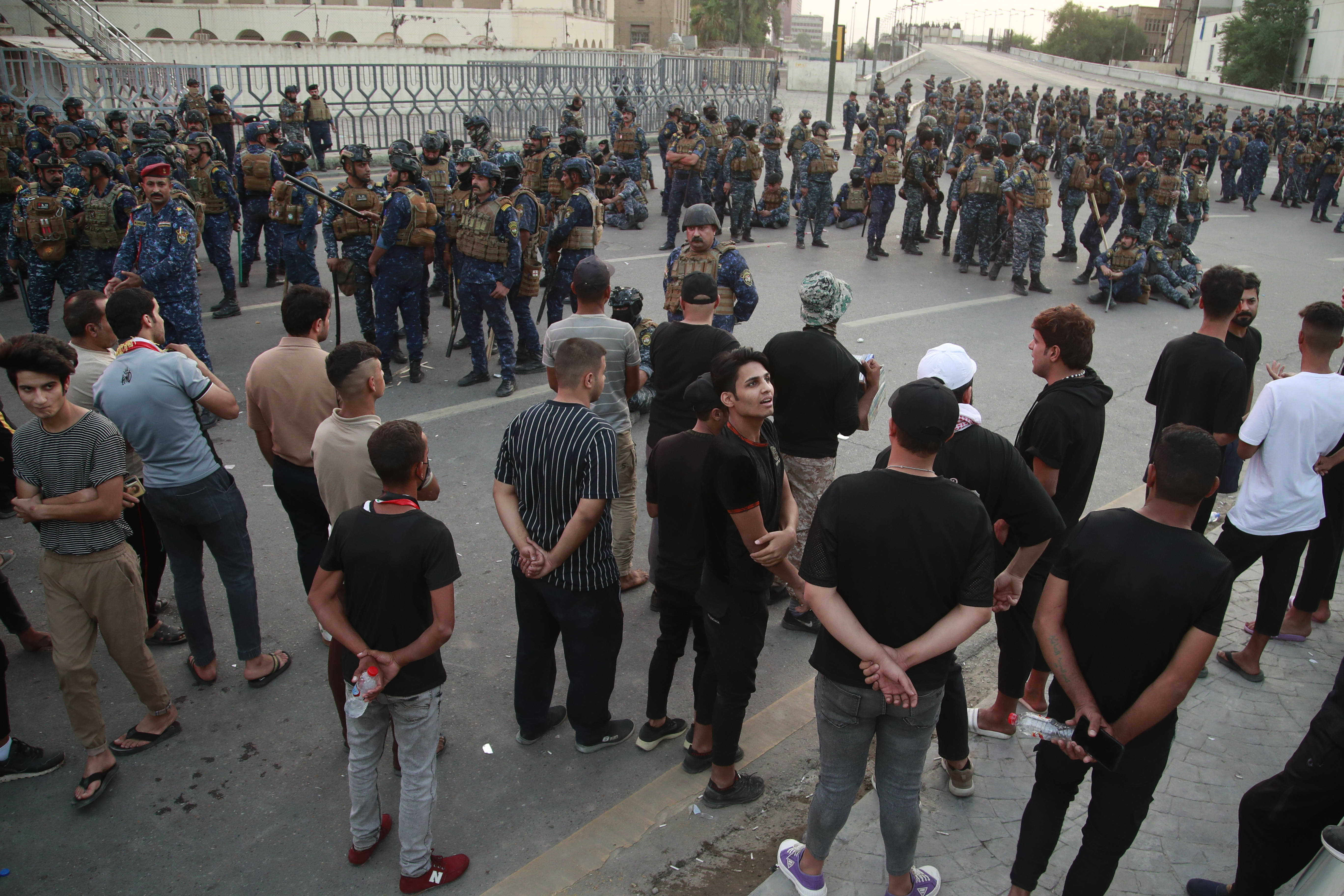
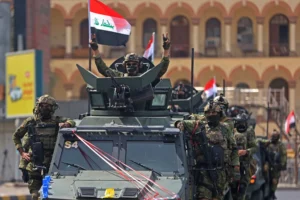
Iraqi security forces stand guard as demonstrators gather to mark the third anniversary of the anti-government protests in Baghdad, Iraq, Tuesday, Oct. 25, 2022. (AP Photo/Hadi Mizban)
It is therefore a question here, a bit like Lewis Coser, of distinguishing conflict, and the logics of rupture, especially those that involve violence, of opposing them, even if in reality, everything is not so simple, and if, for instance, some actors use violence in a strictly instrumental way, as a resource in a conflictual relationship – which is at the heart of the theories of the 60s and 70s called ‘resource mobilisation’ that give great importance to this idea.
The sociological approach to social or political conflict requires that it be analytically distinguished from crisis and rupture. It also requires that levels in the conflict be distinguished. The example of the workers’ movement is enlightening here. At the highest level, social or political conflict involves the main orientations of collective life, what Alain Touraine called its historicity. When the workers’ movement claims to direct production, decide on the allocation of the surplus, to steer society, it is at this level, which is also that of its adversary, who then affirms that it is up to him to control historicity, so incapable would the workers be – they are accused by the masters of labour and their organic intellectuals of incompetence. To drink, to be lazy, to threaten the social order… When those who speak in the name of the workers’ movement demand laws, obtain the establishment of institutions to better defend the interests of the workers, they place action at a lower level, which is no longer that of historicity, but which is political. And when negotiations begin between employers’ organisations and trade unions concerning, for example, income or working conditions, we move on to yet another level, where it is a question of changing the relationship between their contribution and their remuneration in favour of workers.
All this is positive and clearly part of the functioning of democracy, in a political culture where negotiation, reasoned exchange, compromise is possible. It must be said clearly: progress – a notion that is certainly very contested today – has happened over the centuries through conflictual mobilisations, demands for new rights, struggles more or less largely inscribed in logics of conflict, non-lethal or bloody protests.
Let us now consider the word violence – we are dealing here with social and political violence, especially when it is deadly, and its possible consequences: terrorism, civil war, guerrilla warfare for example, physical violence, which undermines the integrity of individuals, and communities first and foremost physically, but also necessarily morally. We therefore leave aside what Robert Castel and Pierre Bourdieu called symbolic violence, an expression that actually refers to the domination of one group over others when it is so extreme that the dominated internalise the categories of the dominant. Male violence, in Bourdieu, for example, is the internalisation by women of men’s ways of thinking and living, an approximate synonym would speak here of alienation.
There are different theories in the social sciences to account for violence. They are not necessarily contradictory, each of them can even shed light, more or less powerful, on violent behaviour. Let us retrace the most relevant.
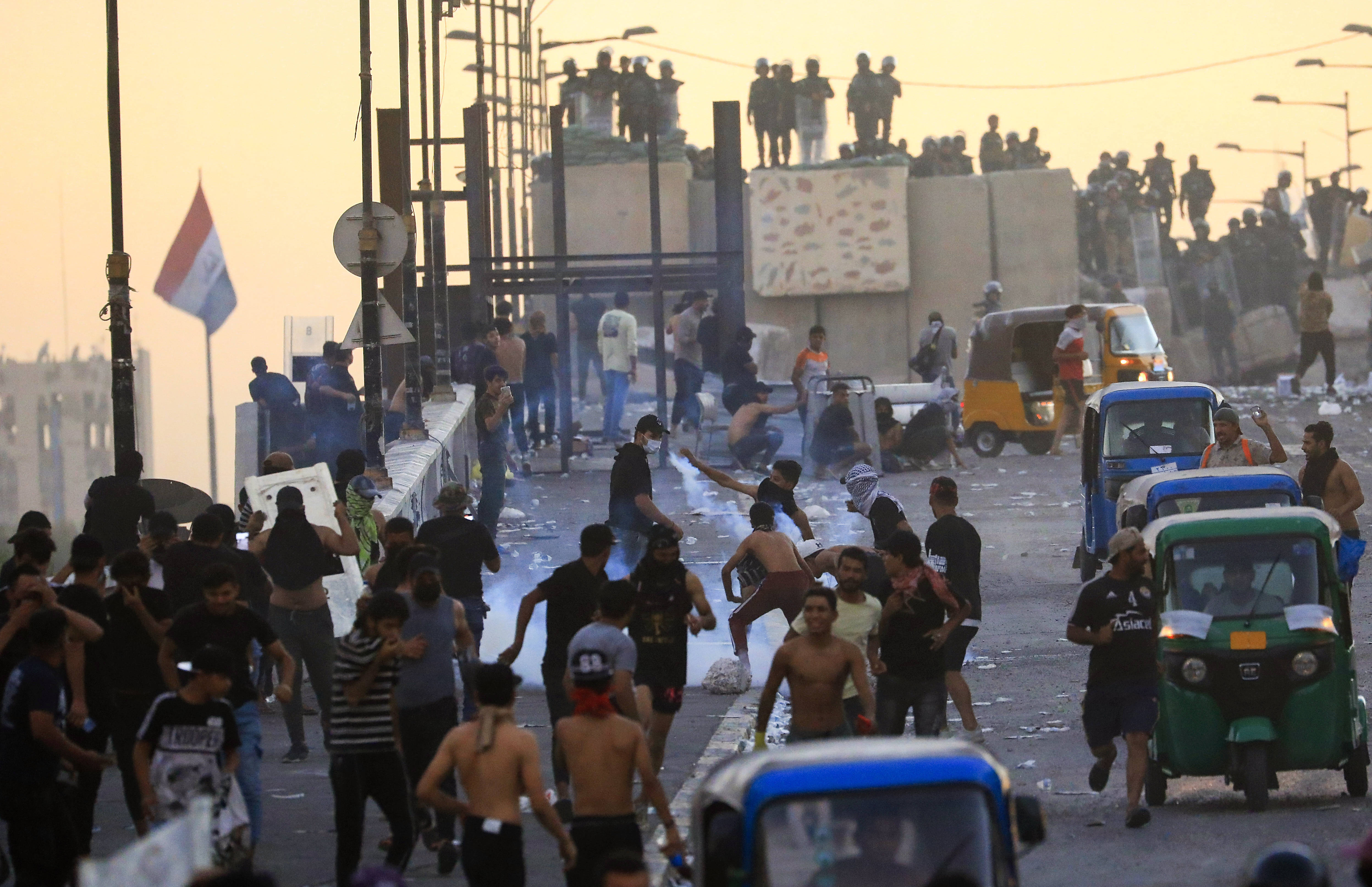
Security forces fire tear gas during a demonstration in Tahrir Square in Baghdad, Iraq, Wednesday, Sept. 28, 2022. (AP Photo/Hadi Mizban)
First of all, there are explanations for violence in terms of crisis and frustration. In this perspective, whose premises are found in Alexis de Tocqueville about the French Revolution, violence is a reaction to a situation, it reflects dysfunctions, deficiencies of the system, or of a subsystem, it is based on a feeling of deprivation. Frustrated actors react.Then, very different, comes the idea that violence is instrumental: actors use it to achieve ends, according to objectives, violence is a resource that is part of strategies, in calculations. We will come back to that.
A third theory emphasises the cultural dimensions of the phenomenon: violence is prepared in cultural conditions, for example in the family, or in education, which makes future actors much more likely than others to resort to it. It then has, even with a great time lag, a link with the personality, as it is shaped by culture very early, from early childhood. A fourth approach focuses on violence for violence’s sake, violence which is an end in itself, for example enjoyment, and therefore cruelty.
Each of these explanatory theories has its limits, and deserves criticism, but it must above all be admitted that they each provide, if necessary, a light, more or less powerful, to better understand this or that concrete historical experience? And, more broadly, to reflect on the link between violence and conflict, in the sense proposed above. In three out of four of these theories, in fact, violence is much more the opposite of conflict than one of its elements.
The violence of the crisis, of frustration, is all the more used because there are no mediations, collective actors that could contribute to transforming problems, frustrations, the feeling of frustration into collective demands that can be the subject of debates, discussions, negotiations, compromises. This role can be carried out by associations, NGOs, religious organisations, political parties, trade unions, as well as intellectuals.
When violence seems to be linked to a personality type, education, family or culture, for example dominated by intolerance and authoritarianism, it is all the easier to exercise here because there is no network of organisations that would make it possible to deal with problems through debate, negotiation and therefore through the democratic recognition of a conflict. Violence is exercised because there is apparently no alternative, because force is ultimately trusted to solve problems that a democracy otherwise solves, because the democratic spirit has no place, or gives the image of powerlessness, of failure. Thus, for example, Germany, after World War I, allowed the forces of anti-democracy, and violence, shaped by a century of authoritarian and anti-Semitic education, to prevail over the Weimar Republic.
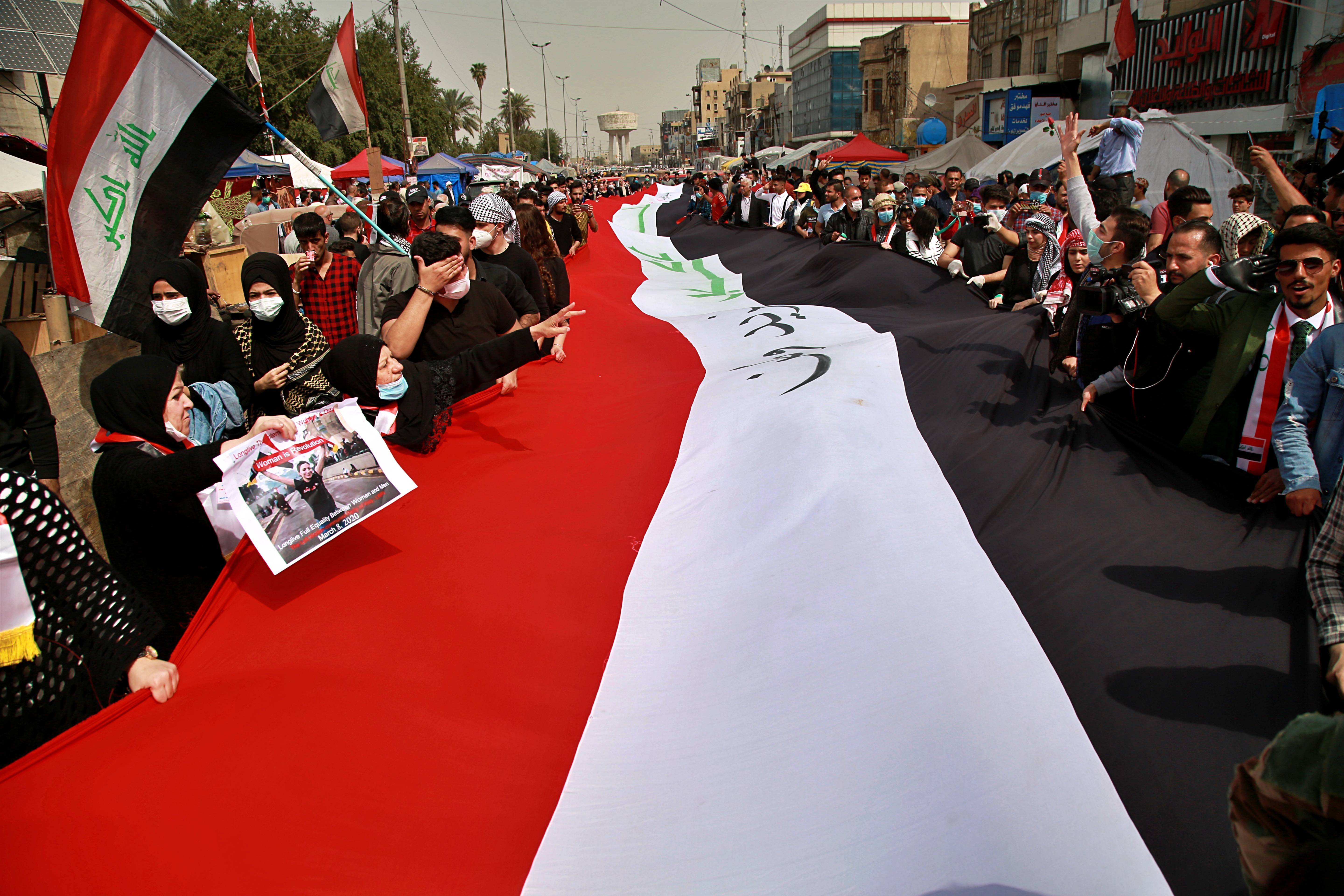
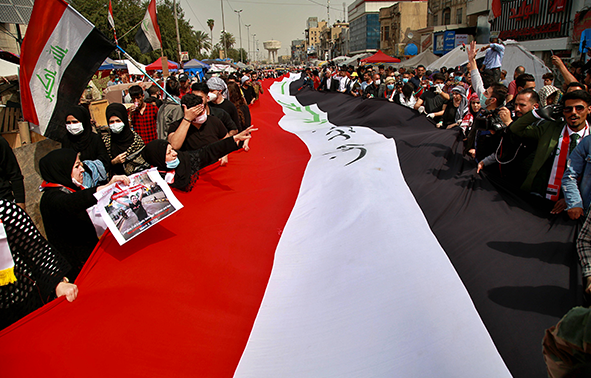
Anti-government protesters hold Iraqi flags during a rally demanding women’s rights on International Women’s Day in Tahrir square in Baghdad, Iraq, Sunday, March 8, 2020. (AP Photo/Khalid Mohammed
Violence for violence’s sake, cruelty, sadism is a reality that is observed, among other things, in extreme situations where no control, no regulation hinders them. Here again, these are acts that have nothing to do with the slightest negotiation, the slightest democratic treatment of any demands.
Instrumental violence, on the other hand, calls for a different analysis. It is conceivable that it will prolong collective action, give it a certain vigour, a capacity to achieve results when the situation does not in any way allow other methods, when the mobilisation of other resources seems less effective. From this point of view, it is not the opposite of conflict, it is a modality of it. But it is a misunderstanding of concrete realities to stick to this too elementary idea. Instrumental violence, in fact, if it must be lasting, consistent, is never perfectly controlled by those who resort to it. It escapes them, it becomes, for example, terrorism, it loses contact with its initial meanings, it can become unlimited.
Violence is always associated with logics of loss of meaning. For example, what should in the mind of a political actor be limited, controlled violence generates a response from the state which, through the vigour of repression, pushes the actor to move to a higher stage of violence in order to make himself heard. A spiral can be set up, in which the protagonist of the violence gradually cuts himself off from the population to which he refers, which does not understand: for example, a hold-up that serves to provide funds to an organisation engaged in a conflict, or the murder of a torturer symbolising the oppression of a nation, but everything changes when the hold-up goes wrong, when there are deadly clashes, when some then go underground, become terrorists, or when, in the name of a national cause, terrorists place bombs in places where the victims have nothing to do with any oppression. Instrumental violence ceases to be legitimate, because recognised as relevant by those in whose name it is exercised, it becomes a loss of meaning, action is part of a process that I have called inversion, its initial meaning is lost. Let’s take a concrete example: when ETA appeared in the Spanish Basque Country, in the 60s, its violence was instrumental, limited, controlled and well perceived by the Basque population, it came to shape a conflict. Then came democracy, the Basque identity received a certain recognition, and violence, instead of disappearing, became more and more blind, unlimited, terrorist, for example, targeting, for example, civilians in public places, which is incomprehensible to the population which, twenty years earlier, understood that ETA was killing a Francist police official known for his sadism and torture.
Thus, even instrumental violence cannot truly be complementary to conflict. It may be temporary, at certain times; But as soon as it becomes sustainable and central, it introduces logics of rupture, loss of meaning, inversion. In any case, and whatever approach is worth using to properly analyse a concrete experience, violence is rather the opposite of conflict.
From there, it is possible to reflect on a decisive question: to avoid or minimise violence, should we not find or find conflict, in the sense I have given to this term?
It should first be noted that when the conflict occupies a vast space, when collective actors each oppose each other with great vigour, then there is less space for violence. The history of the great social movements clearly shows this. Thus, the nascent workers’ movement, or on the contrary in its phase of historical decline, as has been the case since the 70s in many industrial societies, is weak, not very powerful, very ideologised, and this leaves much more room for violence than when a highly developed social democracy occupies the field. The terrorism of the extreme left claiming to be of the workers’ movement was strong at its beginnings, in anarchist forms, at the end of the nineteenth century, for example in France, and in the 70s of the twentieth century, with the Red Brigades in Italy, for example.
If we want to minimise or prevent violence, one conclusion must be drawn here: we must not try to repress, prohibit or at least prevent the development of social conflicts, but on the contrary encourage them to be built – democratically.
When the conflict has taken the form of violence, for example with guerrilla warfare, a second conclusion must be drawn: violence will be ended only by acknowledging its at least initial links with a conflict, and thus by recognising the conflict itself. This means that enemies must become adversaries, that they stop wanting to destroy themselves and that, on the contrary, they find the path of modus vivendi in which the conflict remains, where the actors are recognised, but without violence. The actors are not able to find this path on their own. They hate each other, accuse each other of the worst horrors, perceive the enemy as a barbarian, a liar, and at the limit, do everything to dehumanise, animalise, objectify him, as did at the time of entering the war in the Pacific both the Americans evoking the Japanese and the Japanese vis-à-vis the Americans – we must read here the book of John Dower, War without Mercy. Race and Power in the Pacific War (1986). Hence the importance of mediation and mediators, who create the conditions for connecting actors, teach them to know each other, to talk to each other, to consider each other as human beings. Countries have become experts in mediation, including Norway.
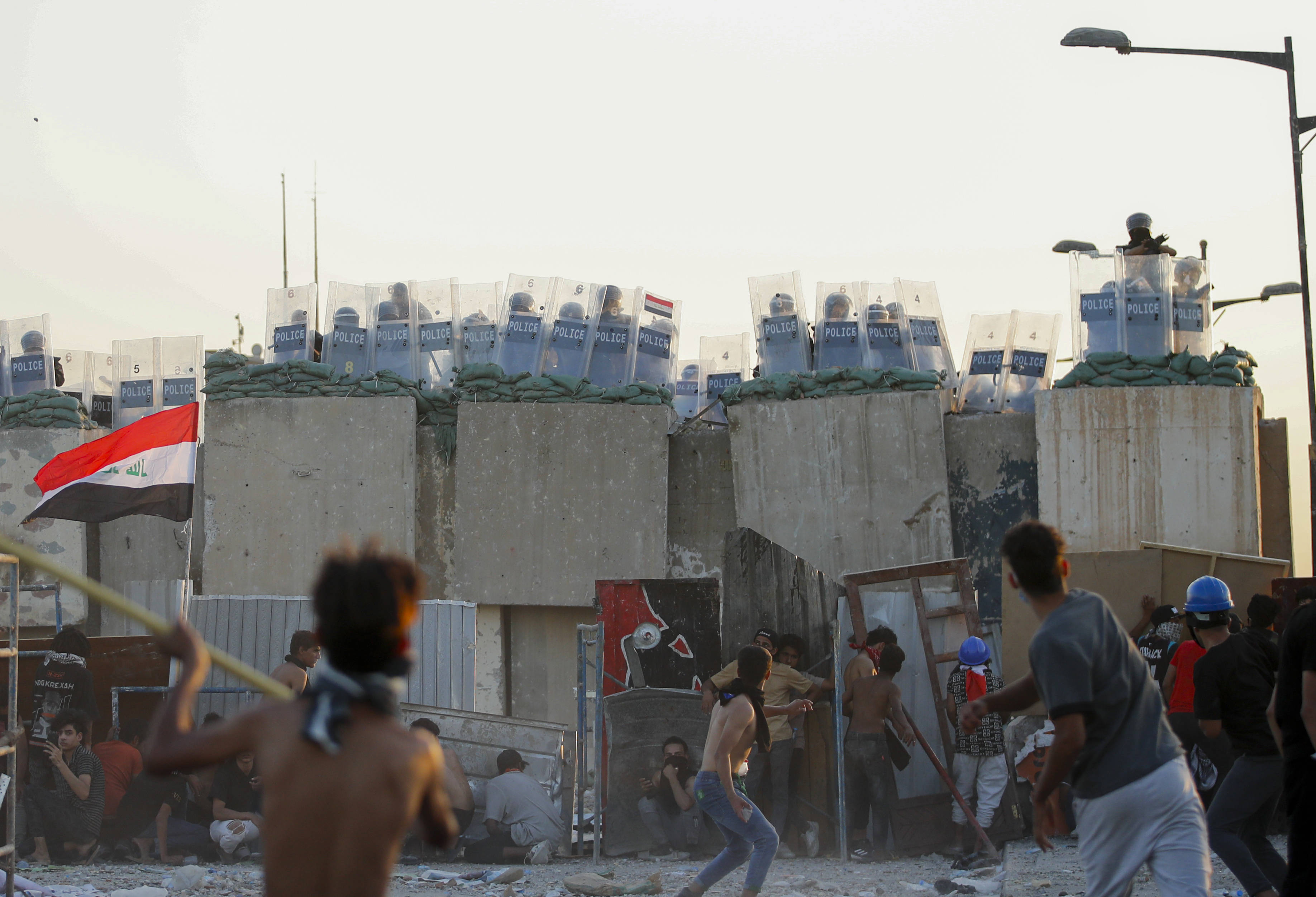
Anti-government protesters take cover from Iraqi Security forces who have closed a bridge leading to the Green Zone, during a demonstration as they gather to mark the third anniversary of the anti-government protests in Tahrir Square in Baghdad, Iraq, Saturday, Oct. 1, 2022. (AP Photo/Hadi Mizban)
It also means inventing the process that will allow the actor of violence to become a non-violent actor. An example can illustrate this remark: it is that of the negotiation that took place between a guerrilla, the FARC, and the Colombian government in the 2010s, until a peace agreement. An important condition of the negotiation was that the guerrillas could become a legal political actor, become institutionalised, cease to be a violent actor and become an actor in political debate and conflict. This recognition was achieved, in particular, by the right granted to the guerrillas to henceforth have a certain number of mandates for parliamentarians.
Often, it is believed that ending violence means ending the conflict that gave rise to it, or that it shapes, even if it means perverting it. In the jargon of international organisations, we even speak of ‘conflict resolution’ with the idea that the issue is to put an end to a conflict that has taken violent form. In fact, it is better to abandon this paradigm and think above all about the possibilities of reviving the conflict to get out of violence, or prevent it from flourishing. What is said here applies primarily to social and political conflicts, and could also apply to war. We know that for Clausewitz, the great thinker of war, it is the extension of politics by other means: to end a war is precisely to find the path of politics or geopolitics.
These remarks obviously do not exhaust the subject. But, to conclude, they constitute an invitation to constitute the prevention and exit from violence, and not only violence itself, as a field of research for the human sciences, and not only as a set of military, diplomatic, judicial expertise and skills or related to the intervention of NGOs.